Papers
Topics
Authors
Recent
Search
2000 character limit reached

Learning Transferable Visual Models From Natural Language Supervision

Published 26 Feb 2021 in cs.CV and cs.LG | (2103.00020v1)

Abstract: State-of-the-art computer vision systems are trained to predict a fixed set of predetermined object categories. This restricted form of supervision limits their generality and usability since additional labeled data is needed to specify any other visual concept. Learning directly from raw text about images is a promising alternative which leverages a much broader source of supervision. We demonstrate that the simple pre-training task of predicting which caption goes with which image is an efficient and scalable way to learn SOTA image representations from scratch on a dataset of 400 million (image, text) pairs collected from the internet. After pre-training, natural language is used to reference learned visual concepts (or describe new ones) enabling zero-shot transfer of the model to downstream tasks. We study the performance of this approach by benchmarking on over 30 different existing computer vision datasets, spanning tasks such as OCR, action recognition in videos, geo-localization, and many types of fine-grained object classification. The model transfers non-trivially to most tasks and is often competitive with a fully supervised baseline without the need for any dataset specific training. For instance, we match the accuracy of the original ResNet-50 on ImageNet zero-shot without needing to use any of the 1.28 million training examples it was trained on. We release our code and pre-trained model weights at https://github.com/OpenAI/CLIP.

Citations (22,065)

Summary

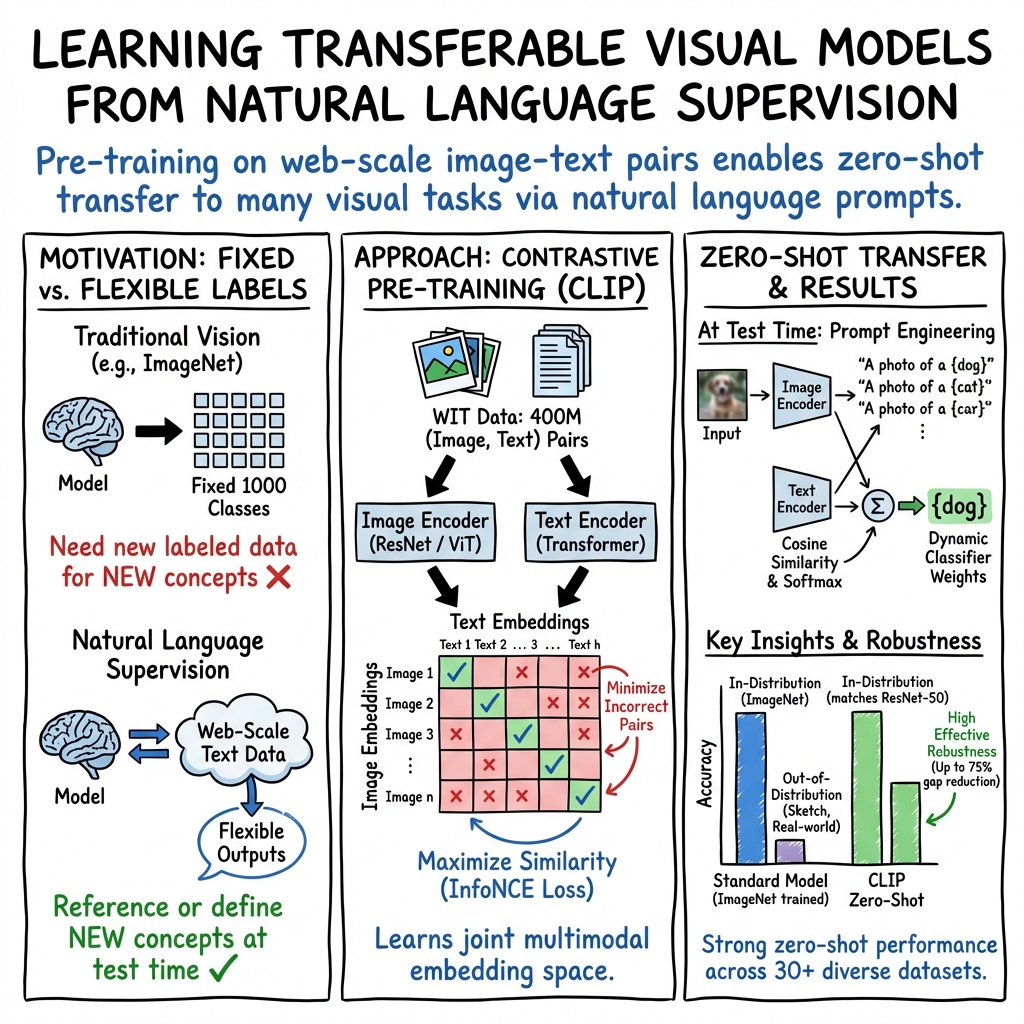
  • The paper introduces CLIP, a novel framework that uses natural language supervision to learn visual representations without relying on extensive labeling.
  • The paper details a contrastive pre-training method that jointly optimizes image and text encoders using cosine similarity to match correct pairs.
  • The paper demonstrates CLIP’s scalability and versatility by achieving competitive zero-shot performance across various visual tasks.

Analyzing the Potential of Learning Transferable Visual Models from Natural Language Supervision

In the rapidly evolving field of deep learning, the quest for efficient and robust methods for learning visual models is unending. A recent study, Learning Transferable Visual Models From Natural Language Supervision, introduces a promising approach that utilizes the vast amounts of unlabelled data on the web for training state-of-the-art computer vision systems. This paper presents a method that leverages natural language supervision, derived from raw text about images, to learn visual representations; a novel strategy aimed at overcoming the limitations imposed by the current supervised learning methods.

Introduction to Natural Language Supervision for Visual Learning

State-of-the-art computer vision systems typically rely on a fixed set of predetermined object categories, requiring extensive labeled datasets to specify other visual concepts. This paper introduces a scalable method that predicts the compatibility between a caption and an image, using a dataset of 400 million (image, text) pairs collected from the internet. After pre-training, natural language is used to reference learned visual concepts (or describe new ones), enabling zero-shot transfer of the model to downstream tasks.

Methodology and Approach

The proposed method, dubbed CLIP (Contrastive Language-Image Pre-training), moves away from traditional training objectives. Instead of predicting exact words of the text accompanying each image, CLIP trains to solve the more manageable task of predicting which text in a batch is paired with which image. This simplification, combined with a contrastive objective, significantly boosts training efficiency.

CLIP consists of two main components: an image encoder and a text encoder, which are trained jointly. The training objective is to maximize the cosine similarity of the image and text embeddings of the N real pairs in a batch, while minimizing the similarity of the N²-N incorrect pairings. This method has shown impressive scalability, enabling the study of behaviors of image classifiers trained with natural language supervision at a significantly larger scale than previous studies.

Theoretical and Practical Implications

The paper explores the practical and theoretical underpinnings of learning from natural language supervision. The scalability of CLIP is detailed by training a series of models spanning nearly two orders of magnitude in compute, demonstrating that transfer performance is a smoothly predictable function of compute.

On the practical side, CLIP exhibits remarkable versatility across a wide array of visual tasks, including OCR, geo-localization, and action recognition in videos. It often matches or surpasses task-specific supervised baseline models without requiring dataset-specific training data. This capability to generalize from zero-shot inference has notable implications for the deployment of vision systems across diverse applications.

Future Developments and Challenges

While CLIP represents a significant step forward, it is not without limitations. Its performance, although competitive, still lags behind state-of-the-art models specifically trained on large labeled datasets for certain tasks. Additionally, the reliance on vast amounts of data for pre-training raises questions about efficiency and sustainability.

Furthermore, ethical considerations surrounding the use of unfiltered internet data for training are mentioned, highlighting the potential for learned social biases. Addressing these biases, enhancing data efficiency, and closing the performance gap in specialized tasks are outlined as key areas for future research.

Conclusion

The study of CLIP introduces a transformative approach to learning visual representations, leveraging the abundance of text descriptions associated with images on the internet. By effectively utilizing natural language as a source of supervision, it opens new frontiers in creating flexible, robust, and broadly applicable visual models. Despite its challenges, the methodology presents a compelling case for the future direction of computer vision research, where the synergy between language and vision can be harnessed to remarkable effect.
Paper to Video (Beta)

No one has generated a video about this paper yet.

Whiteboard

Open Problems

We haven't generated a list of open problems mentioned in this paper yet.

Tweets

Sign up for free to view the 51 tweets with 4648 likes about this paper.

YouTube

Cream Soda – Меланхолия (Премьера клипа 2021) 2.5M views
But how do AI videos actually work? | Guest video by @WelchLabsVideo 2.1M views
Explaining the Segment Anything Model - Network architecture, Dataset, Training 43K views
From Zero to Text-To-Image Latent Diffusion Models – explained in 15 concepts! 38K views
AI generated art goes brrrrr [VQGAN+CLIP] 37K views
Create Art using ONE Sentence? - AI Generated with VQGAN + CLIP 32K views
You Describe & AI Photoshops Faces For You [StyleCLIP] 25K views
Multimodal AI: LLMs that can see (and hear) 20K views
Multimodal Embeddings: Introduction & Use Cases (with Python) 9.9K views
[I'ML] Ранжирование и ретривел — описание эффективных алгоритмов и архитектур 5.6K views
How LLMs Actually Understand Images. 5.2K views
LLM Chronicles #6.3a: OpenAI CLIP for Zero-Shot Image Classification and Similarity 2.4K views
OpenAI CLIP Embeddings: Walkthrough + Insights 2.4K views
【DeepLearning研修】Transformerの基礎と応用 --第3回 Transformerの画像での応用 2.3K views
Platon et l'IA: comment les modèles voient-ils le monde ? 1/4 (5mn1p) 1.7K views
พูดคุยกับ Harry Research | โมเดลมันรู้ได้ไงว่าภาพนี้คืออะไร 1.4K views
Introduction to CLIP: Multimodal Embedding Models 1.2K views
Top AI Research Papers for Beginners - in 2024 1.2K views
Infinite Lofi Beats Generated by Artificial Intelligence 639 views
The Future of Work: Will Artificial Intelligence Replace Creative Jobs? 549 views
Lec 33 | Multimodal Encoder Models 541 views
Platon et l'IA: au-delà de la Caverne 4/4 (5mn1p) 423 views
SORA Deep Dive: Predict patches from text, images or video 411 views
V* - Better than GPT-4V? Iterative Context Refining for Visual Question Answer! 358 views
The 7 AI Papers bridging 2017 to 2024 - Transformers Everywhere 355 views
CLIP Pytorch Implementation, Learning Transferable Learning Models From Natural Language Supervision 338 views
młody λ - ICLR 2023 318 views
CLIP: Contrastive Language–Image Pretraining model. Transferable Visual Models From Natural Language 270 views
Next-Level AI Powered Image Search - From Bogus to Very Accurate Results 217 views
Connecting OpenAI's CLIP, DALLE-2, DALLE-3 with Sora (Papers Explained) 195 views
Annabel Lee narrated and illustrated by an A.I 146 views
Attention Is All We Need (アテンション・イズ・オール・ウィー・ニード) 【sunoaiv5】 137 views
VCMI Journal Club #14 | November 2023 | Isabel Cristina Rio-Torto de Oliveira 104 views
PyTorch: Training your first Convolutional Neural Network (CNN) 101 views
The Only Video You Need to Understand Image Generation AI 99 views
CLIP:Contrastive Learning Transferable Visual Models from Natural Language Supervision #research #AI 99 views
Striveworks Journal Club: Learning Transferable Visual Models from Natural Language Supervision 97 views
This OpenAI paper gets cited 21895 times?!! 86 views
20220530 Data Determines Distributional Robustness in Contrastive Language Image Pre-training 임용택(1) 71 views
AI for the Improviser - Zero Shot Learning in just Five Minutes 68 views
LLaMA 4 Explained: Meta's Latest AI Breakthrough! 59 views
Il robot artista: può l’intelligenza artificiale essere creativa come un umano? IA Fra ti spiego 57 views
Voice Controlled robotics, using language transformer encoders and reinforcement learning 56 views
多模態 LLM 如何理解輸入?編碼器設計大拆解 48 views
Mandelbrot Project - How...? 46 views
CLIP model: Jembatan antara aspek visual dan teks dalam Visual Language Model 👀 45 views
[review] CLIP Learning Transferable Visual Models From Natural Language Supervision - 1 39 views
CLIP: Learning Transferable Visual Models From Natural Language Supervision 36 views
Learning Transferable Visual Models From Natural Language Supervision 31 views
言語を画像に繋げる技術CLIP:論文紹介『Learning Transferable Visual Models From Natural Language Supervision』 26 views