- The paper presents the Ht-SVD method which decomposes third-order tensors over reduced biquaternion algebra for efficient computation.
- It develops novel algorithms using DFT and block circulant matrices to enable fast, parallel singular value calculations.
- Experimental results demonstrate enhanced color video compression with improved PSNR and significantly faster processing compared to existing methods.
Singular Value Decompositions of Third-Order Reduced Biquaternion Tensors
The paper "Singular value decompositions of third-order reduced biquaternion tensors" introduces the concept of singular value decomposition (SVD) for third-order tensors over reduced biquaternion algebra Hc with applications in color video processing. This algebra extends real and complex number systems, allowing for a more efficient manipulation of quaternion-based data structures. The authors develop algorithms for computing the singular value decomposition via a novel operation called the Ht-product. The paper provides solutions for reduced biquaternion tensor equations and applies these concepts to color video compression, presenting experimental results that demonstrate faster execution compared to existing methods.
Reduced Biquaternion Algebra and Ht-Product
The core of the study revolves around the use of reduced biquaternion algebra, designated by Hc, which is a commutative quaternion algebra. It simplifies operations compared to Hamilton quaternions, specifically in signal and image processing applications. The paper defines several tensor operations and structures, such as block circulant matrices and the Ht-product, which enable multiplication of third-order tensors over Hc. The Ht-product involves a series of operations, including the use of Discrete Fourier Transform (DFT) matrices to transform and manipulate tensor slices, facilitating tensor decomposition in the frequency domain.
Ht-Singular Value Decomposition
The paper's main contribution is the formulation of the Ht-SVD for third-order reduced biquaternion tensors. For a given tensor A∈Hcn1×n2×n3, the decomposition is expressed as:
A=U∗HtS∗HtV∗
where U and V are unitary tensors, and S is an f-diagonal tensor. This decomposition allows for efficient parallel computation of singular values, leveraging the structural properties of reduced biquaternion tensors. The paper outlines a methodology to compute the Ht-SVD, highlighting its advantages over traditional methods, including improved computational performance.
Applications in Color Video Compression
The practical application of Ht-SVD is demonstrated through color video compression. Biquaternion tensors are used to represent color video data in a compact form, exploiting the algebraic properties of Hc to achieve efficient compression. Experimental results show that the Ht-SVD method achieves comparable preservation of video quality, measured by the Peak Signal-to-Noise Ratio (PSNR) metric, yet offers significant improvements in computational speed over quaternion-based methods.
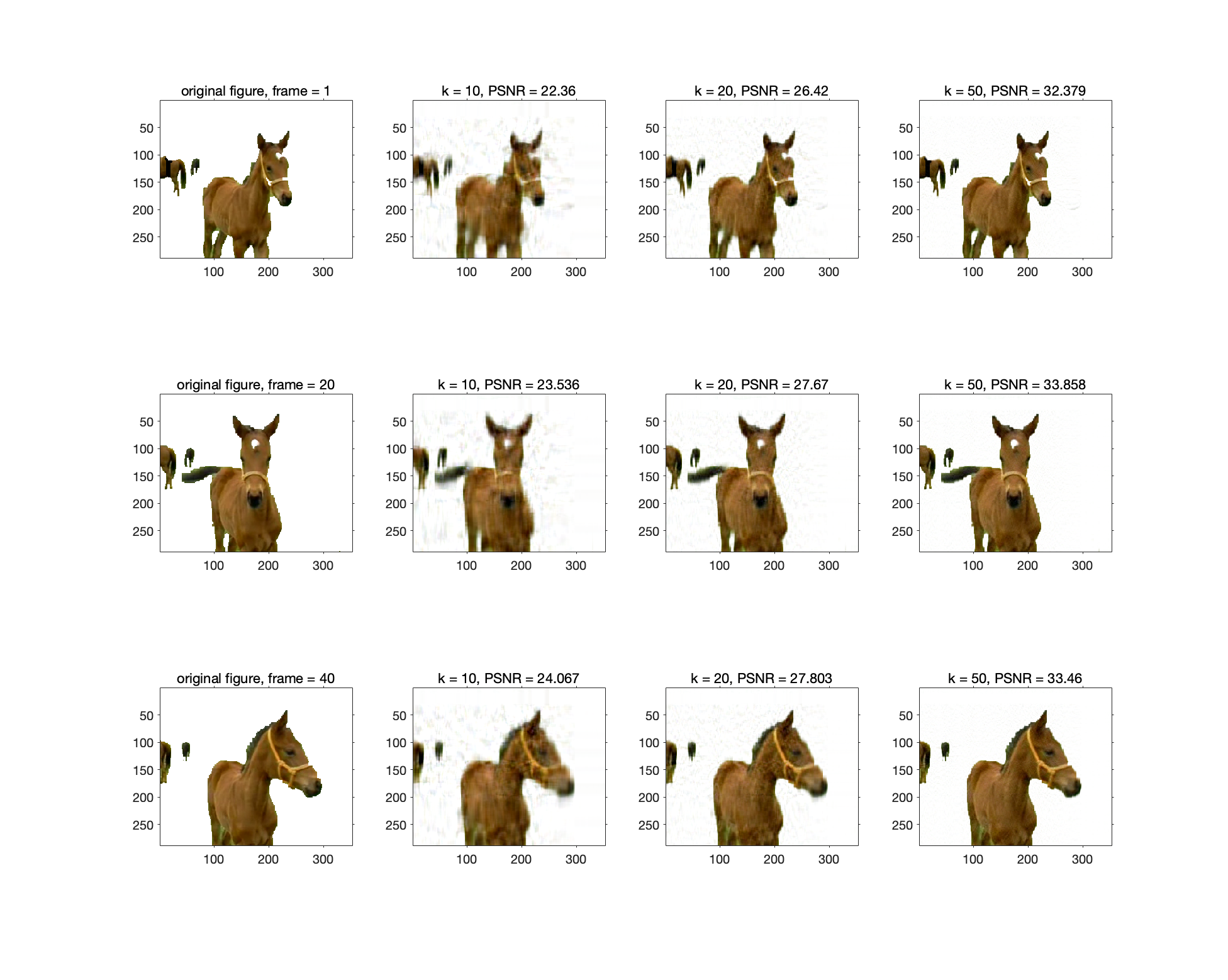
Figure 1: PSNRs of the rank-k (k=10, 20, 50) approximations to DO01_013 by Ht-SVD.
The authors compare the performance and computational speed of Ht-SVD with Qt-SVD, using experimental datasets. The findings suggest notable superiority in speed with similar compression capabilities.
Conclusion
The paper successfully extends the use of singular value decompositions to third-order reduced biquaternion tensors, providing a solid foundation for efficient processing of multi-dimensional signals and images. This work paves the way for further exploration into reduced biquaternion tensor algebra, offering promising improvements in applications involving large-scale data compression, particularly in multimedia processing domains such as video. The proposed algorithms and experimental results validate the practical merit of this approach, highlighting both theoretical advancements and real-world application potential. Future work might explore extending these techniques to broader tensor configurations and integrating them into complex signal processing systems.