- The paper identifies emergent communication as a paradigm for training AI agents to develop human-like language through real-time, interactive learning.
- The review details the use of reinforcement and supervised learning to bridge agent-generated signals with natural language comprehension, emphasizing game environments.
- The paper evaluates critical metrics for compositionality and communicative efficacy, contrasting machine-centered and human-centered approaches.
Towards More Human-like AI Communication: A Review of Emergent Communication Research
The paper "Towards More Human-like AI Communication: A Review of Emergent Communication Research" (2308.02541) offers a comprehensive examination of the emergent communication (EmCom) field. This research domain focuses on developing artificial agents capable of using natural language in a manner that transcends simple tasks, effectively communicating and learning new concepts. EmCom challenges traditional NLP approaches by aiming for communication protocols that align with human language's dynamics and nuances.
Introduction to Emergent Communication
Emergent communication represents a paradigm shift where agents are trained to interact and create communication protocols through collaboration and competition in various environments. Unlike traditional LLMs that rely solely on large-scale datasets, EmCom emphasizes real-time interaction, which introduces challenges and opportunities for creating more human-like AI communication systems. This shift is driven by the recognition of learning misalignments in LLMs, which may capture linguistic structures without comprehending their functional use in human communication.
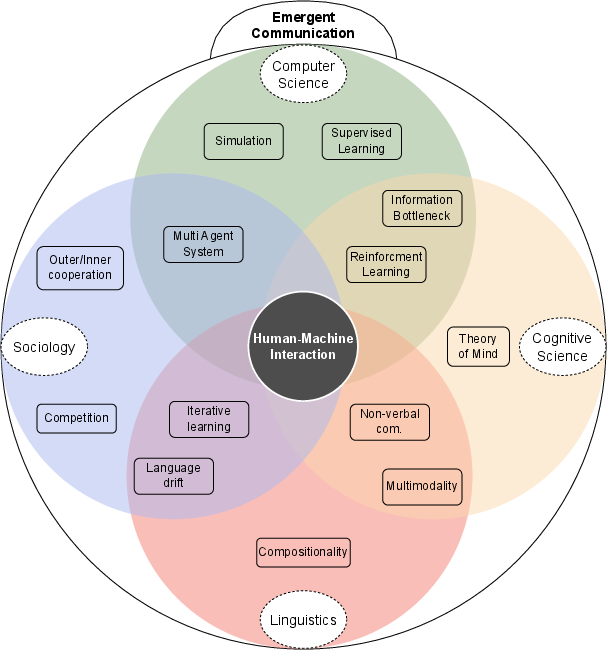
Figure 1: Exploring the multidisciplinary nature of Emergent Communication: A Venn Diagram showcasing the intersections between Linguistics, Cognitive Science, Computer Science, and Sociology.
Game Environment in EmCom
Games serve as fundamental environments for studying EmCom, facilitating interactions where communication emerges naturally. Referencing the archetypal referential game (Figure 2), intelligent agents like senders and receivers are engaged in constructing and interpreting messages to identify target objects among distractors. Such frameworks allow for exploring language emergence in a controlled setup, revealing how different input structures impact communicative generalization and compositionality.
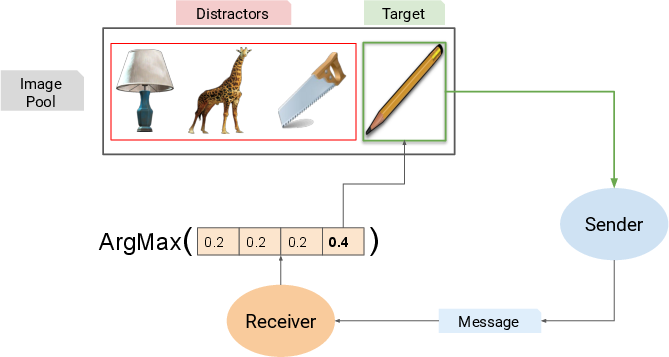
Figure 2: General pipeline for a discriminative referential game. The sender is shown a target image (a pencil) and generates a message, while the receiver selects the correct target from a pool.
Learning Paradigms and Challenges
Reinforcement learning (RL) and supervised learning are pivotal for training agents in EmCom scenarios. RL, with strategies like REINFORCE and Gumbel-Softmax, enables learning communication policies under stochastic conditions, albeit with challenges regarding variance. Alternatively, supervised learning complements RL, especially when pretrained LLMs are involved, facilitating a bridge between agent-generated communication and human language understanding.
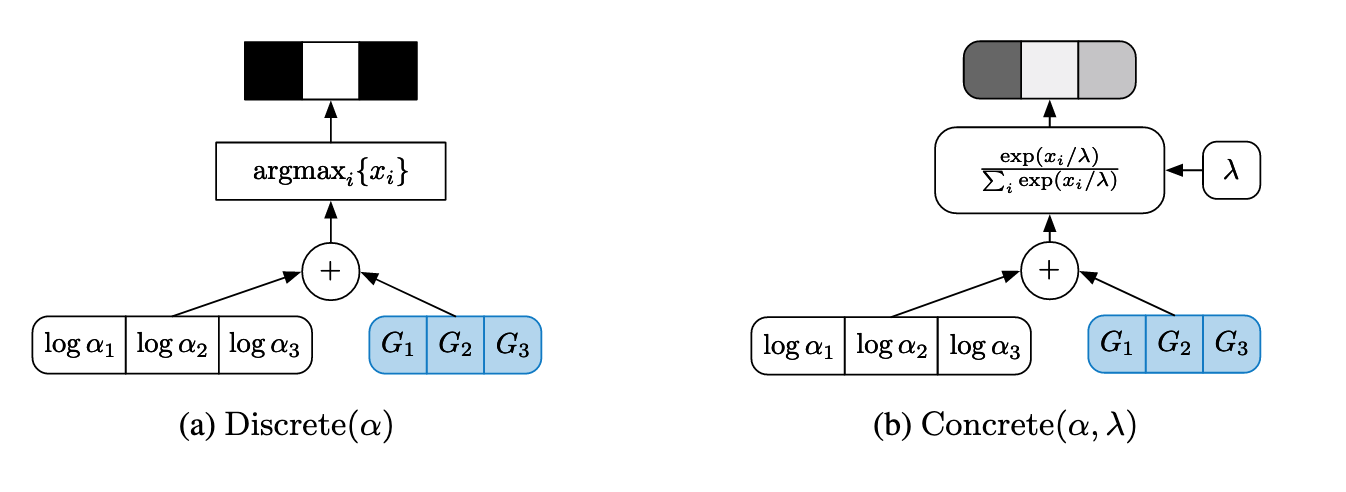
Figure 3: Visualization of sampling graphs for 3-ary discrete D∼Discrete(α) and 3-ary Concrete X∼Concrete(α,λ).
Interaction Types and Theory of Mind
EmCom employs diverse interaction types, notably distinguishing between cooperative and competitive settings (Figure 4). Cooperative interactions are key to studying communication, while competitive scenarios drive the understanding of strategic language utilization. Furthermore, integrating Theory of Mind (ToM) concepts allows agents to anticipate and influence other agents' actions, an aspect crucial for developing advanced communication strategies.
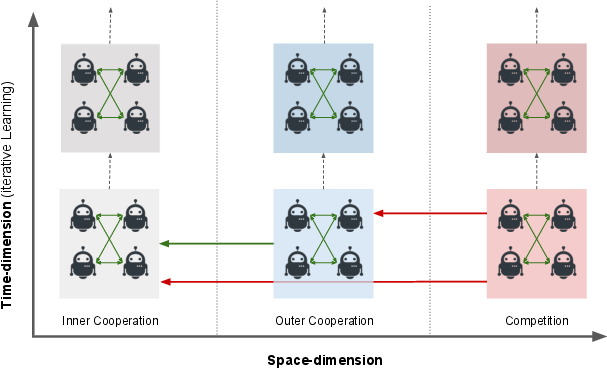
Figure 4: Visualization of interaction types in Emergent Communication, with spatial and temporal dimensions.
Evaluation Metrics
Evaluating emergent communication necessitates a multifaceted approach (Figure 5). Reward-based metrics quantify task success, while message mutual information, embedding analysis, and similarity measures provide insights into the language's structural properties and communicative efficacy. These metrics help discern whether the generated communication exhibits properties like compositionality, crucial for practical language applications.
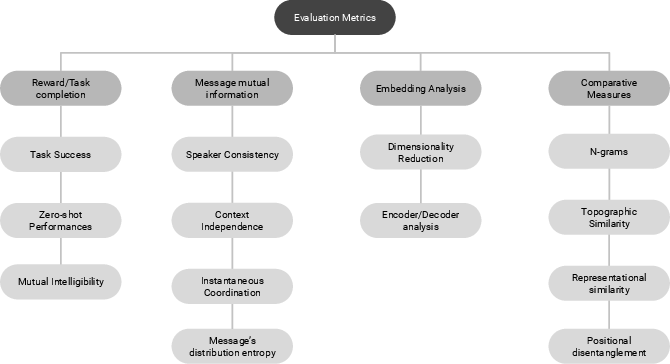
Figure 5: Hierarchical view of evaluation metrics, showcasing the diversity of aspects evaluated in emergent communication systems.
Human-Centered versus Machine-Centered Approaches
The paper dichotomizes EmCom into machine-centered and human-centered approaches. Machine-centered approaches explore Artificial Emergent Languages (AELs), focusing purely on symbolic language development without direct mapping to human languages. In contrast, human-centered approaches integrate natural language elements to align emergent communication more closely with human linguistic frameworks.
Conclusion
The review encapsulates the intricate dynamics of emergent communication research, linking theoretical constructs with practical applications. By analyzing interdisciplinary contributions, it lays a foundation for future developments aimed at refining AI communication systems towards genuinely human-like interactions. As emergent communication continues to evolve, its implications for AI extend into creating agents capable of nuanced, contextual, and adaptive interactions in increasingly complex environments.