- The paper introduces an orthogonal constraint that decomposes structural probes into isomorphic rotation and linear scaling.
- Multitask training with shared orthogonal transformations reduces overfitting and effectively captures distinct linguistic features.
- Evaluation on BERT layers confirms competitive performance, reduced memorization, and enhanced interpretability of language structures.
Introducing Orthogonal Constraint in Structural Probes
The paper "Introducing Orthogonal Constraint in Structural Probes" presents a novel form of structural probing for NLP models that incorporates an orthogonal constraint. The research extends existing methodologies by introducing a decomposition approach that enhances interpretation and generalization in probing tasks.
Background
Structural Probing
Structural probes are used to analyze the latent space of pre-trained LLMs (PLMs) like BERT and ELMo by applying a linear transformation to the embeddings and optimizing for linguistic tasks such as dependency distance and depth. This study builds on the work of Hewitt and Manning (2019), who introduced structural probes for syntactic analysis by modeling syntactic distances and depths using linear transformations and regression objectives.
Orthogonal Probes
The novel contribution of this research lies in replacing the linear transformation with an orthogonal transformation combined with a scaling vector, which allows decomposition of the probe into two distinct stages: isomorphic space rotation and linear scaling. This modification provides a more robust framework that can jointly train for multiple linguistic structures (e.g., syntactic dependencies, lexical hypernymy) with reduced memorization effects.
Methodology
Configurations
The orthogonal transformation is designed to maintain the structure of the original embedding space. The matrix V is orthogonalized, ensuring that transformations retain spatial relationships without distortion, typical of non-orthogonal transformations.
Multitask Training
By sharing the orthogonal transformation across tasks and varying the task-specific scaling vector, the model can perform multi-task probing efficiently. This configuration reduces parameter count and prevents overfitting, leading to greater selectivity in capturing relevant linguistic features.
Regularization Techniques
The research employs double soft orthogonality (DSO) to enforce orthogonality constraints and sparsity regularization to reduce the dimensionality of the scaling vector effectively. These mechanisms help identify dimensions critical for encoding specific linguistic structures.
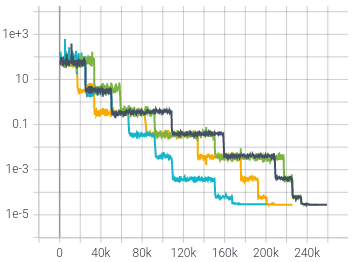
Figure 1: Values of orthogonality penalty during joint training of Orthogonal Structural Probe on top of layers: 3 (green), 7 (yellow), 16 (gray), 24 (blue). Optimization steps on the x-axis.
Evaluation
The Orthogonal Structural Probe was evaluated across different layers of a pre-trained BERT model. The introduction of an orthogonal constraint resulted in similar or superior performance compared to traditional structural probes, particularly in tasks evaluating syntactic and lexical structures.
Dimensionality Analysis
The embedding space's dimensionality was dynamically adjusted during training via sparsity constraints, resulting in low-rank subspace projections that maintained high model performance. This dimensionality reduction highlights the capture of focal linguistic information in fewer dimensions, enhancing interpretability and efficiency.
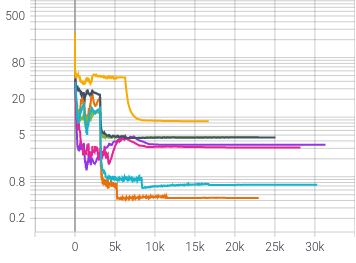
Figure 2: Values of sparsity penalty during separate training of Orthogonal Structural Probe s~with lambda=0.05. Objectives from highest to lowest value: lexical distance (yellow), positional distance (green), dependency distance (gray), positional depth (violet), lexical depth (magenta), dependency depth (blue), random depth (orange). Optimization steps on the x-axis.
Results
The empirical results demonstrated that Orthogonal Structural Probes are less susceptible to overfitting due to their reduced memorization of random structures, as indicated by lower correlations in control tasks. Multitask training settings maintained competitive performance metrics and revealed clear separation in encoding different types of linguistic information, such as syntax and lexis, supporting the probes' efficacy in complex language understanding scenarios.
Conclusion
This paper introduces an innovative structural probing technique that leverages orthogonal transformations to separate and analyze linguistic information in PLMs effectively. The work presents a significant advancement in probing techniques by enabling multitask learning with enhanced interpretability and reduced parameter utilization. Future research may explore applying these techniques to other linguistic domains and PLMs, further diversifying their applicability and impact in NLP.
Overall, this research highlights the potential for orthogonal constraints in elucidating the relationships among different linguistic embeddings, offering promising directions for both theoretical exploration and practical applications in language technology.

