Papers
Topics
Authors
Recent
2000 character limit reached

Chern insulator in a hyperbolic lattice

Published 4 Mar 2022 in cond-mat.mes-hall | (2203.02101v2)

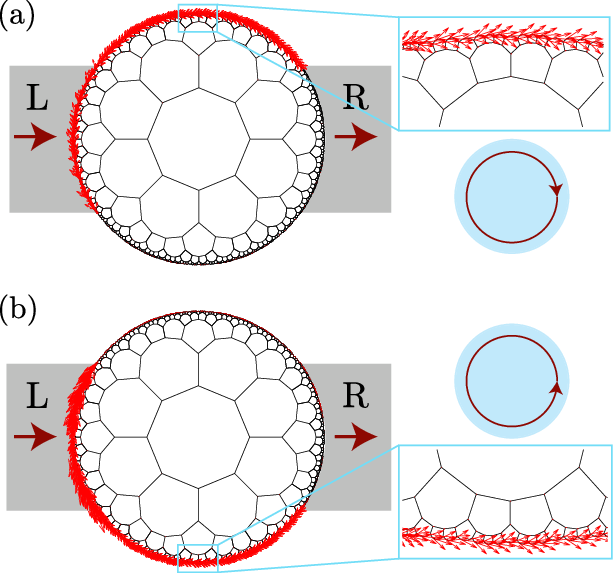
Abstract: Motivated by the recent experimental realizations of hyperbolic lattices in circuit quantum electrodynamics and the research interest in the non-Euclidean generalization of topological phenomena, we investigate the Chern insulator phases in a hyperbolic ${8,3}$ lattice, which is made from regular octagons ($8$-gons) such that the coordination number of each lattice site is $3$. Based on the conformal projection of the hyperbolic lattice into the Euclidean plane, i.e., the Poincar\'{e} disk model, by calculating the Bott index ($B$) and the two-terminal conductance, we reveal two Chern insulator phases (with $B=1$ and $B=-1$, respectively) accompanied with quantized conductance plateaus in the hyperbolic ${8,3}$ lattice. The numerical calculation results of the nonequilibrium local current distribution further confirm that the quantized conductance plateau originates from the chiral edge states and the two Chern insulator phases exhibit opposite chirality. Moreover, we explore the effect of disorder on topological phases in the hyperbolic lattice. It is demonstrated that the chiral edge states of Chern insulators are robust against weak disorder in the hyperbolic lattice. More fascinating is the discovery of disorder-induced topological non-trivial phases exhibiting chiral edge states in the hyperbolic lattice, realizing a non-Euclidean analog of topological Anderson insulator. Our work provides a route for the exploration of topological non-trivial states in hyperbolic geometric systems.
Summary

  • The paper demonstrates chiral Chern insulator phases and a disorder-induced topological Anderson insulator in a hyperbolic {8,3} lattice using numerical analysis.
  • It utilizes the Poincaré disk model to map hyperbolic geometry to Euclidean space, enabling Bott index calculations and quantum transport simulations.
  • Findings suggest potential experimental realizations in photonic crystals and quantum materials by exploiting non-Euclidean topological states.

Chern Insulator in a Hyperbolic Lattice

This paper examines the emergence of chiral Chern insulator (CI) phases in a hyperbolic {8,3}\{8,3\} lattice, elucidating both clean and disorder-influenced topological transitions. The investigation leverages a Poincaré disk model to project the hyperbolic lattice into a Euclidean representation. Through numerical methods, including the calculation of the Bott index and two-terminal conductance, distinct CI phases are identified alongside a disorder-induced topological Anderson insulator (TAI) phase.

Hyperbolic Lattice Model

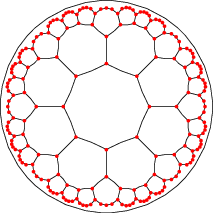
In classical Euclidean two-dimensional lattices, regular tessellation is limited to a few specific geometries. By contrast, hyperbolic geometries permit endless regular tessellation possibilities due to their constant negative curvature. The study utilizes a hyperbolic {8,3}\{8,3\} lattice, defined by octagonal tiling with a coordination number of three, to explore novel topological phenomena absent in Euclidean analogs. Figure 1

Figure 1: Schematic illustration of the hyperbolic {8,3}\{8,3\} lattice.

Numerical Analysis of Clean Systems

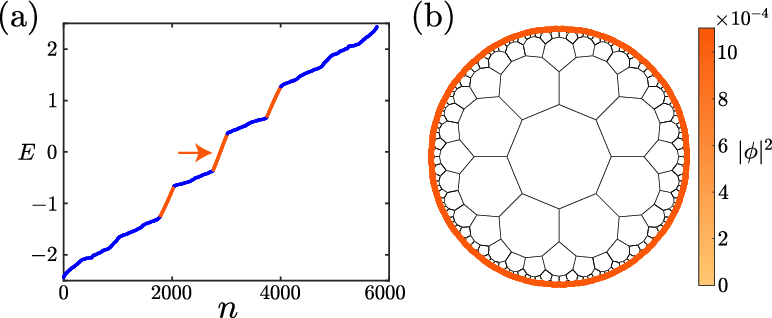
The Qi-Wu-Zhang model's Hamiltonian adapts to the hyperbolic {8,3}\{8,3\} lattice and is evaluated under open boundary conditions via numerical diagonalization. The energy spectrum, shown in Figure 2, demonstrates localized edge states, indicative of a potentially nontrivial topological phase. These states are inherently linked to the lattice's boundary and are characterized by a Bott index of B=1B=1. Figure 2

Figure 2: Energy spectrum of the Hamiltonian H0H_{0} showing edge-localized eigenstates.

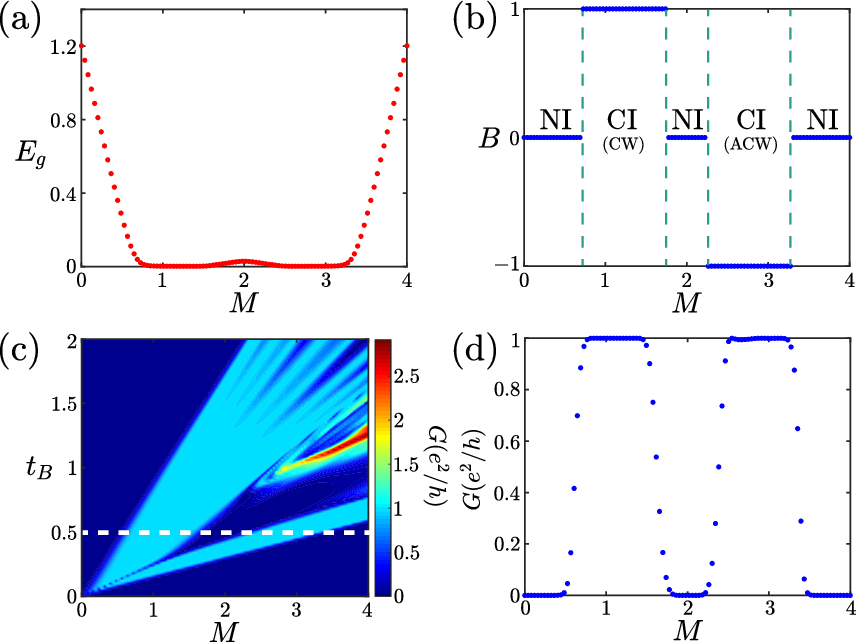
Further analysis reveals that tuning the model's material parameter MM induces topological phase transitions. Bott index calculations confirm these transitions—correlating with conductance plateaus measured in quantum transport simulations (Figure 3). Figure 3

Figure 3: Energy gap and phase diagram characterizing the transition between insulator and Chern insulator phases.

Disorder Effects and Topological Anderson Insulators

The resilience and transformation of topological phases under disorder in the hyperbolic lattice are of significant interest. When localized disorder is introduced (Figure 4), CIs exhibit robustness to weak disorder, preserving their chiral edge states. More intriguingly, disorder facilitates the emergence of a TAI phase in parametric regimes previously characterized by trivial topology in cleaner environments. Figure 4

Figure 4: Disorder effect on Bott index and conductance demonstrating phase robustness.

Conclusion

The exploration of Chern insulators within hyperbolic lattices not only expands theoretical understanding of non-Euclidean topological states but also opens pathways toward experimental realization in systems such as photonic crystals and circuit QED. Future studies should extend this work into field constrained by periodic boundary conditions, leveraging hyperbolic band theory further to elucidate potential applications in quantum materials and technologies.

Paper to Video (Beta)

Whiteboard

No one has generated a whiteboard explanation for this paper yet.

Open Problems

We haven't generated a list of open problems mentioned in this paper yet.

Collections

Sign up for free to add this paper to one or more collections.