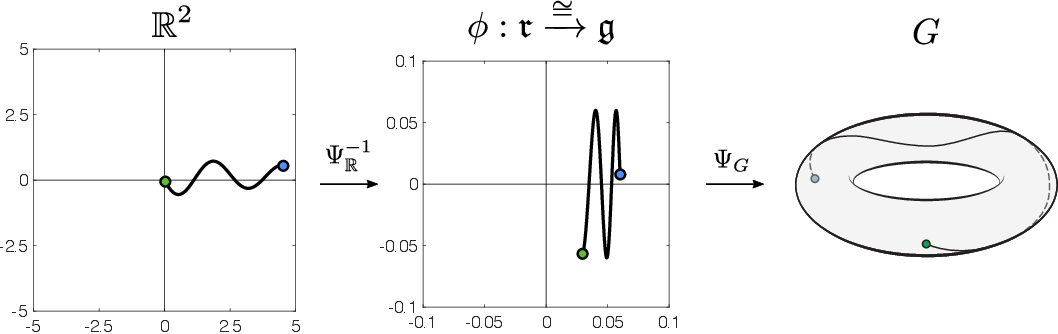
- The paper introduces a novel extension of classical path signatures from Euclidean spaces to Lie groups, providing a universal and characteristic feature map.
- It employs iterated integrals over Lie algebras and offers a Julia implementation, ensuring efficient computation for complex time series analysis.
- The approach demonstrates practical advantages in human action recognition and two-sample hypothesis testing by accurately capturing rotational dynamics.
Summary of "Path Signatures on Lie Groups"
Introduction
The paper "Path Signatures on Lie Groups" (2007.06633) expands the theory of path signatures — a robust nonparametric tool traditionally used for time series analysis in Euclidean spaces — to the complex setting of Lie groups. This adaptation is crucial for handling time series data with intrinsic geometric constraints, as seen in applications involving rotation and motion in spaces like SO(3). The authors demonstrate that this generalized approach preserves the universality and characteristic properties observed in the Euclidean case, thus offering a feature map that is both theoretically sound and practically advantageous for tasks such as human action recognition.
Theoretical Foundation
Path Signature Definition
A Lie group is a manifold that supports a group structure, making it ideal for modeling phenomena with geometric constraints. The notion of path signatures is lifted to time series valued in Lie groups by employing iterated integrals over paths expressed through the Lie algebra, the tangent space at the group identity. This constructs a feature map within a tensor algebra that characterizes the path comprehensively up to tree-like equivalence, a quotient of paths exhibiting similar end-points and structural loops.
Key Features of Lie Group Path Signatures
Empirical Application
Human Action Recognition
The paper showcases the application of Lie group path signatures in human action recognition, employing SO(3) representations of skeletal motions. By simplifying preprocessing — avoiding extensive processes like dynamic time warping — the authors achieve comparable results to other shallow learning methods with less complex data transformations. This highlights the efficiency and interpretability of path signatures, where second-level signature matrices provide insights into the underlying mechanics of human movement.
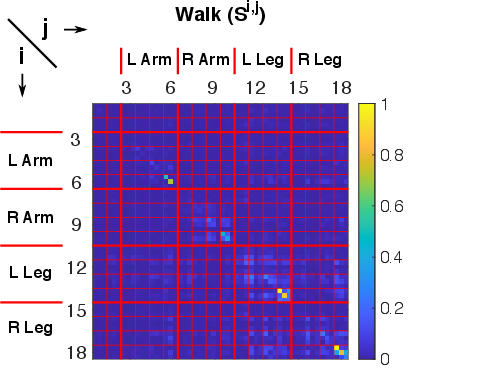
Figure 2: Averaged absolute second level signature matrix for the action class "walk."
Two-Sample Hypothesis Testing
Utilizing the characteristic property, the paper further elaborates on hypothesis tests distinguishing between distinct random walks on SO(3). The Lie group path signatures notably outperform their Euclidean counterparts, demonstrating superior sensitivity to subtle differences in rotational drift, an invariant under group translations.
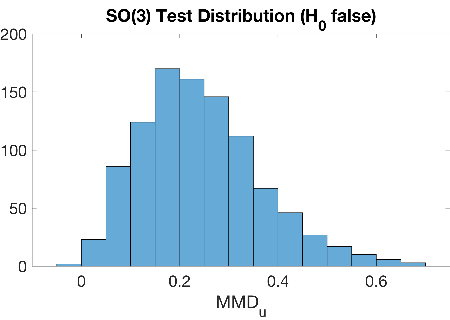
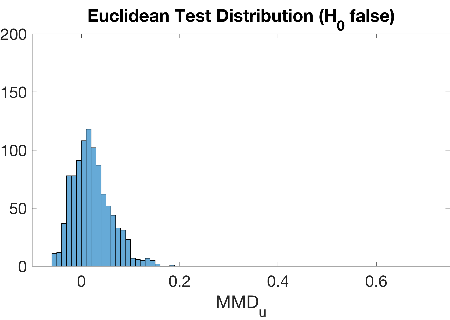
Figure 3: Test (top) and null (bottom) distributions of MMDu when H0 is false.
Conclusion
The authors establish that path signatures on Lie groups retain both theoretical and practical strengths essential for modern time series challenges. This advancement opens avenues for analyzing data types constrained by geometric properties, such as rotations and motions, marking a significant stride in both theoretical development and expansive applicability across data science domains. Future research may explore manifold scenarios and explore further applications far beyond classical Euclidean settings.