Papers
Topics
Authors
Recent
Search
2000 character limit reached

Leveraging Multi-AI Agents for Cross-Domain Knowledge Discovery

Published 12 Apr 2024 in cs.AI and cs.CL | (2404.08511v1)

Abstract: In the rapidly evolving field of artificial intelligence, the ability to harness and integrate knowledge across various domains stands as a paramount challenge and opportunity. This study introduces a novel approach to cross-domain knowledge discovery through the deployment of multi-AI agents, each specialized in distinct knowledge domains. These AI agents, designed to function as domain-specific experts, collaborate in a unified framework to synthesize and provide comprehensive insights that transcend the limitations of single-domain expertise. By facilitating seamless interaction among these agents, our platform aims to leverage the unique strengths and perspectives of each, thereby enhancing the process of knowledge discovery and decision-making. We present a comparative analysis of the different multi-agent workflow scenarios evaluating their performance in terms of efficiency, accuracy, and the breadth of knowledge integration. Through a series of experiments involving complex, interdisciplinary queries, our findings demonstrate the superior capability of domain specific multi-AI agent system in identifying and bridging knowledge gaps. This research not only underscores the significance of collaborative AI in driving innovation but also sets the stage for future advancements in AI-driven, cross-disciplinary research and application. Our methods were evaluated on a small pilot data and it showed a trend we expected, if we increase the amount of data we custom train the agents, the trend is expected to be more smooth.

Definition Search Book Streamline Icon: https://streamlinehq.com
References (9)
  1. Utilizing XGBoost for the Prediction of Material Corrosion Rates from Embedded Tabular Data using Large Language Model. In 2023 IEEE International Conference on Bioinformatics and Biomedicine (BIBM), December 2023. DOI: 10.1109/BIBM58861.2023.10385544.
  2. NLPADADE: Leveraging Natural Language Processing for Automated Detection of Adverse Drug Effects. In 2023 IEEE International Conference on Bioinformatics and Biomedicine (BIBM), December 2023. DOI: 10.1109/BIBM58861.2023.10385626.
  3. Comparative Study of Domain Driven Terms Extraction Using Large Language Models. arXiv preprint arXiv:2404.02330, 2024. Archive Prefix: arXiv, Primary Class: cs.CL. Available at https://arxiv.org/abs/2404.02330.
  4. FAIR Enough: How Can We Develop and Assess a FAIR-Compliant Dataset for Large Language Models’ Training? arXiv preprint arXiv:2401.11033, January 2024. Available at http://arxiv.org/abs/2401.11033.
  5. Learning Transferable Time Series Classifier with Cross-Domain Pre-training from Language Model. Proceedings of ACM Conference (Conference’17), March 2024, Volume 1. Available at http://arxiv.org/abs/2403.12372.
  6. Mohammed Rizvi. Exploring the landscape of artificial intelligence in education: Challenges and opportunities. In HORA 2023 - 2023 5th International Congress on Human-Computer Interaction, Optimization and Robotic Applications, Proceedings. Institute of Electrical and Electronics Engineers Inc., 2023. DOI: 10.1109/HORA58378.2023.10156773.
  7. MetaGPT: Meta Programming for A Multi-Agent Collaborative Framework. arXiv preprint arXiv:2308.00352v5, August 2023. Available at https://arxiv.org/abs/2308.00352v5.
  8. ReAct: Synergizing Reasoning and Acting in Language Models. arXiv preprint arXiv:2210.03629v3, October 2022. Available at https://arxiv.org/abs/2210.03629v3.
  9. Cross-Domain Recommendation with Cross-Graph Knowledge Transfer Network. In IEEE International Conference on Communications, June 2021. DOI: 10.1109/ICC42927.2021.9500882.
Summary

  • The paper presents a multi-agent framework that integrates domain-specific AI agents to collaboratively overcome the limitations of narrow expertise.
  • It evaluates four distinct workflows, revealing that the MetaGPT+OpenAI+RAG flow achieves the best balance of speed and accuracy with a ROUGE-1 precision of 0.49.
  • The study demonstrates that collaborative AI using the ReAct methodology significantly enhances cross-domain insights, driving interdisciplinary research forward.

Leveraging Multi-AI Agents for Cross-Domain Knowledge Discovery

Introduction

The paper "Leveraging Multi-AI Agents for Cross-Domain Knowledge Discovery" presents a framework for harnessing collaborative AI agents to facilitate cross-domain knowledge discovery. Traditional AI systems are often limited to narrow domains of expertise, which restricts their capability to synthesize and utilize information across different fields. This paper introduces an innovative approach where multi-agent systems are deployed, each specialized in a distinct knowledge area, to collaboratively overcome these limitations.

Multi-Agent Architecture

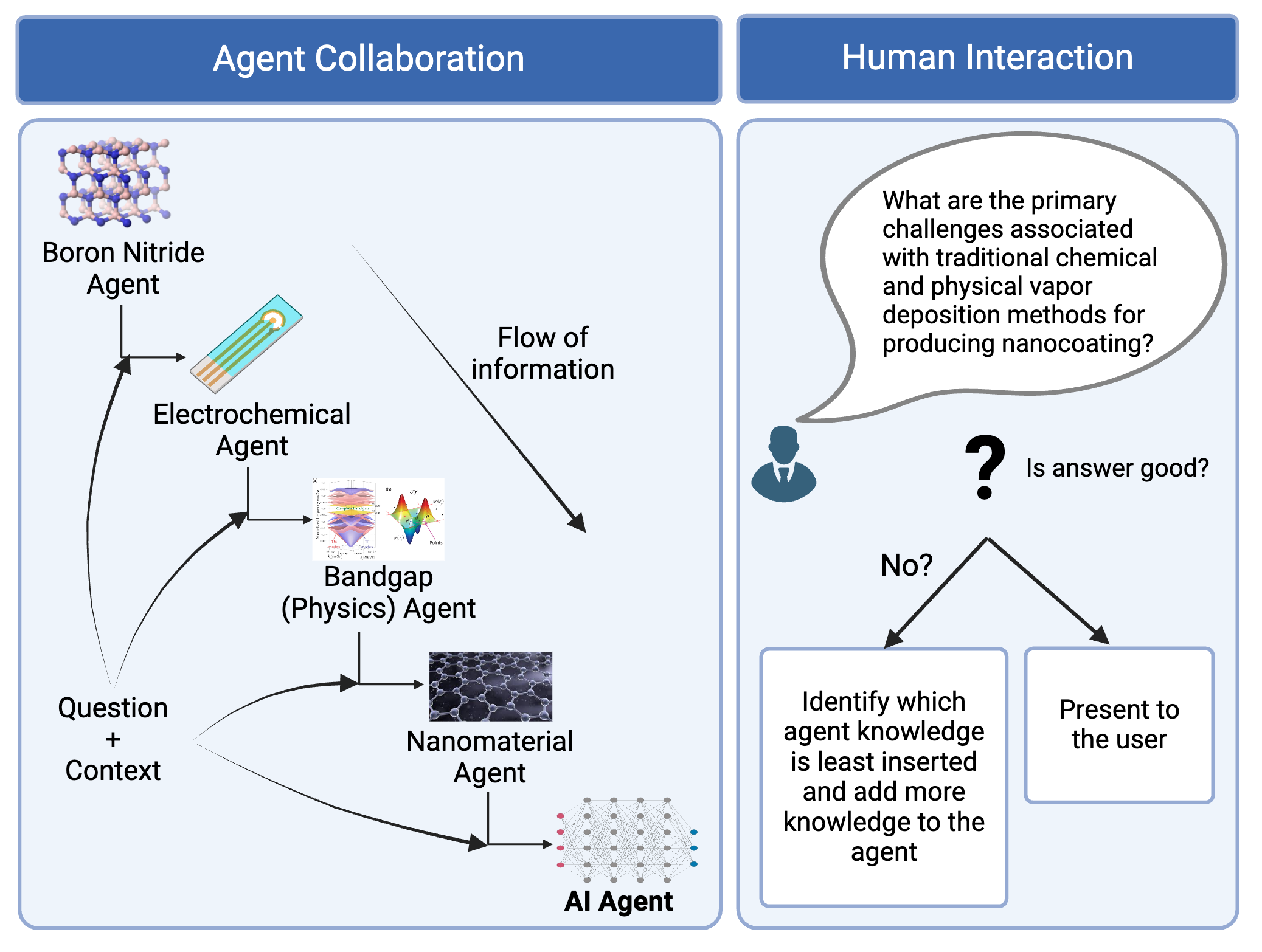
The proposed multi-agent architecture capitalizes on domain-specific expert agents within a unified framework to achieve comprehensive cross-domain knowledge discovery. Each agent follows a ReAct framework, characterized by three main processes: observe, think, and act. This allows agents to gather relevant data, process it using domain-specific insights, and then execute decisions to collaboratively solve complex problems. Figure 1

Figure 1: Multi-agent Flows

In this architecture, agents are specialized in distinct areas like Boron Nitride, Electrochemistry, Bandgap Physics, Nanomaterials, and AI, and are trained on datasets comprising approximately 1000 research papers per domain. The collaborative mechanism is achieved through a shared platform where agents communicate effectively, enhancing the integration and synthesis of diverse information.

Implementation Methodology

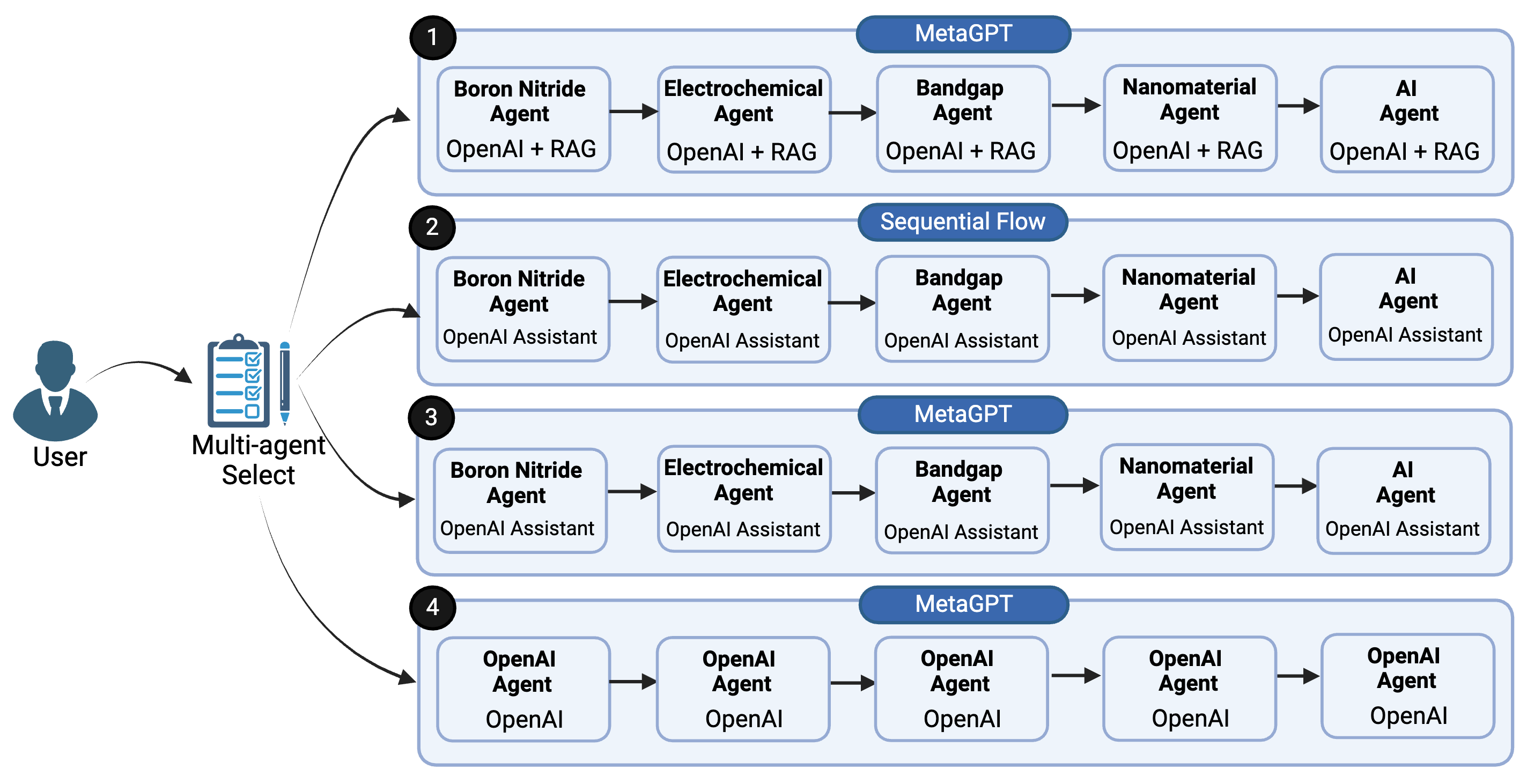
The paper evaluates four different implementation flows:

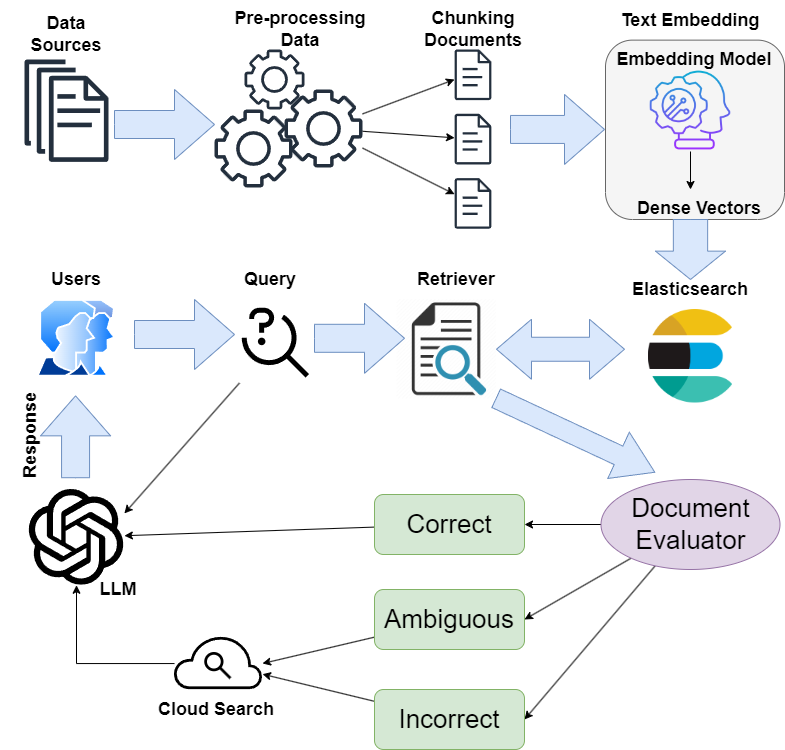
  • MetaGPT+OpenAI+RAG: Utilizes a RAG architecture to integrate custom knowledge from research papers with OpenAI's general knowledge. Figure 2

    Figure 2: RAG Architecture

  • Sequential Flow + OpenAI Assistant: Employs OpenAI Assistant API-based agents in sequence, enriched with domain-specific knowledge.
  • MetaGPT + OpenAI Assistant: Similar to the sequential flow but utilizes the MetaGPT framework for context management across different agents.
  • MetaGPT + OpenAI: A baseline employing only the OpenAI agent as a control to measure the impact of custom integrations.

The workflows are evaluated based on efficiency, determined by processing speed, and accuracy measured through ROUGE-1 precision and cosine similarity. These metrics provide insights into the effectiveness of each configuration in delivering precise, context-relevant responses in cross-disciplinary queries.

Experimental Setup and Results

The experiments involved testing agents on domain-specific questions to assess their knowledge integration and synthesis capability. Flow 1 (MetaGPT+OpenAI+RAG) emerged as the most effective, providing the highest quality responses by maintaining comprehensive conversational context. Figure 3

Figure 3: Experimental Setup

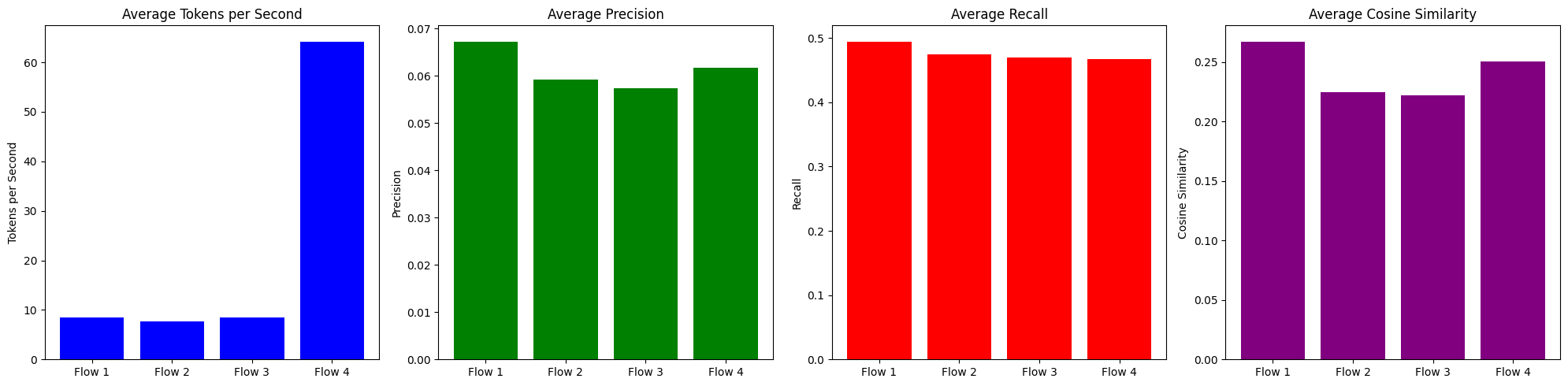
  • Speed of Answer Generation: Flow 4 demonstrated the highest speed with 64.23 tokens per second, but Flow 1 balanced speed with quality effectively.
  • ROUGE-1 and Cosine Similarity: Flow 1 showed superior accuracy with a precision of 0.49 and improved cosine similarity metrics, emphasizing the importance of custom knowledge integration. Figure 4

    Figure 4: Average Evaluation Metrics

Discussion

The multi-agent system marks a significant advancement in AI-driven knowledge discovery. The ability of agents to collaborate and innovate within a shared framework demonstrates considerable potential in dealing with cross-domain challenges. The integration and sharing of diverse domain-specific insights result in robust problem-solving capabilities, paving the way for intelligent systems capable of adapting to various research domains. Future research should focus on enhancing coordination mechanisms and expanding the domains and datasets utilized to sustain the scalability and effectiveness of such collaborative AI systems.

Conclusion

The study underscores the critical role of collaborative AI in advancing cross-domain knowledge discovery. The distinct configurations of multi-agent systems reveal the significance of domain-specific expertise for tackling complex problems. By deploying specialized agents, the system not only enhances the quality of AI-generated responses but also opens new avenues for AI-driven interdisciplinary research applications. Future work may further evolve these frameworks to improve efficiency and adapt to a broader range of domains, harnessing collective AI intelligence to address global challenges.

Paper to Video (Beta)

Whiteboard

No one has generated a whiteboard explanation for this paper yet.

Open Problems

We haven't generated a list of open problems mentioned in this paper yet.

Collections

Sign up for free to add this paper to one or more collections.

Tweets

Sign up for free to view the 2 tweets with 0 likes about this paper.