Papers
Topics
Authors
Recent
Search
2000 character limit reached

"My agent understands me better": Integrating Dynamic Human-like Memory Recall and Consolidation in LLM-Based Agents

Published 31 Mar 2024 in cs.HC | (2404.00573v1)

Abstract: In this study, we propose a novel human-like memory architecture designed for enhancing the cognitive abilities of LLM based dialogue agents. Our proposed architecture enables agents to autonomously recall memories necessary for response generation, effectively addressing a limitation in the temporal cognition of LLMs. We adopt the human memory cue recall as a trigger for accurate and efficient memory recall. Moreover, we developed a mathematical model that dynamically quantifies memory consolidation, considering factors such as contextual relevance, elapsed time, and recall frequency. The agent stores memories retrieved from the user's interaction history in a database that encapsulates each memory's content and temporal context. Thus, this strategic storage allows agents to recall specific memories and understand their significance to the user in a temporal context, similar to how humans recognize and recall past experiences.

Definition Search Book Streamline Icon: https://streamlinehq.com
References (29)
  1. Hafeez Ullah Amin and Aamir Malik. 2014. Memory Retention and Recall Process. 219–237. https://doi.org/10.1201/b17605-11
  2. The human hippocampus and spatial and episodic memory. Neuron 35, 4 (2002), 625–641.
  3. S.D.L.R.S.P.P.U. California. 1987. Memory and Brain. Oxford University Press, USA. https://books.google.co.jp/books?id=WH-HF5E9XSsC
  4. Antonio Chessa and Jaap Murre. 2007. A Neurocognitive Model of Advertisement Content and Brand Name Recall. Marketing Science 26 (01 2007), 130–141. https://doi.org/10.1287/mksc.1060.0212
  5. Xuan-Quy Dao. 2023. Performance comparison of large language models on vnhsge english dataset: Openai chatgpt, microsoft bing chat, and google bard. arXiv preprint arXiv:2307.02288 (2023).
  6. GPT-4 Technical Report. arXiv:2303.08774 [cs.CL]
  7. Firebase. 2023. Firestore. https://firebase.google.com/docs/firestore?hl=ja. (Accessed on 01/18/2024).
  8. Transformer Feed-Forward Layers Are Key-Value Memories. arXiv:2012.14913 [cs.CL]
  9. Suppression lateralise du materiel verbal presente dichotiquement lors d’une destruction partielle du corps calleux. Neuropsychologia 16, 2 (1978), 233–237.
  10. Anthony Holtmaat and Pico Caroni. 2016. Functional and structural underpinnings of neuronal assembly formation in learning. Nature neuroscience 19, 12 (2016), 1553–1562.
  11. A Machine With Human-Like Memory Systems. arXiv:2204.01611 [cs.AI]
  12. J. F. C. Kingman. 1993. Poisson Processes. Oxford University Press.
  13. Beatrice G Kuhlmann. 2019. Metacognition of prospective memory: Will I remember to remember? Prospective memory (2019), 60–77.
  14. A survey of transformers. AI Open (2022).
  15. Danilo P Mandic and Jonathon Chambers. 2001. Recurrent neural networks for prediction: learning algorithms, architectures and stability. John Wiley & Sons, Inc.
  16. Altering memory through recall: The effects of cue-guided retrieval processing. Memory & Cognition 17, 4 (1989), 423–434.
  17. OpenAI. 2023. ChatGPT. https://chat.openai.com/. (November 22 version) [Large language model].
  18. Generative Agents: Interactive Simulacra of Human Behavior. arXiv:2304.03442 [cs.HC]
  19. Lloyd Peterson and Margaret Jean Peterson. 1959. Short-Term Retention of Individual Verbal Items. Journal of Experimental Psychology 58, 3 (1959), 193. https://doi.org/10.1037/h0049234
  20. Qdrant. 2023. Vector Database. https://qdrant.tech/. (Accessed on 01/17/2024).
  21. Henry Roediger and Jeffrey Karpicke. 2006. Test-Enhanced Learning Taking Memory Tests Improves Long-Term Retention. Psychological science 17 (04 2006), 249–55. https://doi.org/10.1111/j.1467-9280.2006.01693.x
  22. How to fine-tune bert for text classification?. In Chinese Computational Linguistics: 18th China National Conference, CCL 2019, Kunming, China, October 18–20, 2019, Proceedings 18. Springer, 194–206.
  23. LSTM neural networks for language modeling. In Thirteenth annual conference of the international speech communication association.
  24. Endel Tulving. 2002. Episodic Memory: From Mind to Brain. Annual Review of Psychology 53, 1 (2002), 1–25. https://doi.org/10.1146/annurev.psych.53.100901.135114
  25. Endel Tulving et al. 1972. Episodic and semantic memory. Organization of memory 1, 381-403 (1972), 1.
  26. Guido Van Rossum and Fred L. Drake. 2009. Python 3 Reference Manual. CreateSpace, Scotts Valley, CA.
  27. Atsushi Yamadori. 2002. Frontiers of Human Memory : a collection of contributions based on lectures presented at Internationl Symposium, Sendai, Japan, October 25-27, 2001. Tohoku University Press. https://ci.nii.ac.jp/ncid/BA57511014
  28. MemoryBank: Enhancing Large Language Models with Long-Term Memory. arXiv:2305.10250 [cs.CL]
  29. Hubert A. Zielske. 1959. The Remembering and Forgetting of Advertising. Journal of Marketing 23 (1959), 239 – 243. https://api.semanticscholar.org/CorpusID:167354194
Citations (9)

Summary

  • The paper introduces a novel architecture that integrates dynamic memory recall and consolidation to personalize LLM-based dialogues.
  • The methodology employs a memory database with cosine similarity, time decay, and spaced repetition to trigger recall based on relevance thresholds.
  • Experimental results demonstrate statistically significant improvements over baseline models while highlighting challenges in adapting to abrupt behavioral shifts.

Integrating Dynamic Human-like Memory Recall and Consolidation in LLM-Based Agents

Motivation and Conceptual Framework

The paper addresses a fundamental cognitive limitation in prevailing LLM-based dialogue agents—the deficit in authentic temporal memory processing. Classical transformer architectures rely on self-attention, but lack mechanisms for dynamically consolidating and recalling memory over protracted temporal horizons, impeding coherent context retention and adaptive personalization in dialogue. Leveraging paradigms from human memory research, the authors propose an architectural enhancement: integrating dynamic, human-like memory recall and consolidation mechanisms to foster agents that not only retrieve contextually relevant memories but also modulate the strength of memory retention based on elapsed time, relevance, and recall frequency.

The architecture employs a memory database, where episodic events from user interactions are stored with content and temporal metadata. Memory recall is triggered when a mathematically modeled recall probability—parameterized by relevance (cosine similarity), elapsed time, and recall frequency—exceeds a threshold. The consolidation mechanism emulates human long-term potentiation, reinforcing memories through spaced repetition, and ensures that past experiences never reach complete erasure, but can be reactivated with appropriate contextual cues.

Mathematical Model for Memory Consolidation and Recall

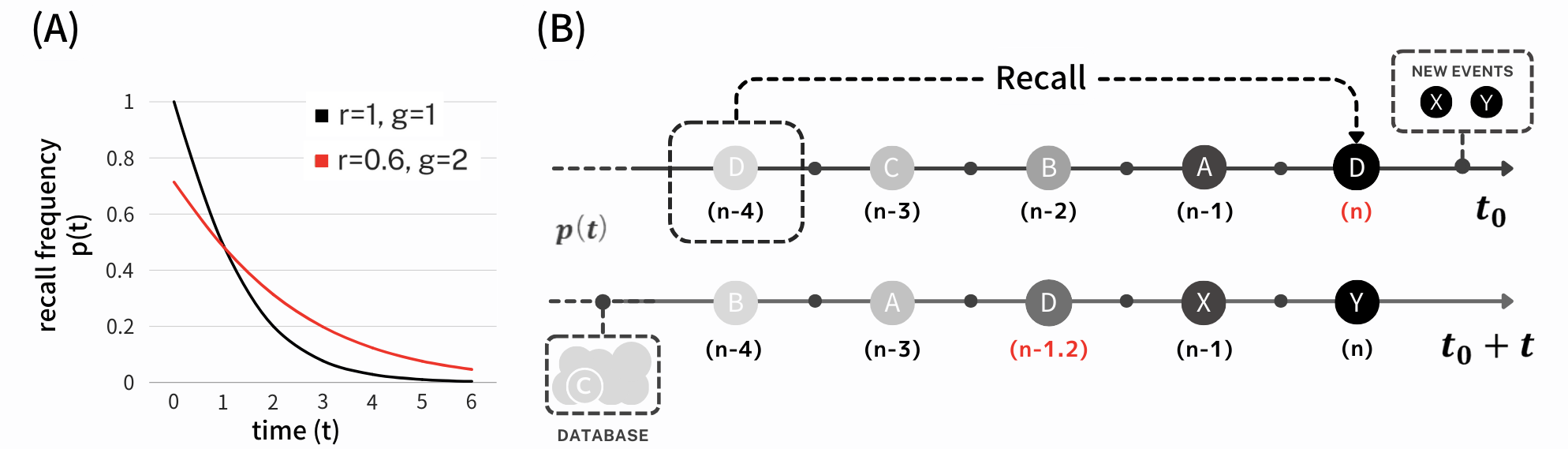
The memory recall probability pn(t)p_n(t) is formulated by adapting neurocognitive models of temporal decay and memory strength. Event relevance is computed as a normalized cosine similarity between vectorized texts. The decay constant aa is inversely scaled by a consolidation gradient gng_n, which accumulates through successive recalls by a monotonic sigmoid function S(t)S(t), reflecting the progressive stabilization of memories over repeated exposure.

pn(t)=1exp(ret/gn)1e1p_n(t) = \frac{1 - \exp(-r e^{-t / g_n})}{1 - e^{-1}}

This formulation modulates recall probability not only by recency but by the cumulative impact of prior recalls—the probability decays exponentially but is increasingly buffered as recall frequency rises. By design, the process precludes absolute forgetting: the memory strength asymptotes above zero, permitting dormant memories to be reactivated by salient cues, in line with established models of human memory retention. Figure 1

Figure 1: Decline in recall probability for memories with differing relevance and consolidation gradients; memory reinforcement through repetition reduces susceptibility to forgetting.

System Architecture and Implementation

The proposed system integrates GPT-4 as the LLM backbone, augmented by Qdrant for vectorized memory retrieval and Firestore for structured storage of chat history. The agent pipeline involves filtering user input for contextual relevance, computing recall probabilities, and dynamically updating memory consolidation parameters. When a memory’s recall probability passes a threshold (empirically set at k=0.86k=0.86), it is injected into the LLM’s prompt, enabling highly personalized responses grounded in temporally indexed user history.

The architecture is agnostic to memory modality—supporting both semantic and episodic retrieval—and is robust to variations in recall interval, favoring events with consistent long-term relevance over those with transient, high-frequency activation. Semantic memory encoding via key-value pairs enables efficient indexing and retrieval with low prompt length overhead compared to approaches reliant on concatenating long context windows.

Experimental Evaluation

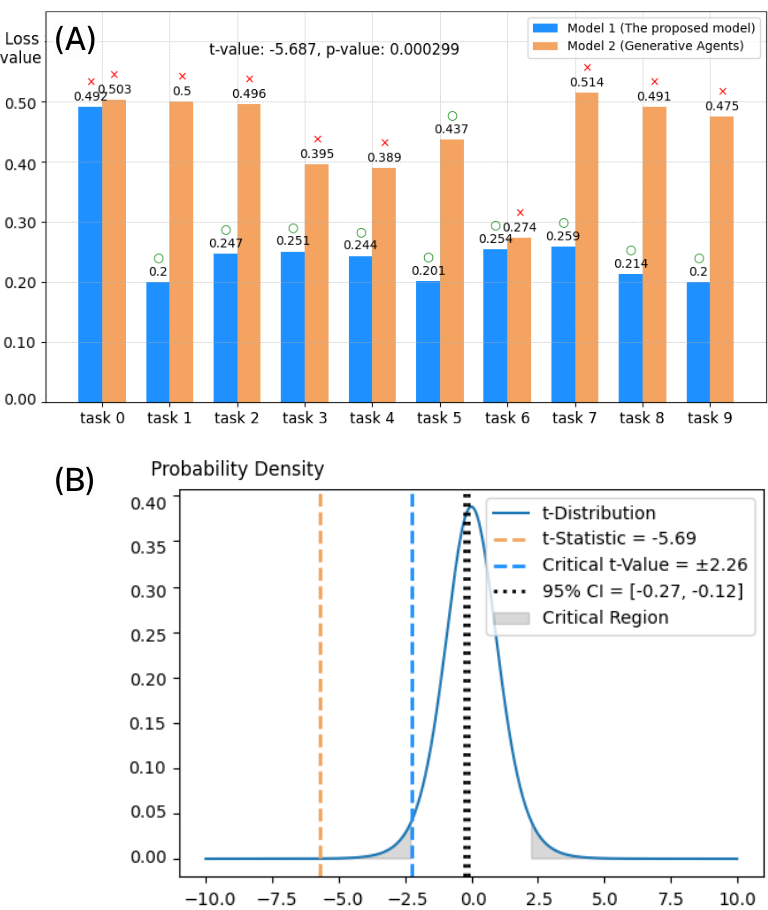
The model was benchmarked against Generative Agents [park2023generative] using both quantitative and qualitative methodologies. On ten tasks simulating real conversational histories, and with six participants conducting longitudinal dialogue sessions, the proposed model exhibited statistically significant lower loss values in recall accuracy as measured by sum-of-squares error and softmax probability normalization. Figure 2

Figure 2: Empirical analysis of loss values across tasks; proposed model achieves consistently superior recall accuracy, significance validated by two-tailed t-tests.

Specifically, the proposed architecture outperformed Generative Agents in accurately recalling temporally significant user events, with t=5.687t=-5.687 and p=0.000299p=0.000299, and a 95% confidence interval of mean difference fully below zero. The model’s nuanced consolidation enabled correct retrieval despite temporal distance if sufficient repetition was present, aligning with established psychological theories of test-enhanced learning and memory consolidation.

Errors are informative: in tasks where user behavior deviated sharply from historical patterns, the model tended to anchor on long-term trends, underscoring a limitation—adaptability to behavioral shifts remains constrained. Generative Agents, relying more on recency and simple importance scoring, sometimes selected incorrect memories with higher short-term relevance.

Implications for AI and Future Directions

The architecture delineated in this work advances temporal cognition for AI dialogue agents. Practically, it enables highly context-aware, efficient, and personalized interactions without expanding prompt length, crucial for maintaining computational scalability in production dialogue systems. The perpetual retrievability of dormant memories mirrors real-world human recall, allowing for richer, emotionally resonant conversational experiences.

Theoretically, the framework supports new research directions in interactional personalization, long-term user modeling, and memory-augmented reinforcement learning. The consolidation gradient and recall probability trigger provide a flexible mechanism to explore adaptive memory mechanisms, potentially extendable to affective, emotional, or intention-driven memory scoring.

Future efforts should focus on robust detection of behavioral shifts in users, dynamically recalibrating consolidation parameters, and optimizing database architectures for efficient, scalable memory retrieval. Larger, more diverse datasets and enhancements in neural memory modeling could further strengthen adaptive recall capabilities.

Conclusion

This work proposes a mathematically grounded, dynamically adaptive memory architecture for LLM agents, emulating human recall and consolidation. The model demonstrates statistically robust superiority in contextual recall and personalized response generation, while revealing vulnerabilities in adapting to abrupt behavioral change. The architecture is practically efficient and theoretically extensible, setting a foundation for research in long-depth, memory-augmented artificial agents and advancing state-of-the-art in human-computer interaction (2404.00573).

Paper to Video (Beta)

Whiteboard

No one has generated a whiteboard explanation for this paper yet.

Open Problems

We haven't generated a list of open problems mentioned in this paper yet.

Collections

Sign up for free to add this paper to one or more collections.

Tweets

Sign up for free to view the 3 tweets with 21 likes about this paper.