- The paper introduces a novel self-supervised learning framework (GATE) that uses graph CCA and dynamic functional connectivity augmentation to improve fMRI classification with minimal labels.
- It employs graph convolutional networks to extract robust embeddings from multiple sliding window views, enhancing the representation of temporal brain activity.
- Experimental evaluations on ABIDE and FTD datasets demonstrate superior accuracy, AUC, precision, and recall compared to state-of-the-art SSL methods.
Graph CCA for Temporal Self-supervised Learning for Label-efficient fMRI Analysis
The paper "GATE: Graph CCA for Temporal Self-supervised Learning for Label-efficient fMRI Analysis" (2203.09034) introduces a novel self-supervised learning (SSL) framework designed to enhance classification tasks in neuro-disease studies using functional magnetic resonance imaging (fMRI) under label-efficient conditions. This method focuses on improving fMRI representation learning and classification accuracy by employing a theory-driven SSL approach using Graph Convolutional Networks (GCNs).
Introduction
Functional connectivity (FC) measures derived from fMRI data have been extensively adopted in diagnosing neuro-diseases, due to their ability to capture changes in brain activity patterns [10.1227NEU]. The dynamic nature of brain connectivity, assessed through sliding window methods applied to BOLD signals, is crucial in understanding temporal variations [DynamicFC]. Traditional methods rely heavily on large datasets with rich annotations, which are often impractical in clinical settings due to the labor-intensive and costly nature of data labeling [hyman2020executive]. Therefore, this study aims to leverage SSL techniques to enhance learning from limited, labeled data effectively.
Graph CCA Strategy
The proposed framework, named Graph CCA for Temporal sElf-supervised learning (GATE), integrates several key components:
Dynamic FC Augmentation Strategy
GATE employs a dynamic functional connectivity method to generate augmented views of fMRI data. This is achieved through two techniques:
- Step Window Augmentation (S-A): Generates views from neighboring sliding windows.
- Multi-scale Window Augmentation (M-A): Uses different scales of sliding windows to form coupled views.
Both strategies aim to capture the essential disease-associated characteristics while mitigating the influence of spurious signals (Figure 1).
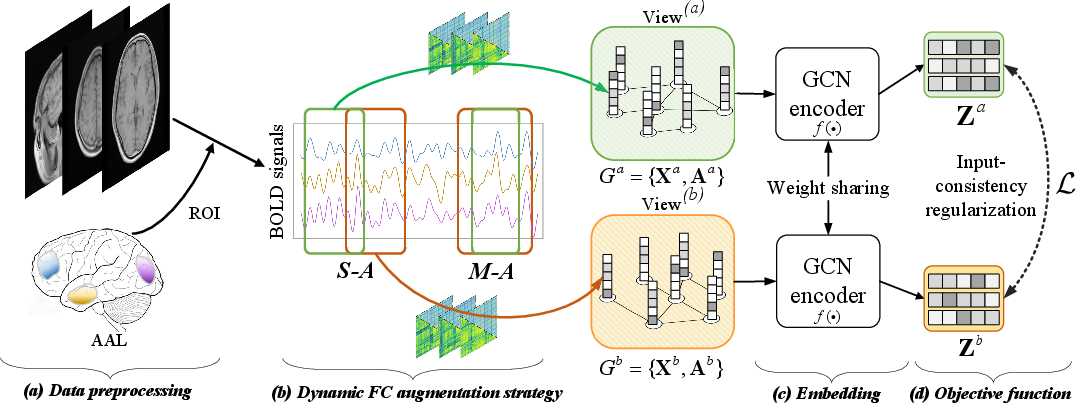
Figure 1: The flowchart of the proposed method for SSL-based dynamic FC representation learning.
Graph Embedding through GCN
The framework uses a GCN encoder to extract the relationships between subjects in each augmented view. This encoder applies graph operations to learn embeddings from both views, ensuring that these embeddings capture both semantic and structural information effectively [GAT].
Objective Function with CCA Regularization
The method introduces a Canonical Correlation Analysis (CCA)-inspired objective function to maximize the correlation between the embeddings obtained from two augmented views. By optimizing this objective function, the framework ensures that feature representations remain robust and uncorrelated with noisy, irrelevant signals (Figure 2).
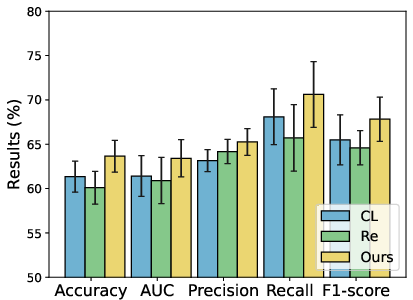
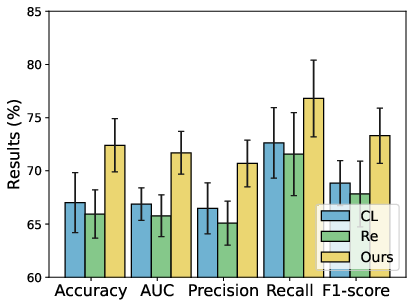
Figure 2: Effectiveness of different SSL strategies, CL: contrastive learning-based SSL and Re: reconstruction-based SSL.
Experimental Evaluation
The effectiveness of GATE was demonstrated on two datasets: the Autism Brain Imaging Data Exchange (ABIDE) and the Frontotemporal Dementia (FTD) dataset. The results indicated superior accuracy, AUC, precision, recall, and F1-score compared to state-of-the-art SSL methods like DGI and MVGRL [DGI], underscoring GATE's efficacy in label-efficient scenarios (Figure 3).
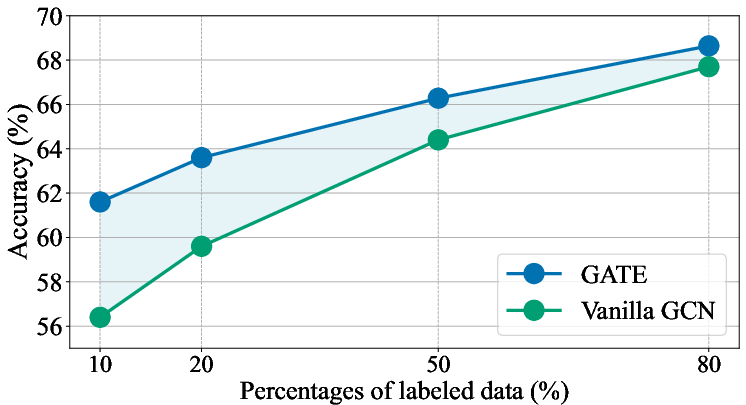
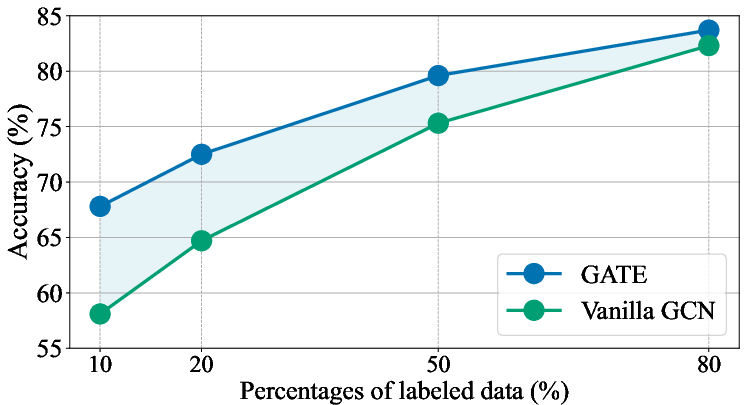
Figure 3: Accuracy of GATE and vanilla GCN at different label rates.
Implications and Future Prospects
The theoretical foundations and experimental validations presented in this paper suggest that GATE effectively leverages SSL strategies to improve fMRI classification under constrained labeling conditions. By maximizing the correlation between coupled views, GATE can mitigate overfitting to noise, which is particularly pivotal in a medical context where data labeling is challenging and sparse. Future studies may focus on integrating more advanced GCN models and leveraging GATE's augmentation strategies in diverse neuroimaging applications, thus enhancing clinical diagnosis accuracy and reliability.
Conclusion
GATE provides a robust approach to enhancing fMRI data analysis by employing SSL strategies that are well-suited to label-efficient environments. Through innovative augmentation and embedding techniques, as well as a CCA-based regularization objective, GATE achieves improved data classification performance in challenging neuro-disease contexts, setting a promising direction for future research in AI-driven medical imaging solutions.