Papers
Topics
Authors
Recent
Search
2000 character limit reached

Generalized Langevin Equation with a Non-Linear Potential of Mean Force and Non-Linear Memory Friction From a Hybrid Projection Scheme

Published 2 Feb 2022 in physics.chem-ph and physics.data-an | (2202.01922v1)

Abstract: We introduce a hybrid projection scheme that combines linear Mori projection and conditional Zwanzig projection techniques and use it to derive a Generalized Langevin Equation (GLE) for a general interacting many-body system. The resulting GLE includes i) explicitly the potential of mean force (PMF) that describes the equilibrium distribution of the system in the chosen space of reaction coordinates, ii) a random force term that explicitly depends on the initial state of the system, and iii) a memory friction contribution that splits into two parts: a part that is linear in the past reaction-coordinate velocity and a part that is in general non-linear in the past reaction coordinates but does not depend on velocities. Our hybrid scheme thus combines all desirable properties of the Zwanzig and Mori projection schemes. The non-linear memory friction contribution is shown to be related to correlations between the reaction-coordinate velocity and the random force. We present a numerical method to compute all parameters of our GLE, in particular, the non-linear memory friction function and the random force distribution, from a trajectory in reaction coordinate space. We apply our method to the dihedral-angle dynamics of a butane molecule in water obtained from atomistic molecular dynamics simulations. For this example, we demonstrate that non-linear memory friction is present and that the random force exhibits significant non-Gaussian corrections. We also present the derivation of the GLE for multidimensional reaction coordinates that are general functions of all positions in the phase space of the underlying many-body system; this corresponds to a systematic coarse-graining procedure that preserves not only the correct equilibrium behavior but also the correct dynamics of the coarse-grained system.
Summary

  • The paper presents a novel hybrid projection scheme merging Mori and Zwanzig approaches to derive a GLE with non-linear potential of mean force and memory friction.
  • It introduces a numerical method to extract GLE parameters directly from reaction coordinate trajectories, validated using butane dihedral-angle dynamics.
  • The work extends to a multidimensional framework, offering enhanced modeling for complex systems in molecular dynamics and related fields.

Generalized Langevin Equation with Non-Linear Dynamics

The paper "Generalized Langevin Equation with a Non-Linear Potential of Mean Force and Non-Linear Memory Friction From a Hybrid Projection Scheme" introduces a novel hybrid projection scheme to derive a Generalized Langevin Equation (GLE) for many-body systems. The developed technique combines the Mori projection and Zwanzig projection approaches, enabling the inclusion of non-linearities in both the potential of mean force (PMF) and memory friction, contributing to a more comprehensive understanding of non-linear dynamics in complex systems.

Hybrid Projection Scheme

The hybrid projection scheme incorporates two key elements: a non-linear PMF that ensures the equilibrium distribution of the system, and memory friction components that split into linear and non-linear parts. The linear component is velocity-dependent, while the non-linear part depends solely on the reaction coordinates. This combination addresses previous limitations of the Mori and Zwanzig schemes by balancing their strengths and enabling the explicit computation of all GLE parameters directly from simulation or experimental data.

Numerical Method for GLE Parameter Extraction

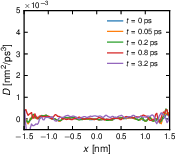
A significant contribution of the paper is the introduction of a numerical method that calculates the GLE parameters, particularly the non-linear memory friction function and the distribution of the random force, directly from reaction coordinate trajectories. This method is applied to the dihedral-angle dynamics of a butane molecule in water, demonstrating the presence of non-linear memory friction and non-Gaussian corrections in the random force distribution. Figure 1

Figure 1: Visualization of the hybrid projection scheme integrating linear and non-linear fines for comprehensive system dynamics analysis.

Application and Implications

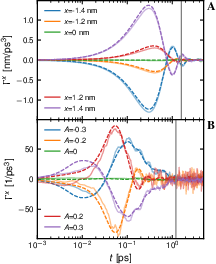
The application of the hybrid projection scheme on butane in water displays significant deviations from Gaussian behavior in random forces and emphasizes the utility of non-linear memory friction in modeling system dynamics. It demonstrates that even for simple molecular systems, non-linear behaviors are crucial for understanding the true dynamics beyond the approximate GLE models traditionally used. Figure 2

Figure 2: Effect of the non-linear memory friction on the butane dihedral angle dynamics, showcasing deviations from the simplifications in traditional models.

Multidimensional GLE Derivation

The paper extends the methodology to multidimensional reaction coordinates and offers a systematic coarse-graining procedure preserving both equilibrium and dynamic aspects of the coarse-grained system. This sets a foundation for applying the hybrid scheme to a broader range of physical systems, facilitating the study of complex non-linear interactions in various scientific domains.

Conclusion

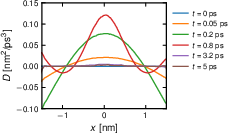
The novel hybrid projection scheme represents a significant advancement in determining the GLE for complex systems, offering deeper insights into non-linear dynamic behaviors. This approach has wide potential applications in molecular dynamics, chemical reactions, and biological systems, where traditional linear models fall short. Future developments might expand this scheme's applicability and precision in predicting non-linear dynamics across broader scenarios. Figure 3

Figure 3: Demonstrates the scaling capability of the hybrid scheme to multidimensional reaction coordinates, allowing complex system interactions to be modeled effectively.

Paper to Video (Beta)

Whiteboard

No one has generated a whiteboard explanation for this paper yet.

Open Problems

We haven't generated a list of open problems mentioned in this paper yet.

Collections

Sign up for free to add this paper to one or more collections.