Papers
Topics
Authors
Recent
Search
2000 character limit reached

Joint Communication and Control for Wireless Autonomous Vehicular Platoon Systems

Published 15 Apr 2018 in cs.IT | (1804.05290v2)

Abstract: Autonomous vehicular platoons will play an important role in improving on-road safety in tomorrow's smart cities. Vehicles in an autonomous platoon can exploit vehicle-to-vehicle (V2V) communications to collect information, such as velocity and acceleration, from surrounding vehicles so as to maintain the target velocity and inter-vehicle distance. However, due to the dynamic on-vehicle data processing rate and the uncertainty of the wireless channel, V2V communications within a platoon will experience a delay. Such delay can impair the vehicles' ability to stabilize the operation of the platoon. In this paper, a novel framework is proposed to optimize a platoon's operation while jointly consider the delay of the wireless network and the stability of the vehicle's control system. First, stability analysis for the control system is performed and the maximum wireless system delay requirements which can prevent the instability of the control system are derived. Then, delay analysis is conducted to determine the end-to-end delay, including queuing, processing, and transmission delay for the V2V link in the wireless network. Subsequently, using the derived delay, a lower bound and an approximated expression of the reliability for the wireless system, defined as the probability that the wireless system meets the control system's delay needs, are derived. Then, the control parameters are optimized to maximize the derived wireless system reliability. Simulation results corroborate the analytical derivations and study the impact of parameters, such as the platoon size, on the reliability performance of the vehicular platoon. More importantly, the simulation results disclose the benefits of integrating control system and wireless network design while providing guidelines for designing autonomous platoons so as to realize the required wireless network reliability and control system stability.
Citations (130)

Summary

  • The paper introduces a joint framework integrating V2V communication with leader-follower control to ensure platoon stability.
  • It employs stochastic geometry and queuing theory to derive delay thresholds and optimize control gains under diverse wireless conditions.
  • The study offers actionable design guidelines on spacing, control parameters, and bandwidth allocation to enhance reliability in autonomous platooning.

Joint Communication and Control for Wireless Autonomous Vehicular Platoon Systems

Introduction

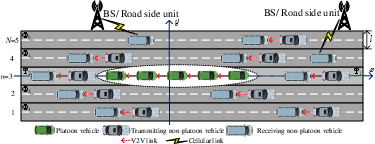
The advancement in autonomous vehicular platoon systems marks a crucial development in Intelligent Transportation Systems (ITSs), poised to significantly enhance road safety, traffic management, and vehicular fuel efficiency in future smart cities. The research on joint communication and control of these systems addresses the challenges of wireless system delays and control stability, with a novel framework aligning vehicle-to-vehicle (V2V) communication with vehicular control systems for enhanced stability and operational reliability. Figure 1

Figure 1: A highway traffic model where vehicles in the dashed ellipse operate in a platoon and other vehicles out of the platoon drive individually.

System Model

The paper models vehicular platoons using a highway traffic scenario, characterized by autonomous vehicles traveling in a platoon and individual non-platoon vehicles. The analysis leverages stochastic geometry to model vehicle densities and interference management in V2V and vehicle-to-infrastructure (V2I) communications. A leader-follower control model governs vehicular dynamics, integrating cooperative adaptive cruise control (CACC) for spacing and velocity management critical to platoon operation. Figure 2

Figure 2: Leader-follower model: a vehicular platoon with one leader and M followers.

Stability Analysis

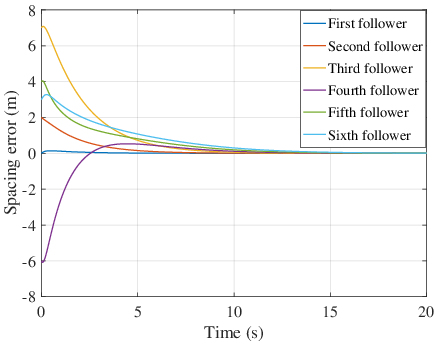
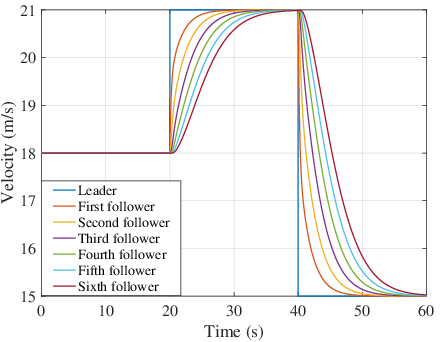
Two types of stability are analyzed: plant stability, ensuring vehicles maintain target velocity and spacing, and string stability, preventing propagation of disturbances in vehicle dynamics. The analysis derives delay thresholds to maintain stability under the influence of wireless communication delays. The mathematical formulation identifies control gains satisfying stability criteria and delineates delay constraints essential for stable platoon operation. Figure 3

Figure 3

Figure 3: Control system stability analysis validation.

End-to-End Latency Analysis

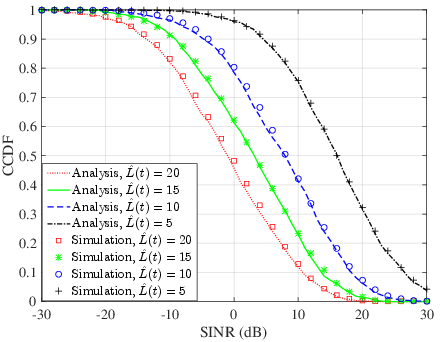
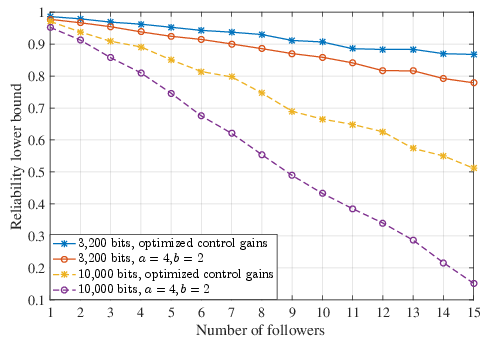
Queuing theory models the delay propagation through vehicular communication paths, incorporating queuing, processing, and transmission delays. Stochastic geometry defines SINR distributions, establishing reliability metrics in V2V links that underpin control system stability. The derivations highlight how system parameters like packet size and platoon size impact wireless network reliability. Figure 4

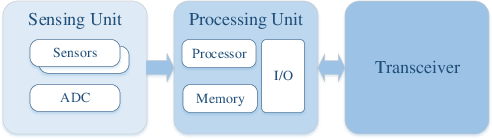
Figure 4

Figure 4: Data path inside a transmitting vehicle.

Figure 5

Figure 5: Validation for the SINR CCDF.

Optimization of Control System

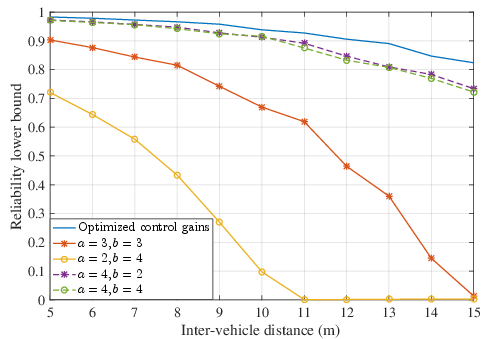
The dual optimization framework proposed enhances wireless network reliability through control system adjustments. By optimizing control gains, the system minimizes delay constraints on the network, thereby improving reliability performance metrics. The methods use the dual update technique to iteratively optimize control parameters, maximizing reliability while maintaining theoretical upper bounds on delay constraints. Figure 6

Figure 6

Figure 6: Optimization design for the control system.

Practical Implications and Future Work

The integration of communication and control systems offers valuable guidelines for design considerations in vehicular platoons. Ensuring stable operations involves precise selection of spacing, control parameters, and wireless bandwidth allocations. Future research may extend to dynamic models involving multiple platoons, addressing real-time challenges in varied traffic scenarios. Figure 7

Figure 7

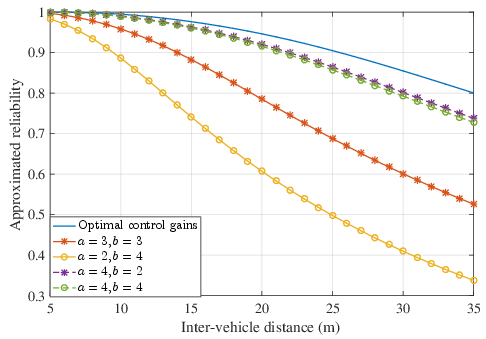
Figure 7: Approximated reliability for platoons with different density for non-platoon vehicles and packet sizes.

Conclusion

This comprehensive study successfully integrates vehicular communication networks with control systems, enhancing vehicular platoon stability and reliability. The proposed methodologies deliver actionable insights for advancing autonomous vehicular systems in ITS applications, positioning this research as pivotal in the transition to smarter traffic systems in the urban landscape.

Paper to Video (Beta)

Whiteboard

No one has generated a whiteboard explanation for this paper yet.

Open Problems

We haven't generated a list of open problems mentioned in this paper yet.

Collections

Sign up for free to add this paper to one or more collections.