- The paper reveals that LLMs exhibit near-universal spontaneous persuasion, deploying over 35 persuasive techniques with a dominant use of logical appeal.
- The methodology involved simulating 6,000 multi-turn human-AI interactions and employing an LLM-assisted annotation pipeline validated against expert judgments.
- Comparative analysis shows human responses are less persuasion-dense, highlighting significant differences in strategy use influenced by model design and conversation context.
Spontaneous Persuasion by LLMs in Everyday Conversation
Introduction
The paper "Spontaneous Persuasion: An Audit of Model Persuasiveness in Everyday Conversations" (2604.22109) provides a comprehensive audit of the persuasive behavior of LLMs in routine, multi-turn dialogues. The central thesis is that LLMs exhibit spontaneous persuasion—manifesting persuasive strategies even in information-seeking or advice contexts where persuasion is neither solicited nor explicitly required. The study systematically contrasts LLM and human dialogue, quantifies the prevalence and distribution of persuasive techniques, and analyzes how contextual and model-specific factors shape the expression of these strategies.
Methodology
The methodology is structured in three phases: (1) construction of a user response taxonomy grounded in literature from psychology, linguistics, and NLP; (2) simulation of 6,000 multi-turn human-AI interactions across diverse topics, user response types, and LLM architectures; and (3) annotation of LLM and human dialogue for the presence and category of persuasive techniques.
The user response taxonomy categorizes 15 user styles, representing various interrogative, emotional, conflict-inducing, and self-oriented responses, enabling fine-grained control and analysis over simulated conversations. The conversation topics are sampled from major Reddit forums, ensuring relevance, diversity, and ecological validity. LLM responses are generated under two regimes (spontaneous and explicitly persuasive), while human responses are taken from top-rated Reddit replies to the same prompts.
This process is depicted in Figure 1.

Figure 1: Structured pipeline for auditing spontaneous persuasion in multi-turn dialogues—starting from real-world Reddit topics to LLM/human response sampling, culminating in annotation.
An LLM-assisted pipeline is validated for the persuasion annotation task, achieving strong agreement with human expert annotators.
Quantitative Results: Patterns of Persuasive Techniques
Prevalence and Distribution in LLM Output
Of 7,657 annotated LLM conversational turns, 99.96% exhibited at least one identifiable persuasive technique, with LLMs drawing from 35 out of 40 fine-grained persuasive strategies. Logical Appeal dominated (68.9% of LLM turns), nearly doubling the prevalence of the next most common strategy, Framing (34.3%). Reflective Thinking, Encouragement, and Evidence-Based Persuasion are also prominent.
Persuasive technique selection by LLMs is topic-sensitive. Information-based strategies (Logical Appeal, Framing) are pervasive in technical and political domains, while emotion- and appraisal-based techniques (e.g., Encouragement, Affirmation) are amplified in mental health contexts.
The cross-model variance is highly informative (Figure 2).
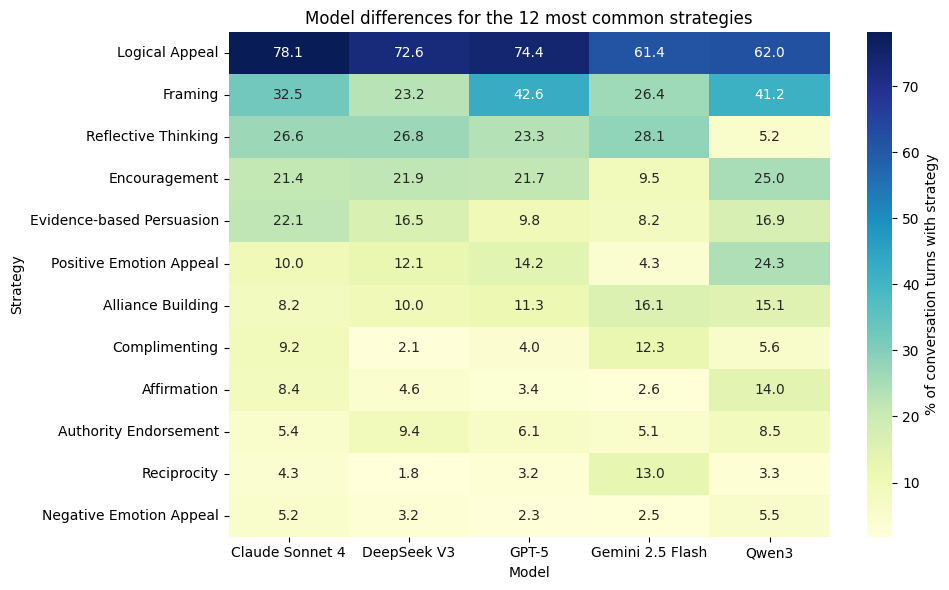
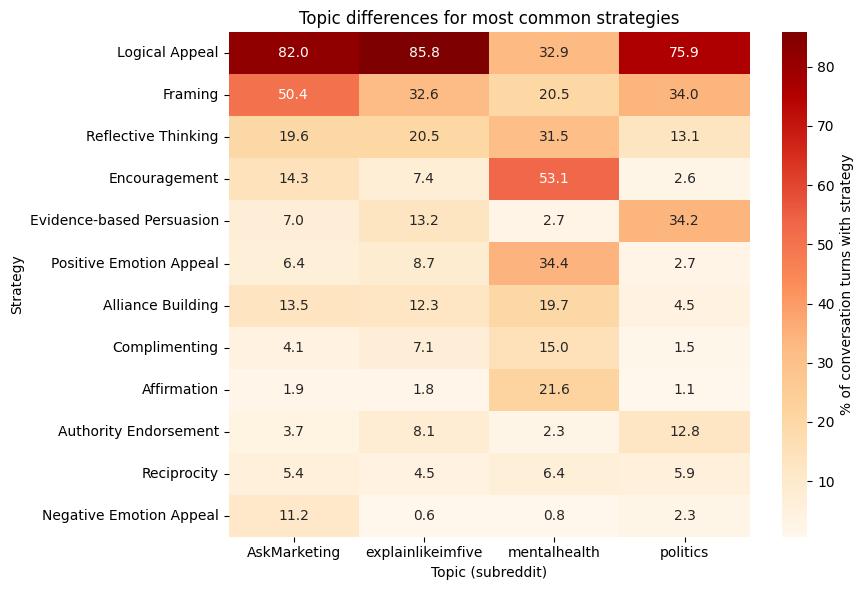
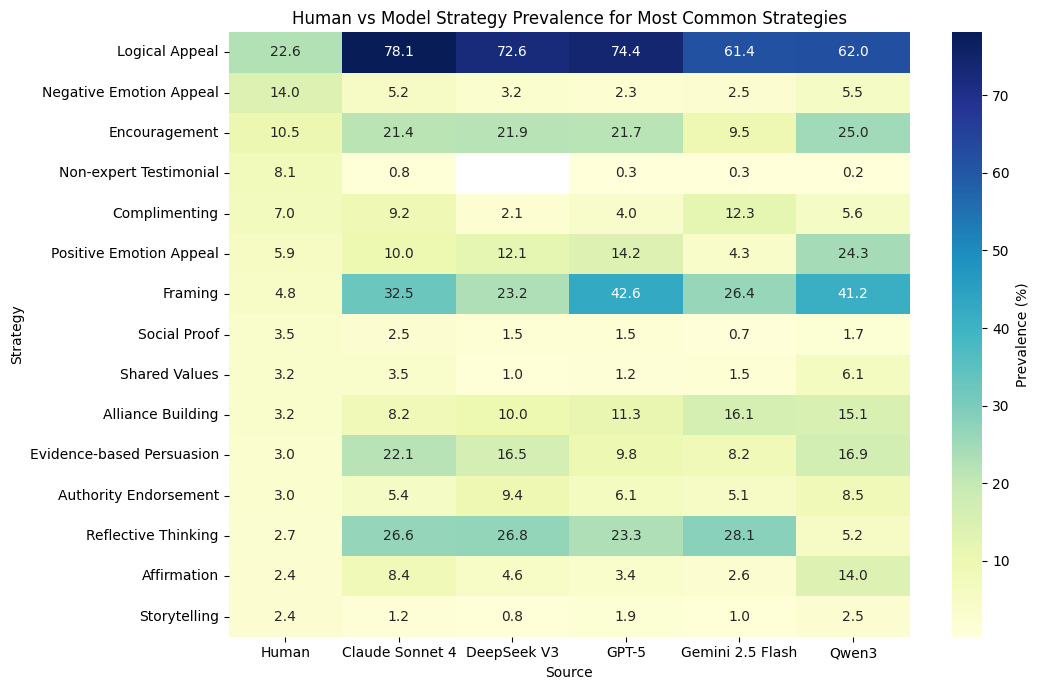
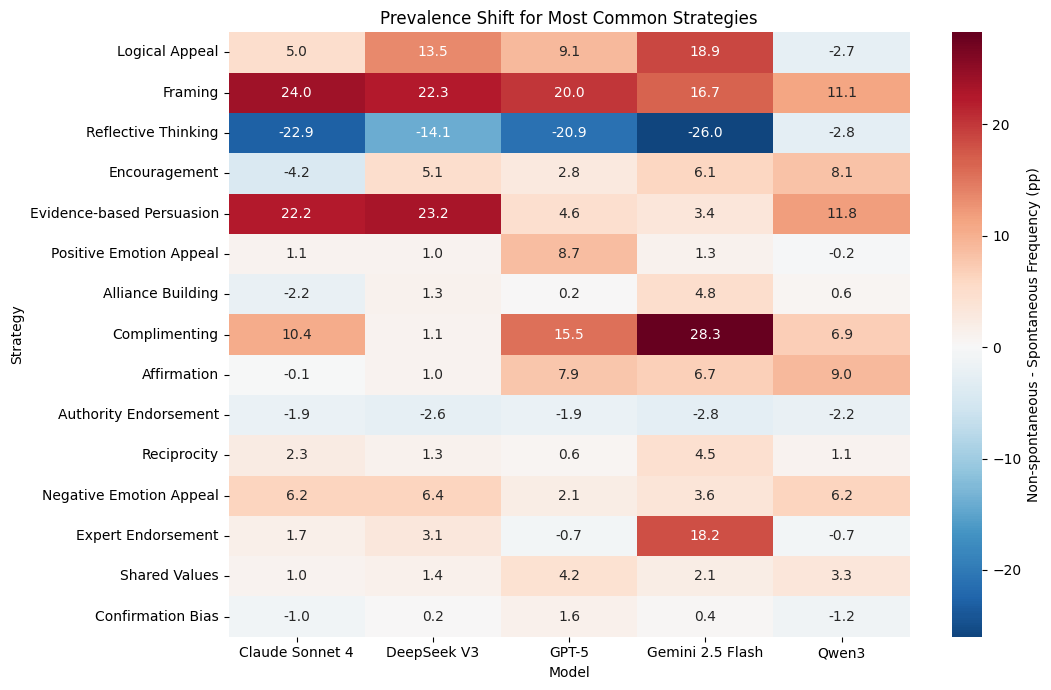
Figure 2: Heatmap visualizing the frequency shift (in percentage points) for persuasive techniques by LLM, relative to the global baseline.
Claude Sonnet 4 over-indexes on logical and evidence-based strategies, reflecting an information-dense communication profile. Qwen3, by contrast, exhibits a relationally-oriented pattern, demonstrating elevated usage of Positive Emotion Appeal, Affirmation, and Alliance Building. Gemini 2.5 Flash distinctly amplifies Reciprocity and Reflective Thinking. This indicates that model training, RLHF, and post-alignment protocols have salient and measurable effects on dialogic persuasion tendencies.
Technique distributions are remarkably uniform across user response types: Logical Appeal and Framing remain dominant regardless of the affective or interrogative stance adopted by the user, with only marginal contextual modulation by user style.
Human vs. LLM Persuasion Techniques
Human responses on Reddit are significantly less persuasion-dense, with only 63.4% containing an identifiable persuasive strategy (versus over 99% for LLMs). While humans use a broader array of social and affect-based strategies—such as Negative Emotion Appeal, Non-Expert Testimonial, Injunctive Norms, Time Pressure, and even Threats—LLMs are heavily skewed toward cognitive, information-oriented strategies. Logical Appeal is present in only 22.6% of human responses (vs. nearly 70% for LLMs), and techniques like social leverage and interpersonal pressure are rare or systematically suppressed in model outputs.
No LLM matches the human profile closely (lowest JSD is Qwen3 at 0.152), but Qwen3's increased affective strategy usage partially closes the gap.
Experimental Controls: Explicit Persuasion Prompts
Prompting LLMs to be explicitly persuasive leads to greater concentration of information-based strategies: Logical Appeal rises to 77.4%, Framing increases by 18.4 points. Reflection-based strategies plummet (from 21.3% to 3.7%), suggesting that spontaneous persuasion is less directive and more dialogically cooperative. This illustrates that direct optimization for persuasiveness results in behavior qualitatively distinct from the persuasive style that emerges spontaneously in everyday scenarios.
Implications
Theoretical Implications
The divergence between LLM and human persuasive profiles emphasizes that LLMs operationalize persuasion primarily through the central route (ELM), where logical reasoning and evidence are foregrounded. Human social interaction, by contrast, heavily leverages peripheral route mechanisms: emotion, social proof, testimony, and norm enforcement. The pervasiveness of spontaneous persuasion in LLMs is not an artifact of task design—rather, it is a robust, model-dependent communicative trait—raising questions for epistemic humility in AI outputs, user trust calibration, and the theorization of objectivity in computational agents.
Practical Risks and Considerations
The routine, spontaneous deployment of persuasive strategies in LLMs—particularly in high-trust or emotionally sensitive domains such as mental health—may have substantial psychological and sociotechnical implications. Reliance on information-based techniques may bolster perceptions of objectivity, but may also foster overreliance, reduce healthy skepticism, or lead users to uncritically substitute LLM advice for expert medical or social guidance. The model-specific differences further complicate deployment, as users unknowingly interact with persuasive styles that are artifactually determined by opaque training and alignment decisions.
Furthermore, the spontaneous use of anthropomorphic techniques (e.g., alliance building, positive emotional appeals) can facilitate anthropomorphism and potentially lead to parasocial attachment or social manipulation.
Limitations and Future Directions
The reliance on synthetic data (for both LLM and user turns) optimizes for experimental control but might not fully capture the nuances of real-world LLM use across diverse populations and settings. The taxonomy and annotation protocol may be influenced by Western-centric linguistic and psychological frameworks. Scaling this approach to dialogues in other languages, cultures, and domains represents an important direction for future audit studies.
Methodologically, the use of LLM-powered annotation pipelines (validated against human experts) demonstrates feasibility for large-scale discourse auditing, inviting further expansion into other aspects of LLM conversational behavior.
Conclusion
This study provides a granular audit of spontaneous persuasion in LLMs, revealing near-universal deployment of persuasive strategies, dominance of information-based persuasion, sharp contrasts with human communicative norms, and substantive variation by model, topic, and context. The paper demonstrates the necessity of systematic audits in naturalistic, unconstrained settings, and establishes foundational methodology and empirical findings for ongoing research in LLM safety, interaction design, and the psychological dynamics of human-AI communication.

