- The paper introduces a multi-period Kyle-type model to show that liquidity benefits from mandatory disclosure depend on the degree of market-making competition.
- The analysis reveals that disclosure compresses both informational and oligopolistic rents, significantly reducing price impact in less competitive markets.
- The empirical validation using SOX Section 403 data confirms that enhanced disclosure improves market liquidity and price efficiency, especially in markets with fewer competitors.
Mandatory Disclosure and Oligopolistic Market Making: Theoretical and Empirical Insights
Introduction
The paper "Mandatory Disclosure in Oligopolistic Market Making" (2604.10194) introduces a formal treatment of how mandatory disclosure protocols interact with the competitive structure of financial intermediaries, notably market makers, to influence market liquidity and price efficiency. Leveraging a multi-period Kyle-type model, the research derives a unique linear equilibrium, establishing that the liquidity-enhancing benefits of disclosure are fundamentally contingent on the degree of market-making competition. Theoretical findings are empirically substantiated using the Sarbanes–Oxley Act (SOX) Section 403 as a quasi-experimental setting in the U.S. equity markets.
Theoretical Framework: Kyle-Type Model with Oligopolistic Market Makers and Mandatory Disclosure
The model extends the canonical Kyle (1985) setup by synthesizing two previously disjoint lines of research: (1) mandatory disclosure under perfect competition and (2) imperfect competition among risk-neutral market makers. Agents consist of noise traders, an informed trader (adverse selection agent), and M≥3 risk-neutral market makers. Trading unfolds over N discrete periods. After each round, the informed trader's order (including optimally chosen dissimulation noise) is mandatorily disclosed.
The principal analytical results include:
- Existence and Uniqueness of Symmetric Linear Equilibrium: The equilibrium is characterized by time-consistent linear strategies for all agent classes, with equilibrium coefficients depending explicitly on the number of market makers M.
- Endogenous Price Impact: The presence of imperfect competition (finite M) yields strictly positive profits for market makers, differentiating the outcome from perfect competition frameworks where intermediary profits vanish.
- Strategic Noise Selection: The informed trader's optimal addition of Gaussian noise is essential to prevent immediate full revelation of private information, preserving dynamic adverse selection and information asymmetry over multiple rounds.
Comparative Statics and Analytical Implications
The equilibrium is benchmarked against three canonical Kyle-model variants: (i) perfect competition without disclosure, (ii) perfect competition with disclosure, and (iii) imperfect competition without disclosure.
Key results include:
- Liquidity Effects of Disclosure Vary with Competition: The marginal benefit of disclosure, measured as the proportional reduction in price impact (Kyle’s λ), is strictly increasing as the number of market makers decreases (imperfect competition). As M→∞, benefits converge to those predicted by perfect competition with disclosure.
- Distribution of Rents: Disclosure compresses both informational rents (for the informed trader) and oligopolistic rents (for market makers). This compression effect is strongest when market-making competition is limited.
- Noise Traders’ Welfare: The greatest reduction in trading costs for noise (uninformed) traders is realized in the least competitive markets, highlighting disclosure's potential for consumer surplus improvement under frictional intermediary competition.
- Price Efficiency: Imperfect competition induces negative short-term price autocorrelation in transaction prices, a signature of rent extraction by market makers. Disclosure moves autocorrelation closer to zero, promoting greater price efficiency without eliminating all negative serial dependence in the presence of a finite M.
Empirical Validation: SOX Section 403 as a Natural Experiment
To empirically evaluate the core theoretical prediction, the implementation of SOX Section 403 (which shortened insider-trading disclosure deadlines) is utilized as an exogenous shock to the U.S. equity market's disclosure environment. Employing a difference-in-differences specification:
- The primary outcome measure is the log of the bid–ask spread, a robust proxy for price impact and market liquidity.
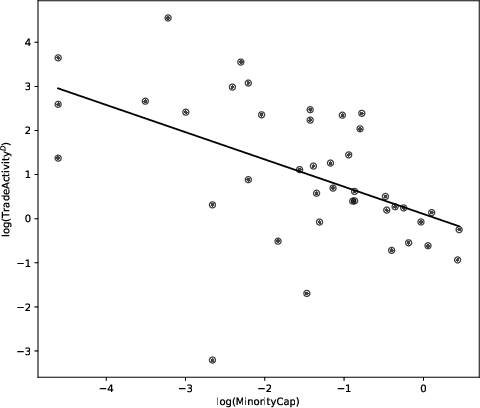
- Market-making competition is proxied by the cross-sectional average number of market makers (MMCNT) per stock, leveraging CRSP data.
The regression model specifies an interaction between the post-event period and the log number of market makers. Theoretical predictions of the model are confirmed: the interaction coefficient is positive and highly statistically significant, indicating that the liquidity improvement (spread reduction) following enhanced disclosure is substantially greater for stocks with fewer competing market makers.

Figure 1: Estimated effect of SOX Section 403 on log(Spread) as a function of market maker count, demonstrating that liquidity improvement from disclosure is concentrated among stocks with weaker market-making competition.
Cross-Sectional and International Evidence
Complementary evidence from cross-country data further substantiates the theoretical predictions:
Extensions and Theoretical Robustness
The analysis assumes exogenous M and a single informed trader, but its central comparative statics are expected to generalize under:
- Endogenous Entry by Market Makers: Lower competition increases the marginal profitability of new entry post-disclosure; thus, disclosure may catalyze market deepening most in poorly competitive environments [IN2013].
- Multiple Informed Traders: With disclosure, competitive informed trading accelerates information revelation, intensifying the interaction found with intermediary competition [GL2012].
Conclusion
This research articulates a novel microstructural mechanism: the liquidity benefits of mandatory disclosure depend critically on the competitive landscape of the intermediary sector. Both theory and empirical evidence converge to demonstrate that disclosure reforms yield the greatest market quality improvement precisely where market-making competition is weakest. This has regulatory implications—mandatory transparency is most valuable when competitive discipline among intermediaries is insufficient. Future research may endogenize the intermediary entry margin and explore broader classes of information environments and agent heterogeneity to further elucidate the interplay between disclosure, competition, and market efficiency.