- The paper introduces the HSTGNN architecture to reconstruct unobserved smart meter readings in district heating networks with high accuracy.
- It employs a triple-branch design with modality-specific GRUs and learned sensor-type graphs to capture complex thermohydraulic couplings.
- Experimental results demonstrate superior performance with RMSE as low as 0.1091 °C, validating the robustness of its virtual sensing approach.
Virtual Smart Metering in District Heating Networks via Heterogeneous Spatial-Temporal Graph Neural Networks
Introduction and Motivation
District heating networks (DHNs) are central to modern energy systems’ decarbonization efforts, enabling the integration of diverse renewable heat sources and facilitating operational flexibility. Achieving reliable, efficient, and optimized operation in these networks requires substantial observability of thermal and hydraulic states, which is hampered by sparse instrumentation, sensor asynchronicity, and faults typical in real-world deployments. While virtual sensing is a cost-effective avenue for augmenting observability, extant methods predominantly assume dense, synchronized data or rely on simplified physical models that poorly capture realistic network heterogeneity and complex thermohydraulic couplings. Machine learning (ML) and, more recently, graph neural networks (GNNs) have shown promise—yet prior spatial-temporal GNN (STGNN) approaches are insufficiently tailored for the multi-modal, physically coupled, and incomplete data characteristic of DHNs.
Experimental Testbed and Data Acquisition
To facilitate principled evaluation and to address the dearth of high-quality, synchronized experimental data, the authors constructed a laboratory-scale DHN at the Aalborg Smart Water Infrastructure Laboratory (SWIL), physically emulating a canonical tree-structured supply-return topology with industrial-grade instrumentation. The network comprises a heat station, multiple pipe segments, and consumer substations, with dedicated, redundant metering for reference measurements.
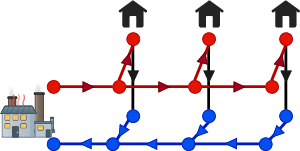
Figure 1: Schematic layout of the district heating network; a tree-structured graph that reflects symmetrical supply–return relationships, with edge inversion to encode hydraulic flow direction.
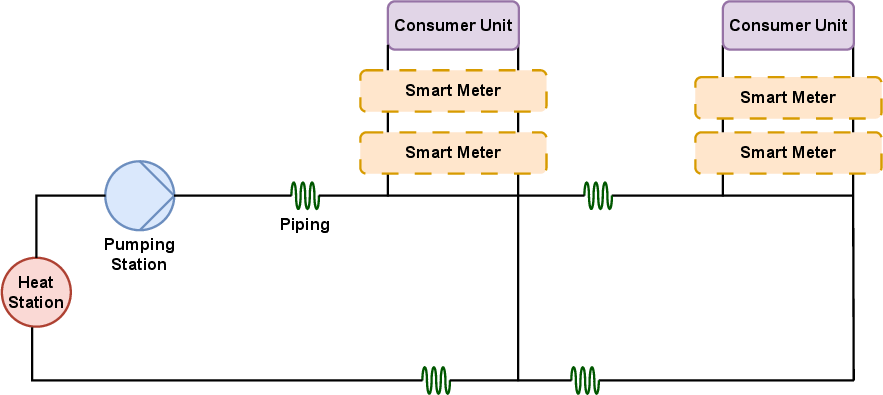
Figure 2: Block diagram of the laboratory-scale DHN topology, highlighting modular connectivity between heat station and consumers.
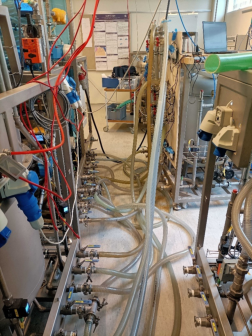
Figure 3: Hardware implementation of the experimental testbed at Aalborg SWIL, ensuring repeatable, high-fidelity data acquisition.
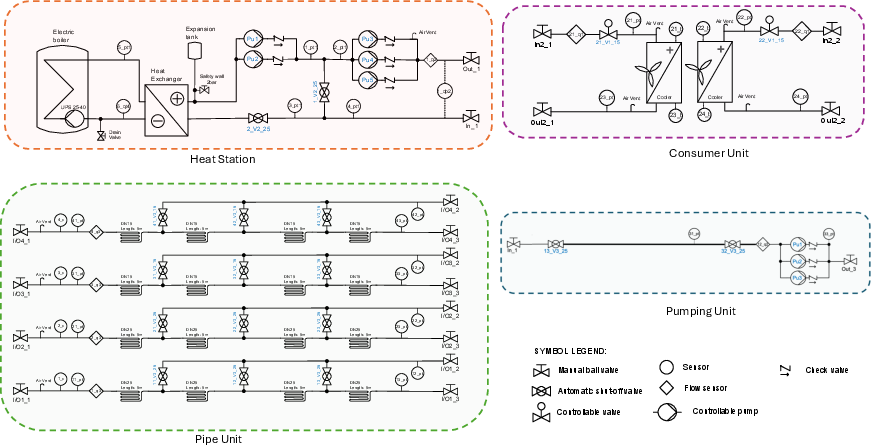
Figure 4: Detailed view of SWIL modules and input–output pairs for each pipe unit, underpinning system-level sensing coverage.
The sensor suite includes electromagnetic flow meters, pressure sensors, and Kamstrup MULTICAL® 303 smart meters for consumer-side references. Data are sampled at 0.5 Hz with rigorous synchronization, resulting in approximately 30 hours of multivariate time-series data over varying hydraulic and thermal regimes. Key operational features—such as transient and steady-state regimes, induced by variable fan speeds at consumer stations and boiler cycling—are present, rendering the dataset representative for virtual sensing estimation tasks in operational DHNs.
The task is to reconstruct unobserved or faulty measurements (especially at consumer endpoints) using available but incomplete network sensor data. The node set is partitioned by physical modality: temperature, flow, and pressure. Each node (sensor) is associated with a univariate time series; the graph edges encode sensor-to-sensor relationships—which may not correspond directly to physical proximity due to network documentation gaps, missing topology information, and domain constraints.
The core contribution is the Heterogeneous Spatial-Temporal Graph Neural Network (HSTGNN) architecture, explicitly designed for the multi-modal, partially observed structure intrinsic to DHNs.
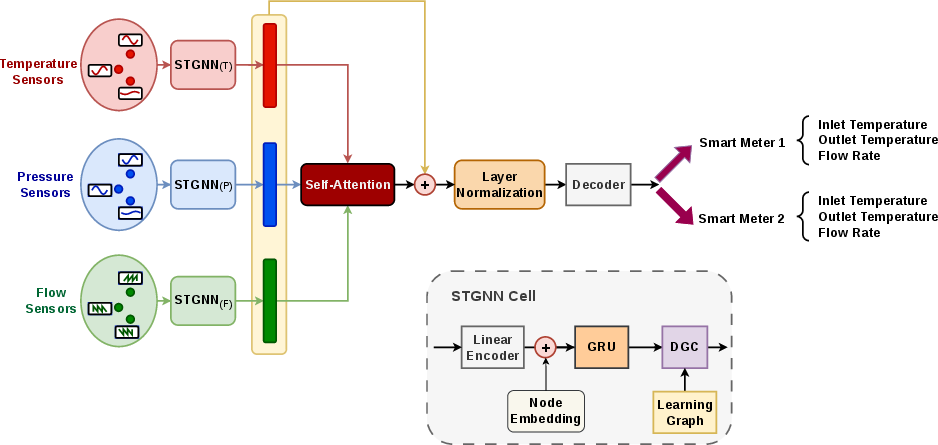
Figure 5: The HSTGNN architecture comprises dedicated branches per sensor modality, independent temporal-spatial structure learning, and a fusion stage.
Architectural Innovations
- Triple-branch Heterogeneous Design: Each sensor type (temperature, flow, pressure) is processed via a dedicated branch. These branches apply independent time-series encoders (GRUs), spatial modules built on learned latent graphs (per modality), and node-specific embeddings to encode location-specific behavior.
- Learned Sensor-type Graphs: Unlike prior approaches relying on manually constructed or fixed-topology graphs, HSTGNN learns the intra-type spatial graphs explicitly from data, employing a categorical edge sampling strategy (using GumbelTopK for differentiable neighbor selection), and propagates representations via diffusion graph convolutions.
- Cross-Type Attention-based Fusion: After intra-modal spatial-temporal modeling, representations are unified via a multi-headed self-attention block that learns how modalities influence each other. This design explicitly captures thermohydraulic couplings—e.g., flow-pressure, flow-temperature—critical for accurate soft sensing.
- Fully Data-Driven Decoding: Sensor representations are linearly mapped to the output space, allowing direct inference of target (virtual) sensor readings.
Experimental Results
Experiments benchmarked HSTGNN against a suite of baselines: GRU-GCN (temporal+graph), LSTM, 1D-CNN, DGC, and GCN. The evaluation employed leave-one-dataset-out cross-validation over four distinct operating datasets, ensuring that models were assessed in previously unseen hydraulic and thermal regimes.
Across all datasets and sensor targets, HSTGNN consistently achieves the lowest RMSE and MAE for virtual smart meter reconstruction, most substantially on temperature-related prediction tasks. In particular, HSTGNN outperforms all baselines in challenging, non-stationary scenarios, achieving inlet and outlet temperature RMSE values as low as 0.1091–0.1852 °C. Flow rate prediction is also highly competitive, with HSTGNN MAE consistently outperforming or matching other methods.
Ablation analysis demonstrates that performance degrades sharply if temperature or flow modalities are removed, clearly evidencing the importance of multi-modal fusion and supporting the claim that modality-specific modeling is critical. Pressure information, while less dominant, contributes measurable robustness improvements.
Qualitative Analysis
Time-series visualizations further corroborate the superior performance of the proposed model, particularly its ability to track rapid transitions and subtle temporal dynamics not captured by simpler spatial or temporal baselines.
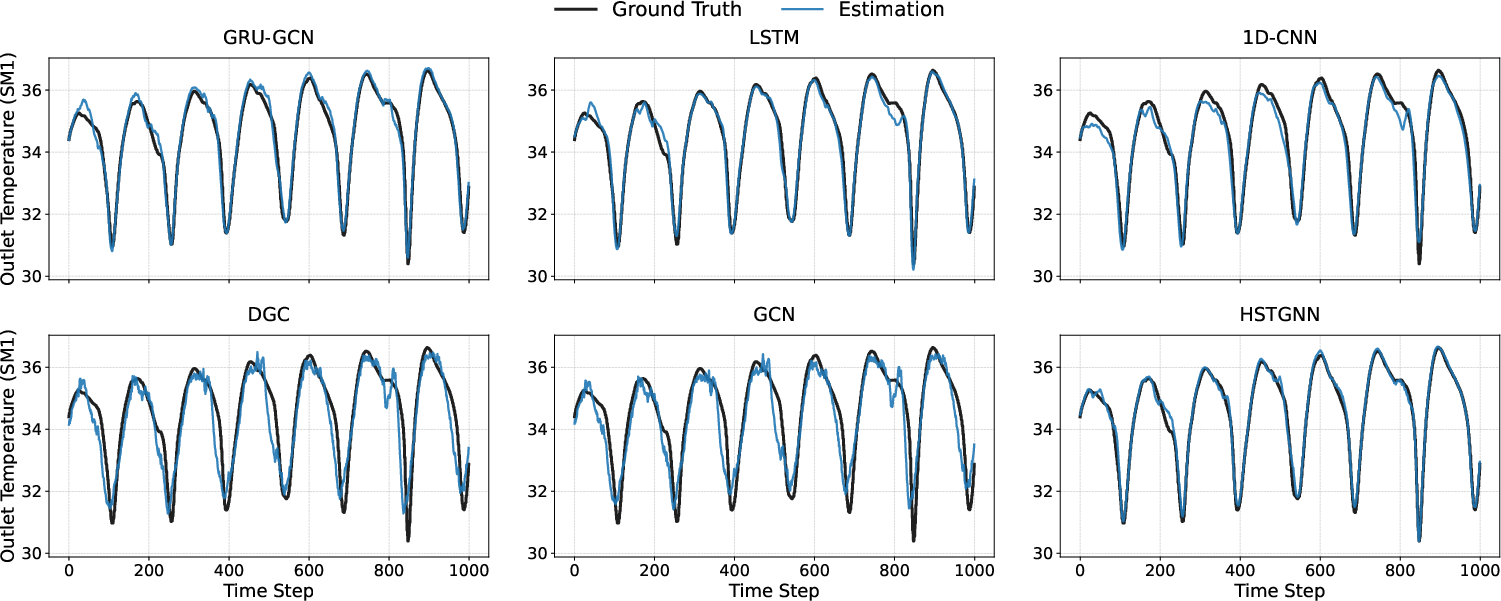
Figure 6: HSTGNN tracks the ground truth outlet temperature for SM1 in Dataset 1 tightly, with minimal deviations compared to other models.
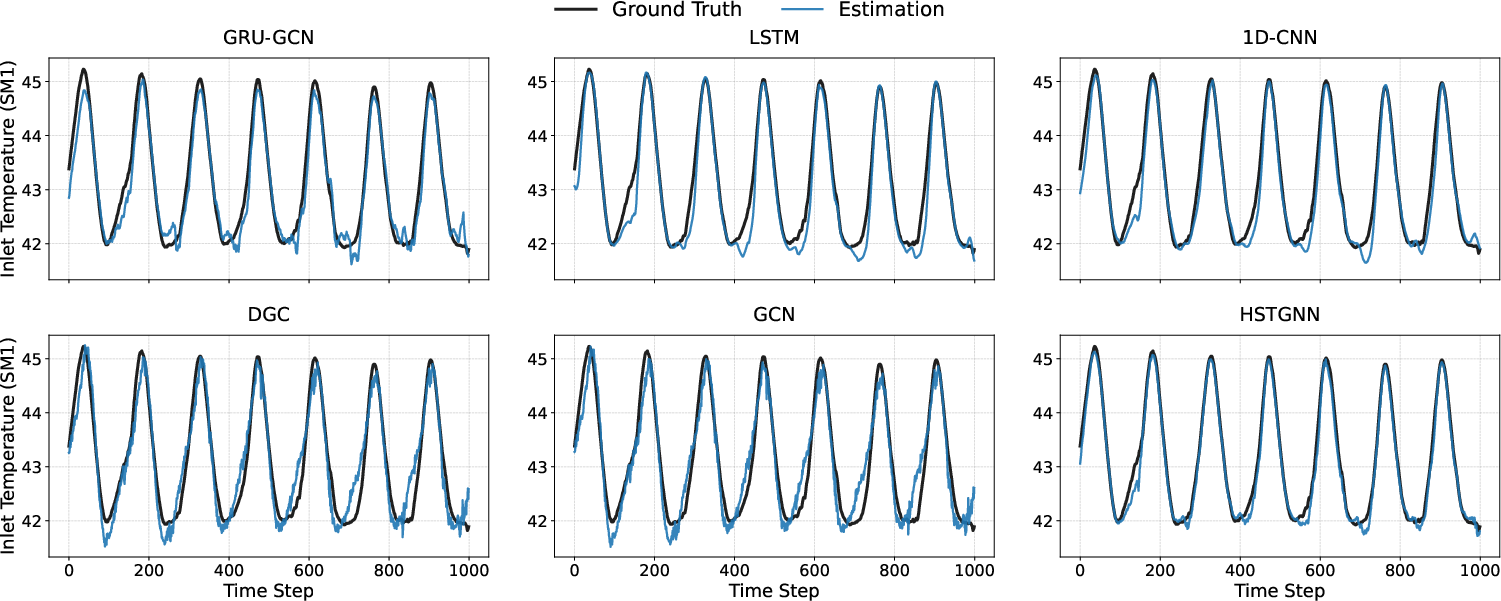
Figure 7: HSTGNN achieves strong fidelity during transient regions in inlet temperature at SM1, outperforming temporal-only and graph-only counterparts.
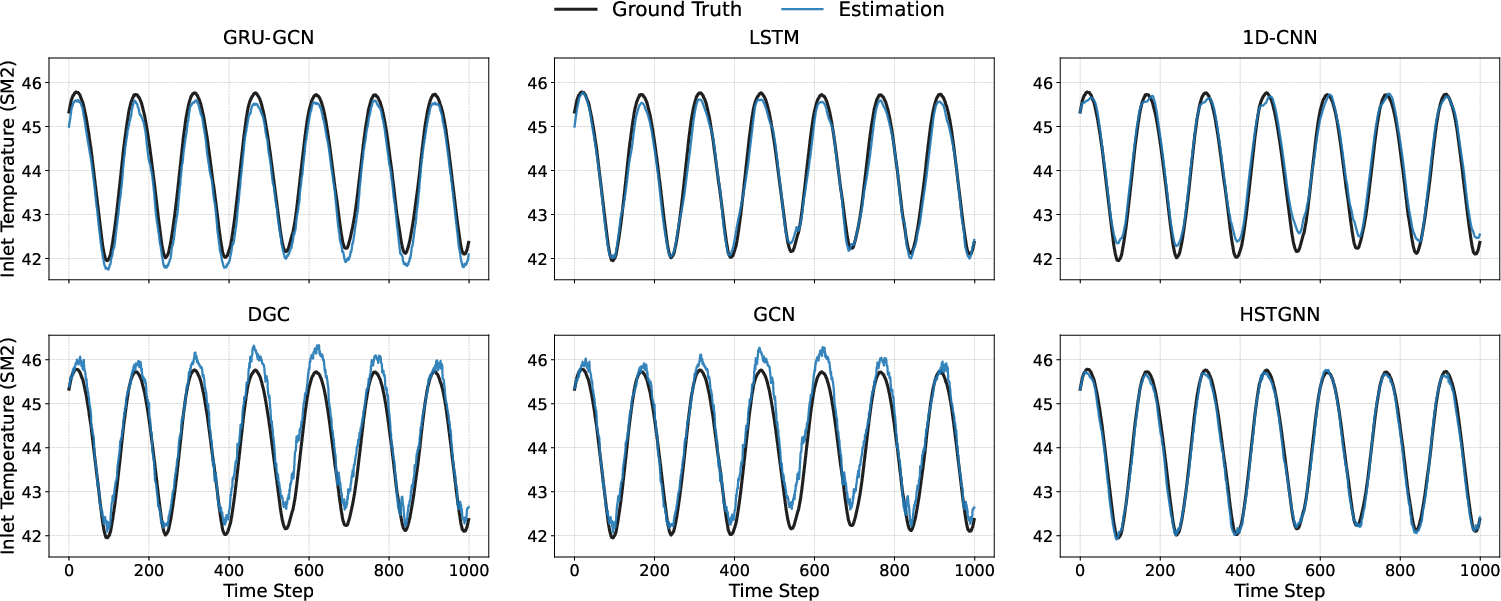
Figure 8: At SM2, Dataset 3, HSTGNN again provides the closest match to the measured inlet temperature signal.
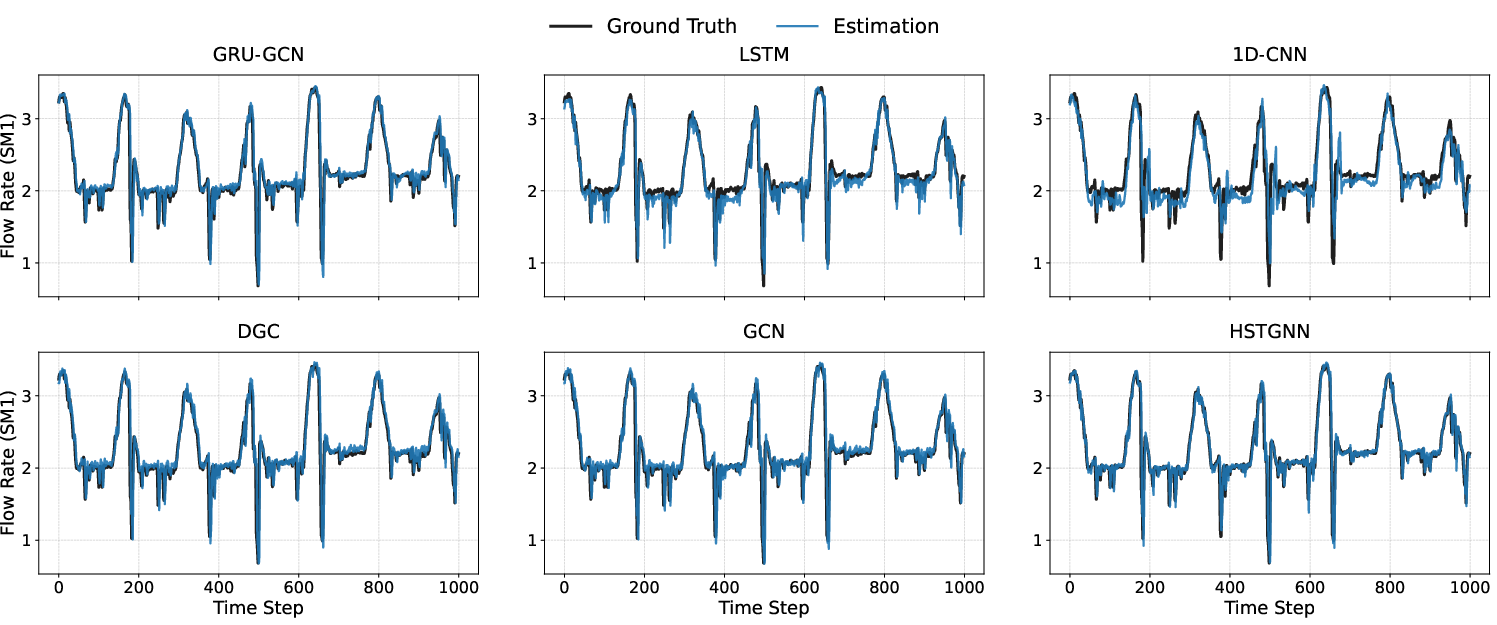
Figure 9: For flow rate prediction at SM1, Dataset 4, both HSTGNN and GRU-GCN excel, with graph-only models outperforming temporal-only baselines due to the spatial character of the dynamics.
Architectural Ablation
Removal of the heterogeneous branching and sensor-specific spatial modeling components in favor of generic encoders and self-attention results in substantial RMSE/MAE increases, justifying the full architectural complexity and the inclusion of modality-specific inductive biases for modeling DHNs.
Theoretical and Practical Implications
HSTGNN validates the crucial hypothesis that exploiting heterogeneous physical and topological characteristics in cyber-physical systems leads to substantial gains in modeling and estimation accuracy. This is particularly salient for DHNs, where physical variable evolution rates differ by orders of magnitude (e.g., pressure propagates near-sonically, temperature evolves over tens of minutes). Explicit learning of both intra- and cross-modality dependencies, with flexible graph construction rather than fixed topology, is essential for robust, generalizable virtual sensing.
The provision of a controlled, high-fidelity dataset with synchronized temperature, flow, and pressure data addresses a major reproducibility and benchmarking gap in the literature. This resource is valuable not only for direct comparison but also for future research—such as uncertainty-aware virtual sensing, integration into cyber-physical digital twins, and optimal sensor placement via graph signal processing.
On the theoretical side, this work bridges advances in GNNs for spatial-temporal forecasting, soft sensing, and multi-modal fusion, introducing a paradigm applicable more broadly to other infrastructure networks (e.g., water, power systems) with heterogeneous, partially observed, and coupled sensor configurations.
Future Directions
Potential future research includes extending branch-specific architectures to exploit domain-specific inductive biases (e.g., incorporating physics-informed priors per modality), scaling up to larger and more irregular networks, quantifying epistemic and aleatoric uncertainty for operational risk management, and integrating the approach with digital twin frameworks for real-time DHN management. Potential improvements also involve sensor placement optimization using time-vertex ML, automated adaptation to missing or faulty sensors, and domain adaptation for transferring models across cities or utility providers.
Conclusion
This paper provides a rigorous architectural and empirical foundation for virtual sensing in district heating networks via HSTGNN, establishing the superiority of explicit heterogeneous spatial-temporal modeling over traditional and homogeneous graph-based approaches. The proposed model addresses the fundamental challenges posed by modality heterogeneity, partial observability, and nontrivial thermohydraulic couplings in operational energy infrastructure. The integration of a comprehensive, reproducible experimental dataset is an important asset to the research community. Advancing this methodology will continue to facilitate intelligent, efficient, and resilient management of large-scale thermal energy networks.
Citation: "Virtual Smart Metering in District Heating Networks via Heterogeneous Spatial-Temporal Graph Neural Networks" (2604.10166)