- The paper establishes that for p = λ/n with λ > 1+ω(ln⁻¹n), nearly the entire giant component of the 2-core is uniquely reconstructible.
- It employs probabilistic methods, spectral gap analyses, and kernel reduction to connect rigidity constraints with graph expansion.
- The results resolve open questions by pinpointing a sharp phase transition and providing asymptotically tight bounds for point reconstruction.
Problem Statement and Context
The paper addresses a geometric rigidity inference problem on the real line: for a set of n real points V, and a random subset of pairwise distances defined by the Erdős–Rényi model G(V,p), what is the size R of the largest subset U⊆V uniquely reconstructible (up to isometry) from those distances? More formally, U is reconstructible if every injection φ:V→R preserving the distances on the edges of G(V,p) also preserves all pairwise distances within U. The conjecture, due to Girão, Illingworth, Michel, Powierski, and Scott, posited that for p=(1+ε)/n with fixed V0, V1 is whp linear in V2.
The paper establishes a significantly stronger result, proving that for all V3 with V4, with high probability (whp) there exists a reconstructible subset V5 covering all but V6-fraction of the largest component of the V7-core of V8. Moreover, this lower bound is asymptotically tight for sets V9 linearly independent over G(V,p)0. The result holds in the optimal regime and resolves open questions regarding the interplay between random combinatorial rigidity and threshold phenomena.
Main Techniques and Results
Model Description and Threshold Analysis
Let G(V,p)1 be a set of G(V,p)2 real numbers, and each unordered pair G(V,p)3 is included as an edge in G(V,p)4 independently with probability G(V,p)5. The notion of reconstructibility is formalized through the concept of G(V,p)6-rigid maps (distance-preserving on the edge set), with trivial rigid maps being global isometries. The goal is to bound the size of maximal subsets G(V,p)7 such that every G(V,p)8-rigid map restricts to an isometry on G(V,p)9.
The principal result is (Theorems 1 and 2):
For R0 with R1, whp a reconstructible subset covers R2 of the largest R3-core component.
This is achieved exactly at the window where the R4-core (the maximal induced subgraph where all degrees are at least two) is itself linear in size ("giant R5-core").
- For R6, giant components do not exist; maximal reconstructible sets are R7.
- The R8-core threshold exactly dictates reconstructibility: no reconstructible subset can exceed its largest component, by isometric symmetry breaking between components.
- In the global rigidity regime (where positions are adversarially chosen after the graph is revealed), analogous results only hold for much higher R9.
Kernel Reduction and Probabilistic Analysis
The analysis leverages the structural decomposition of the U⊆V0-core:
One critical technical device is to prove that, whp, for all nontrivial U0-rigid maps, there exists a large subset U1 of the kernel where all pairwise distances are preserved, i.e., the rigid map is trivial on U2. This is established via expansion properties and eigenvalue bounds for regular graphs (notably, the expander mixing lemma).
A core lemma shows that for random regular graphs with sufficiently good spectral gap, no non-trivial rigid map can differ from the identity on more than a vanishing fraction of vertices.
Probabilistic Counting and Union Bounds
The proof architecture emphasizes tight union bounds using probabilistic combinatorics:
- The total number of connected induced subgraphs is carefully controlled using degree bounds and standard combinatorial estimates.
- The count of possible rigid maps (relating to assignments of "signs" to the distance equations) is bounded by U3 for connected subsets of size U4.
- The paper leverages Chernoff bounds and local limit theorems to manage the probabilities that random paths admit non-trivial rigid extensions.
In particular, for a random path of logarithmic length in a large random graph, the probability that it admits a nontrivial non-isometric rigid map fixing its endpoints is at most U5:
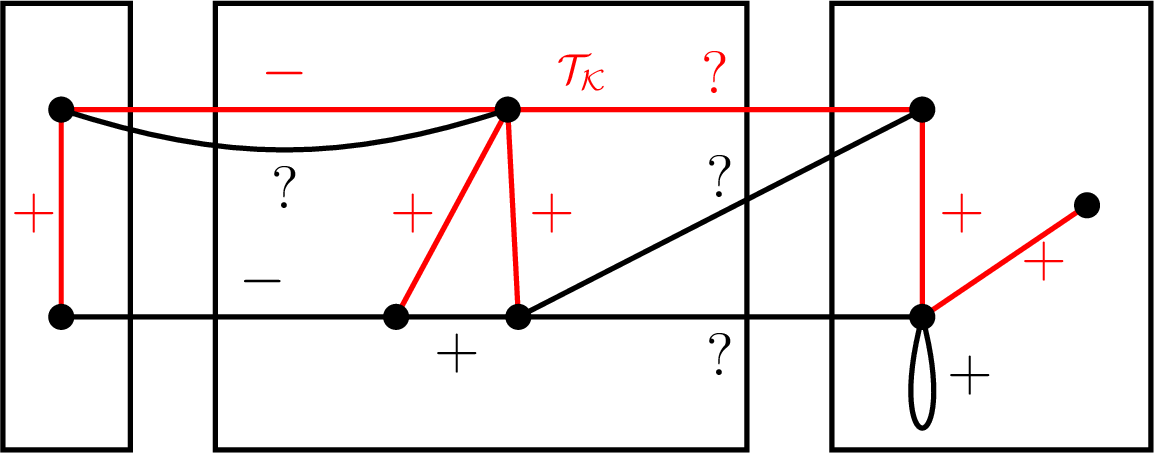
Figure 2: The structure showing how distance relations (sign choices) along paths translate into constraints on possible non-trivial rigid maps.
Expansion, Connectivity, and Small Set Exclusion
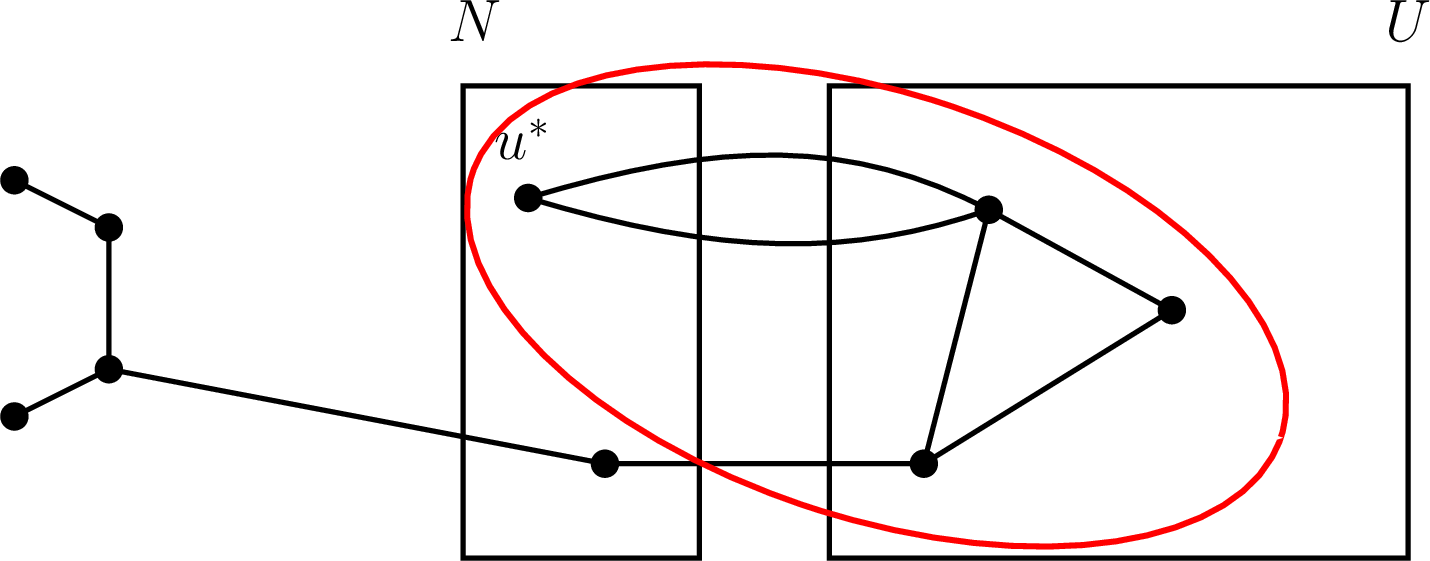
Expansion properties—inherited from the random graph's kernel—ensure that "bad" local symmetries cannot occur except on vanishingly small sets. For each U6 in the kernel, the existence of a connected set U7 containing U8 that could admit nontrivial rigid maps is shown to be exponentially unlikely unless U9 is small.
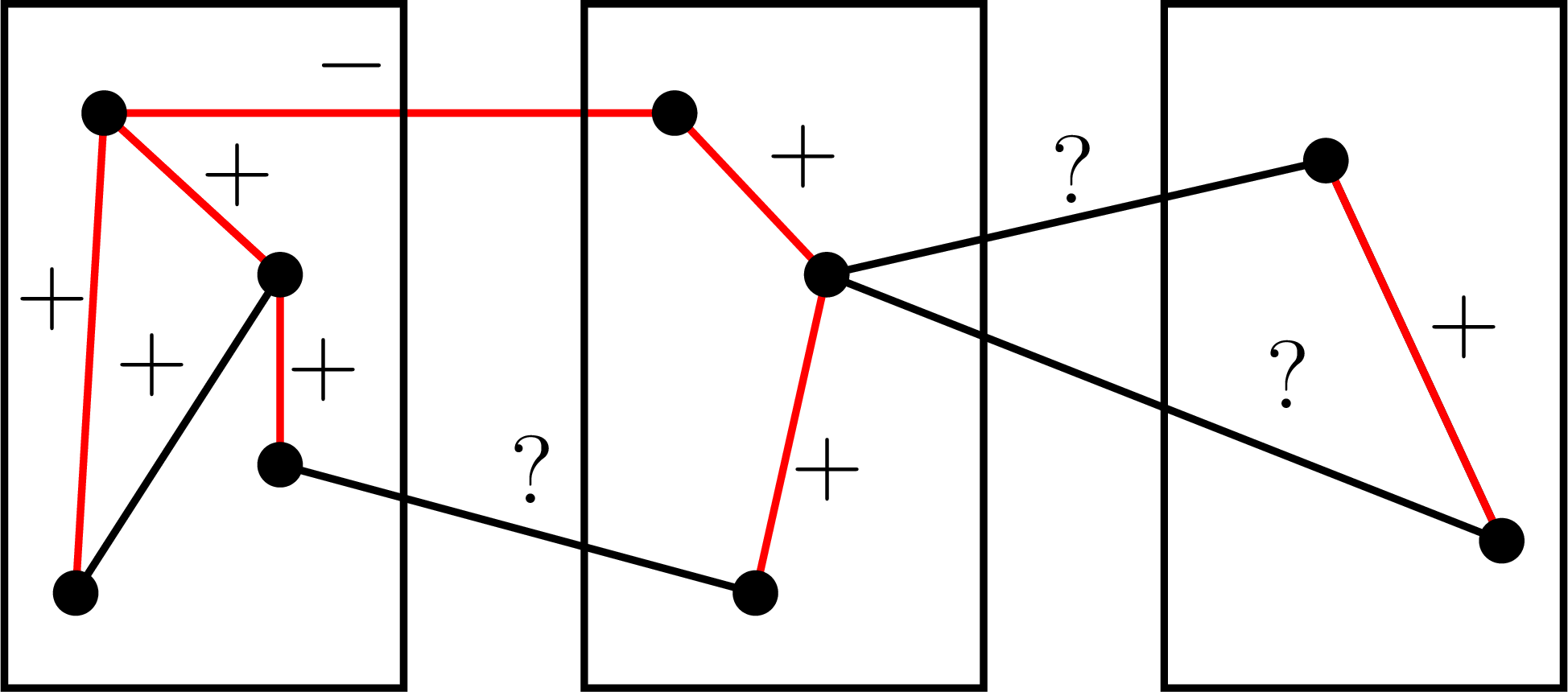
Figure 3: The configuration of a connected subset φ:V→R0 of the kernel and its neighborhood, illustrating how expansion precludes "defective" non-trivial rigid maps.
This reasoning shows that for almost every vertex, rigidity propagates fully: whp, non-trivial rigid maps cannot fix all the distances along a large induced subgraph.
Toy Example and Generalization
The paper devotes an entire section to the random regular (e.g., φ:V→R1-regular) graph case. Here, complete reconstructibility is shown whp for the whole graph, relying on the spectral gap and vertex expansion. This serves as both an intuition-building device and a rigorous test-bed for the more involved random degree-sequence case.
Applications, Implications, and Open Problems
Theoretical Implications
- The results establish a sharp threshold for reconstructibility of large point subsets, precisely matching the percolation threshold for the φ:V→R2-core in random graphs. This echoes the core philosophy of random graph theory: combinatorial and geometric properties undergo abrupt transitions at predictable thresholds.
- The asymptotic tightness of the reconstructibility lower bound (attainable for φ:V→R3-independent sets) elucidates a deep connection between additive number theory and rigidity phenomena.
- The probabilistic techniques developed here are robust and may be extensible to other geometric inference and rigidity-theoretic settings, especially in high-dimensional analogues and inverse problems.
Practical Consequences
- Distance-based graph inference (inverse Gromov problems, reconstruction from incomplete pairwise distances, applications in computational geometry, metric embedding, and molecular conformation): this paper precisely characterizes when almost all of a point set can be unambiguously reconstructed from sparse, noisy or randomly missing data.
- The expansion and spectral techniques may inform practical algorithms for robust rigidity checking in high-dimensional noisy data.
Future Directions
Several avenues are proposed:
- Sharp characterization at the "barely supercritical" regime (φ:V→R4): the asymptotics of the ratio φ:V→R5 as φ:V→R6 remains open.
- Global rigidity threshold: in the worst-case (adversarial) setting, the transition occurs much higher (φ:V→R7); understanding the gap between worst-case and random-case remains an intriguing problem.
- Potential application of these techniques to rigidity theory in higher dimensions and for other symmetric spaces.
Conclusion
The paper "Sharp threshold for reconstructing points on the line" (2604.09176) rigorously identifies and characterizes the threshold for reconstructibility of large subsets of a random φ:V→R8-point configuration from randomly sampled distances. By developing novel probabilistic techniques, detailed combinatorial analysis, and leveraging random graph theory's core tools, the work unifies insights from rigidity theory and random structures. The results reveal reconstructibility's phase transition exactly at the emergence of the giant φ:V→R9-core, prove optimal bounds, and establish a foundation for further study in geometric inference, random rigidity, and their applications.
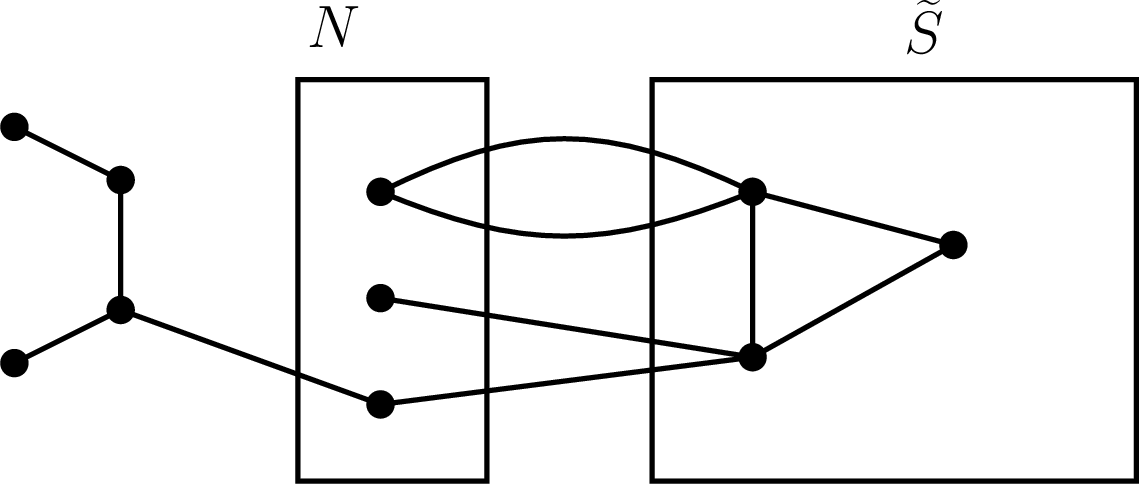
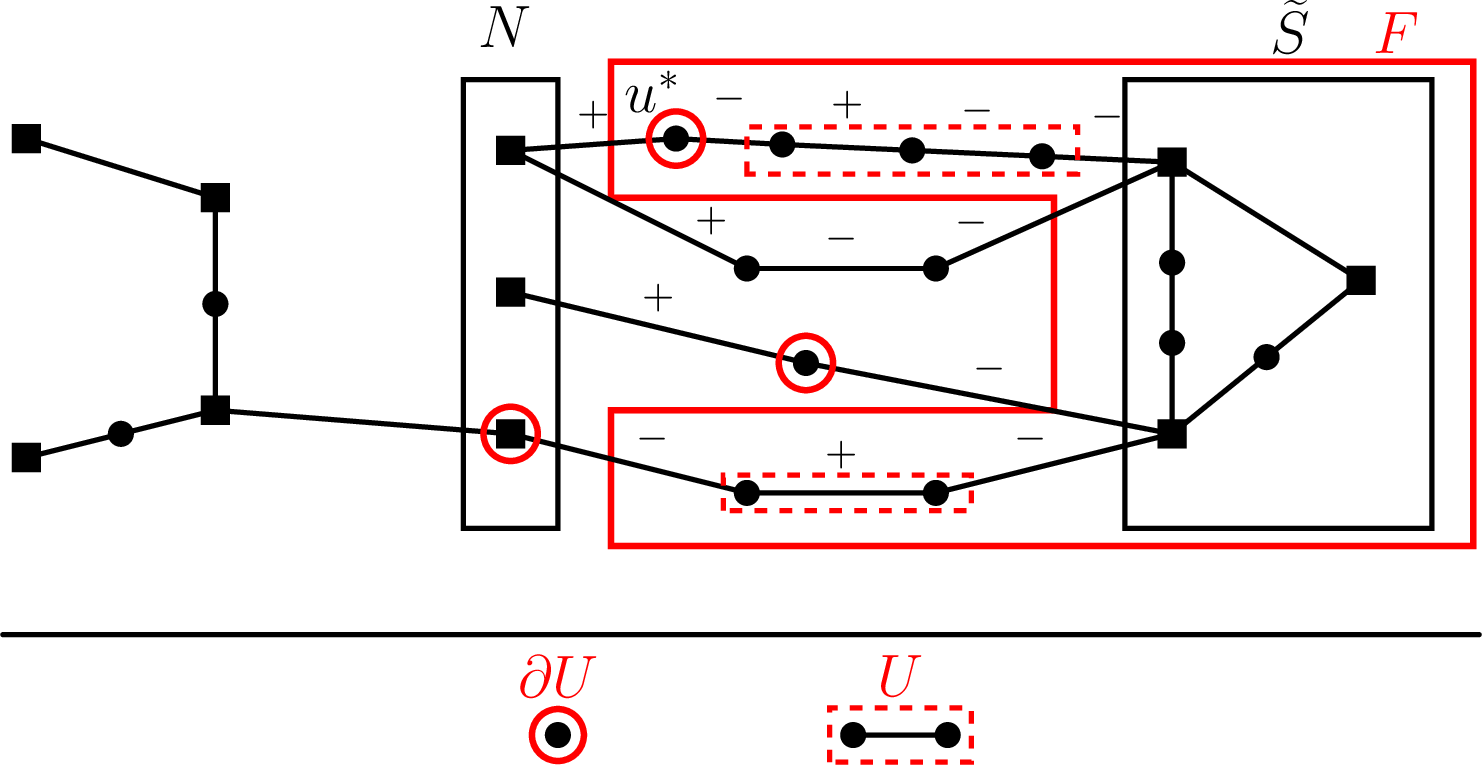
Figure 4: Structure of a connected subset G(V,p)0 with neighborhoods and path decompositions, highlighting the interplay between expansion, distance constraints, and rigidity propagation.