- The paper demonstrates that the coprecessing frame suppresses precession-induced amplitude and phase modulations, thereby improving waveform model fidelity.
- The paper employs 22 NR simulations and mismatch quantification to show enhanced agreement between NR data and aligned-spin models despite residual discrepancies.
- The paper highlights that while the coprecessing frame facilitates surrogate modeling and parameter recovery, explicit treatment of higher-order mode asymmetries remains essential.
Revisiting the Coprecessing Frame in the Presence of Orbital Eccentricity
Introduction
This work presents an in-depth analysis of the coprecessing frame's capability to disentangle precessional and eccentric features in gravitational waveforms from compact binary coalescences with both significant orbital eccentricity and spin-induced precession (2603.29307). As gravitational-wave astronomy enters an era where both effects are increasingly relevant for parameter inference and the understanding of astrophysical formation channels, there is a pressing need to critically evaluate and improve waveform modeling strategies.
Virtually all gravitational waveform models that incorporate precession utilize a coprecessing frame, defined by a time-dependent rotation tracking the dominant quadrupolar emission axis. This operation is designed to factor out the dominant precessional modulations, yielding waveform modes in a frame where precession-induced amplitude and phase modulations are suppressed, mode hierarchy is restored, and the principal mode symmetry is approximated for non-precessing systems.
The analysis demonstrates that, in the absence of precession, the coprecessing frame transformation leaves the waveform invariant. However, for binaries with high precessional spin, the coprecessing frame strongly suppresses the rich amplitude and frequency modulations seen in the inertial frame, particularly restoring the dominance of the (2,2) mode and heavily attenuating mode mixing.
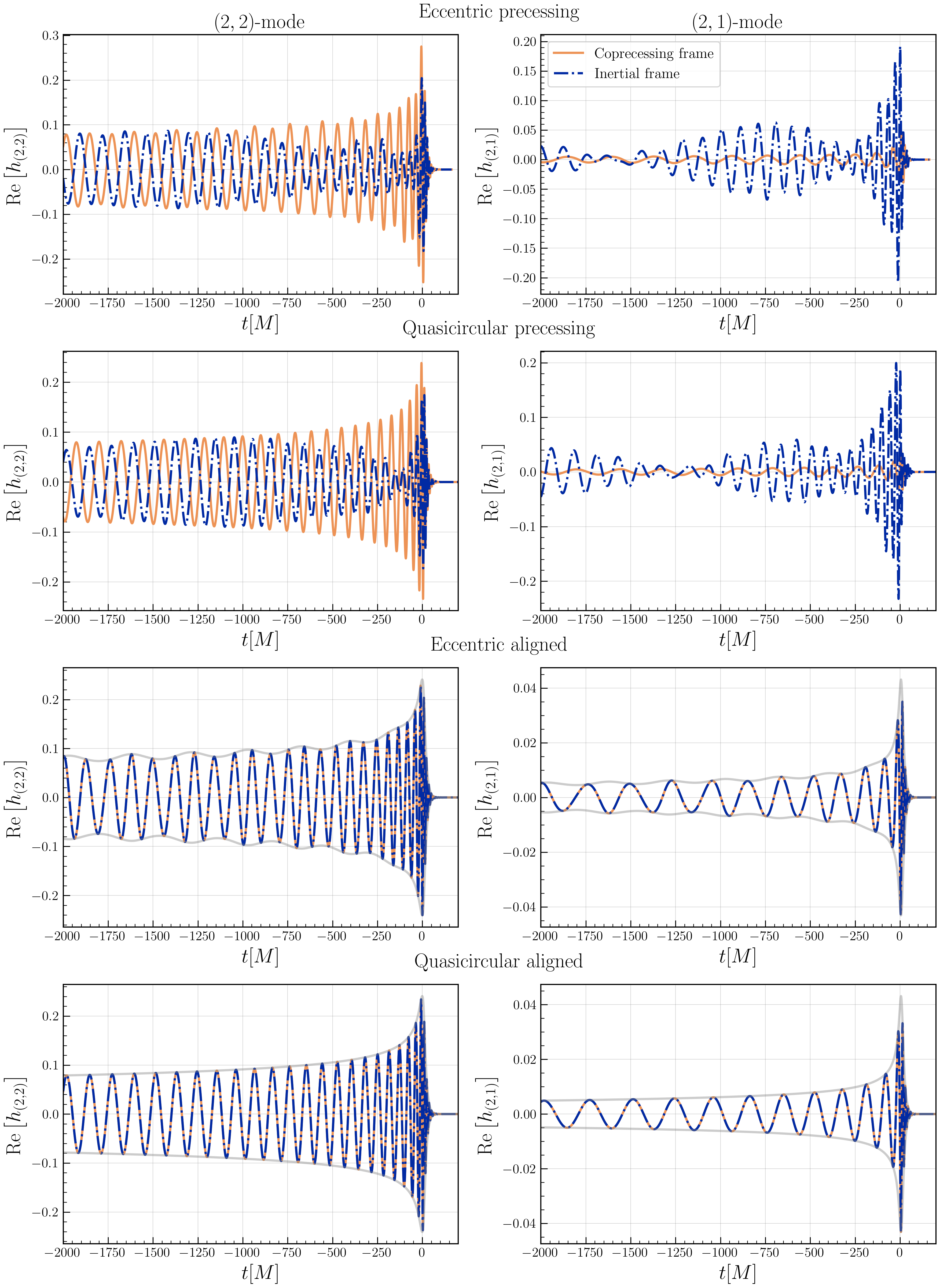
Figure 1: The coprecessing frame simplifies the complex morphology of waveform modes for various combinations of eccentricity and precession, most notably restoring mode hierarchy in precessing systems.
Moreover, even in the presence of moderate to high orbital eccentricity, the coprecessing frame simplifies the waveform morphology, suggesting that precession and eccentricity may be, to a nontrivial degree, treated as separable in the coprecessing representation.
Numerical Relativity Simulations and Mismatch Quantification
The authors employ a suite of 22 NR simulations from the SXS catalog [Scheel:2025jct], featuring both non-negligible eccentricity (e>0.01) and significant in-plane spin components. The central diagnostic for evaluating the efficacy of the coprecessing frame is the mismatch between NR waveforms and the SEOBNRv5EHM model [Gamboa:2024hli], which includes eccentricity but is restricted to aligned spins (i.e., no precession).
The mismatch results demonstrate that transforming NR data into the coprecessing frame consistently reduces mismatches across all inclinations and precessional spin magnitudes, although the resulting mismatches remain above the 10−2 threshold generally required for fully faithful parameter estimation in high-SNR events.
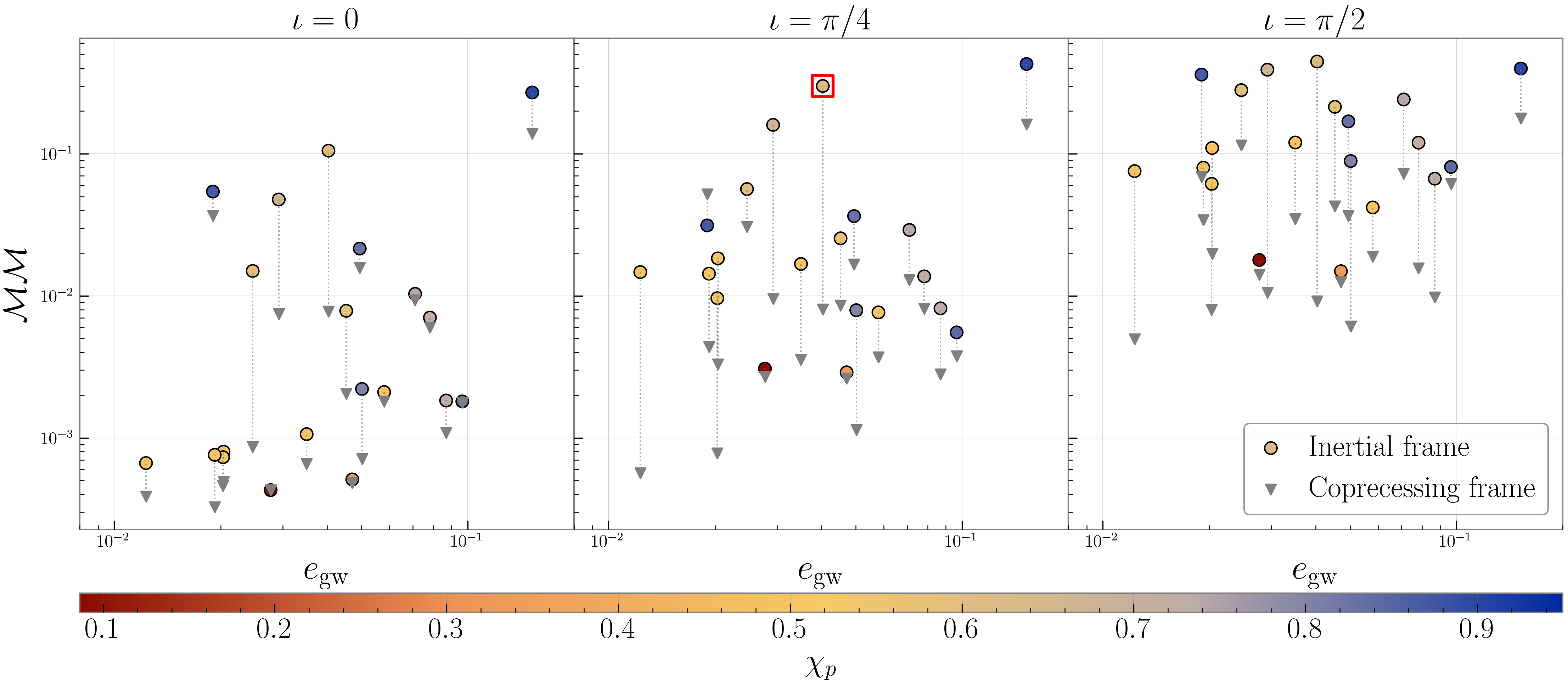
Figure 2: The coprecessing frame reduces mismatches between NR and aligned-spin EOB waveforms for all configurations and inclinations, but not below the typical modeling fidelity requirements for large precessing spins and edge-on inclinations.
The residual mismatches are dominated by higher-order effects and asymmetries in the waveform modes that are not removed by the coprecessing transformation, demonstrating that while the frame simplifies the signal, it does not fully mimic an aligned-spin system.
Detailed Case Studies and Physical Interpretation
Inspection of individual cases, e.g., SXS:BBH:3714, confirms that the coprecessing frame can transform a strongly precession-modulated waveform—in the inertial frame, highly discordant with the best-fit aligned-spin model—into a morphology closely resembling eccentric, spin-aligned predictions, at least for a majority of the inspiral phase.
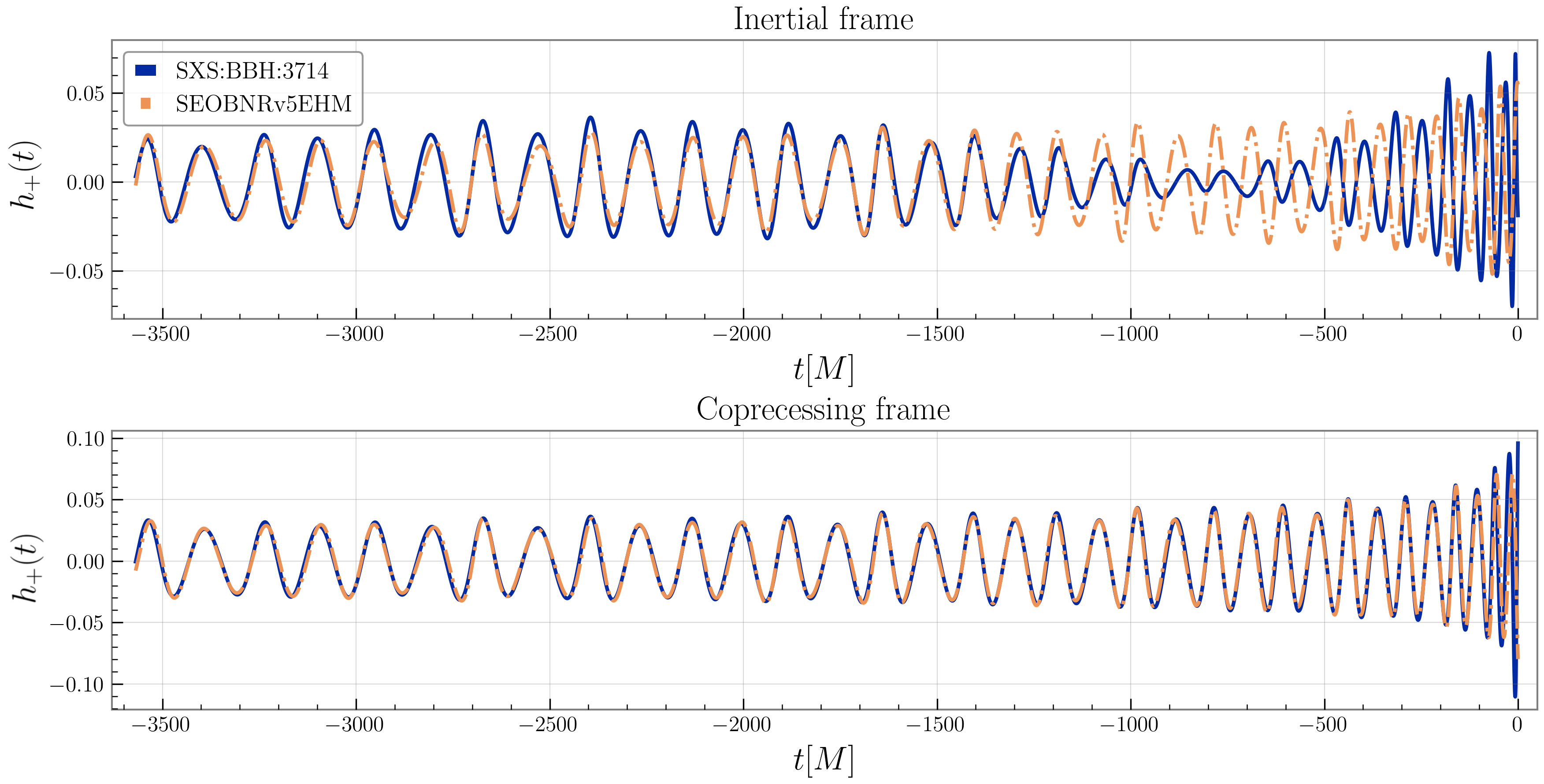
Figure 3: For a system with significant precession, the coprecessing frame almost perfectly aligns NR and SEOBNRv5EHM waveforms, elucidating the dominant role played by frame orientation in precessional morphology.
A parametric study of mismatches as a function of the effective precessing spin χp confirms that while the coprecessing frame captures the principal precessional effects, mismatches still scale with χp due to higher-order and mode-asymmetric features that are not fully trivialized by the transformation.
Systematics in Eccentricity and Parameter Recovery
A secondary analysis examines whether waveform agreement between NR and SEOBNRv5EHM in the coprecessing frame is reflected in the inferred orbital eccentricities. For most cases, coprecessing transformation improves not only mismatches but also the agreement in eccentricity extracted from waveform cycles. However, discrepancies remain—especially for configurations where agreement at early inspiral cycles wanes—highlighting residual degeneracies and waveform systematics.
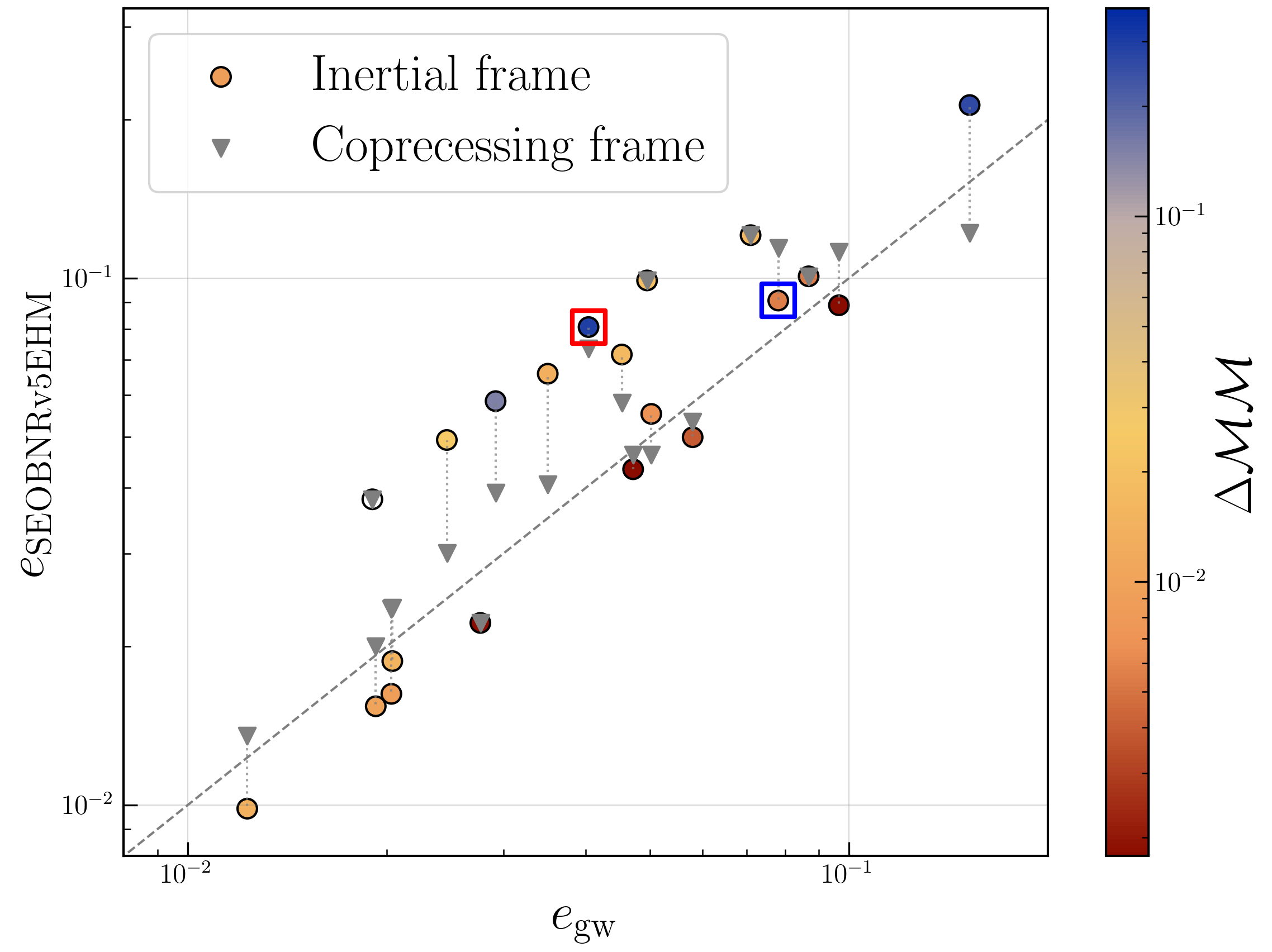
Figure 4: Comparison of eccentricity recovery from NR and SEOBNRv5EHM waveforms elucidates improved but not perfect agreement in the coprecessing frame.
Surrogate Modeling: Reduced Basis Construction
A distinct application of the coprecessing frame arises in the context of NR surrogate waveform modeling. Here, the central desideratum is not the physical interpretability of the coprecessing frame decomposition, but its utility in producing waveform components with smoother parameter dependence and minimized amplitude/phase excursions.
The authors construct reduced bases for the amplitude and phase of the leading waveform modes in both the inertial and coprecessing frames. The coprecessing frame consistently yields more rapid error decay with basis size, affirming that the transformation produces waveform features that are more amenable to compact, accurate interpolation across parameter space.
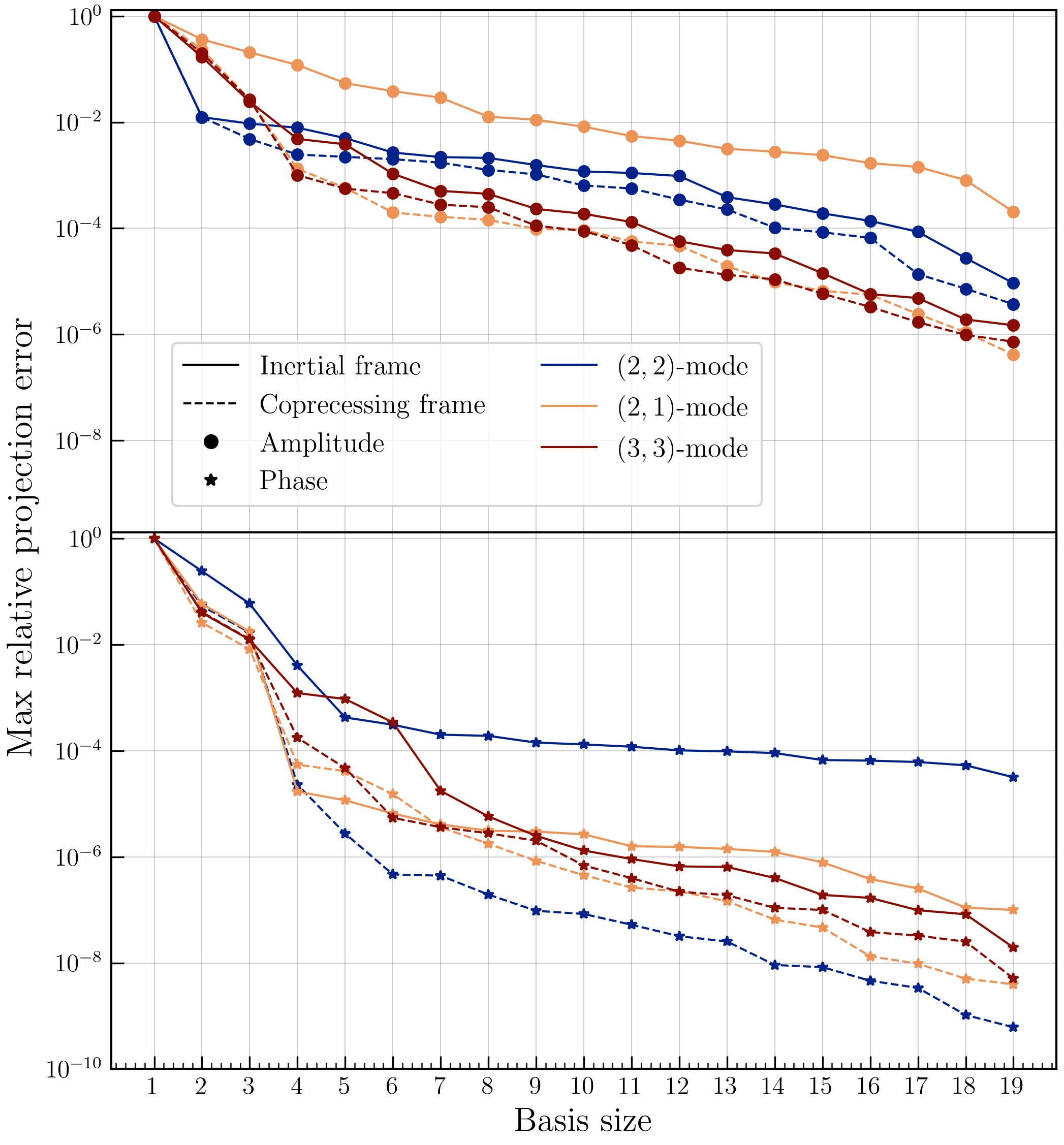
Figure 5: The coprecessing frame substantially reduces the number of basis functions needed to reach a given representation error for mode amplitude and phase.
This effect is especially acute for the (2,1) amplitude and (2,2) phase, reflecting the centrality of these features to the overall complexity of the waveform family.
Implications and Outlook
The results in this work clarify both the strengths and limitations of the coprecessing frame in the modeling of eccentric, precessing binaries:
- For analytic and semi-analytic models, the coprecessing frame continues to serve as a crucial simplification to factor out dominant precession effects. However, achieving high-fidelity waveform models will require explicit modeling of residual mode asymmetries and higher-order mode features not trivialized by the transformation, especially at high inclination or high precessing spin.
- In the surrogate modeling paradigm, the coprecessing frame retains clear value as a tool for basis size reduction and model interpolation efficiency, even when the waveform's physical interpretation in this frame is less central.
- Parameter recovery and systematic errors: The coprecessing transformation improves model-system agreements in both waveform and derived eccentricity, but is not sufficient to eliminate residual systematics, especially in high-spin/high-eccentricity corners of the parameter space.
Conclusion
The coprecessing frame transformation, when revisited in the context of non-negligible orbital eccentricity, retains essential utility for both the analytic and surrogate modeling communities. Nonetheless, as waveform modeling for eccentric and precessing compact binaries matures, addressing residual discrepancies through explicit modeling of mode asymmetries and beyond-quadrupole dynamics remains a necessary trajectory. The findings here delineate the regime of validity for current coprecessing-based models and provide clear benchmarks for future model improvements relevant to both detection and precision inference with advanced GW detector networks.