- The paper introduces a specialized hardware accelerator, MCPT-Solver, which co-optimizes stochastic MTJ devices with Bayesian inference to significantly improve Monte Carlo particle transport simulations.
- The methodology combines a tunable true random number generator with a sequential control circuit, achieving superior randomness quality, low mean squared errors, and robust PVT tolerance.
- System evaluation demonstrates drastic speedup over CPU implementations and precise simulation accuracy, positioning the design for scalable scientific and engineering applications.
MCPT-Solver: Spintronic Probabilistic Hardware for Accelerated Monte Carlo Particle Transport
Introduction
The paper "MCPT-Solver: An Monte Carlo Algorithm Solver Using MTJ Devices for Particle Transport Problems" (2603.28042) presents a domain-specific hardware accelerator designed to efficiently solve Monte Carlo (MC) particle transport problems, addressing the fundamental architectural mismatch between stochastic MC algorithms and deterministic von Neumann hardware. The core innovation lies in co-optimizing a Bayesian-inference-enabled true random number generator (TRNG) with stochastic switching magnetic tunnel junctions (MTJ) and dedicated circuit architecture to deliver tunable, high-entropy, PVT-tolerant randomness. The work establishes significant improvements in both sampling quality and system-level MC inference efficiency, particularly for irregular, memory-bound workloads such as MC-based particle transport.
Background and Motivation
MC particle transport is computationally burdensome due to inherent randomness, non-coalesced memory access, and branch divergence. Profiling with the OpenMC Pincell benchmark reveals that cross-section evaluation (XS), critical for particle advancement and collision processing, incurs dominant cache miss penalties (up to 66% of execution time in XS), exacerbated by random sampling and data locality failures in traditional architectures.
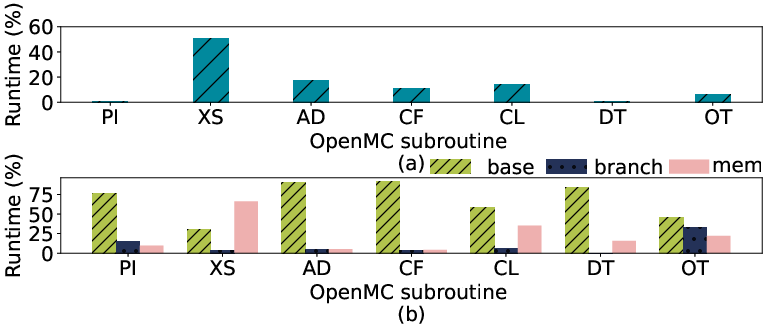
Figure 1: XS subroutine profiling in OpenMC highlights cache-miss-dominated execution profiles in MC particle transport simulation.
Recent research indicates that spintronic devices, and particularly stochastic MTJs, serve as excellent high-entropy, low-power TRNGs, yet prior architectures either generate only fixed-distribution uniform randomness or present poor PVT tolerance. This results in suboptimal sampling accuracy and reliability for MC applications. Conventional digital pseudo-random number generators (PRNGs) such as LCGs or LFSRs are further limited by predictability. Thus, a robust, distribution-programmable, process-variation-resistant TRNG is required to align hardware execution with physical MC process models.
MCPT-Solver Architecture
Physical Principles of MTJ-Based Randomness
MCPT-Solver leverages stochastic switching in STT-driven MTJs as the entropy source. Here, thermal noise modulates the time scale and likelihood of switching between high-resistance (AP) and low-resistance (P) states, controlled via bidirectional write voltage pulses.
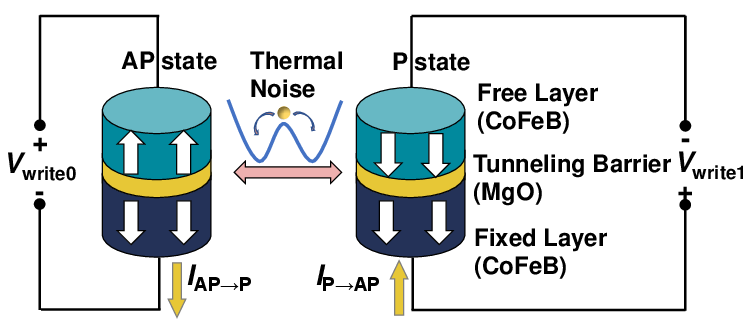
Figure 2: Schematic of the MTJ device structure and stochastic switching process essential for probabilistic sampling.
The probability of a state transition is continuously controlled via voltage, enabling the encoding of arbitrary distribution functions in random number generation.
Bayesian Inference Network
A key architectural feature is a Bayesian inference network implemented in hardware, which chains multiple MTJ switching elements, each parameterized by its parents' current state, thus supporting conditional probability sampling.
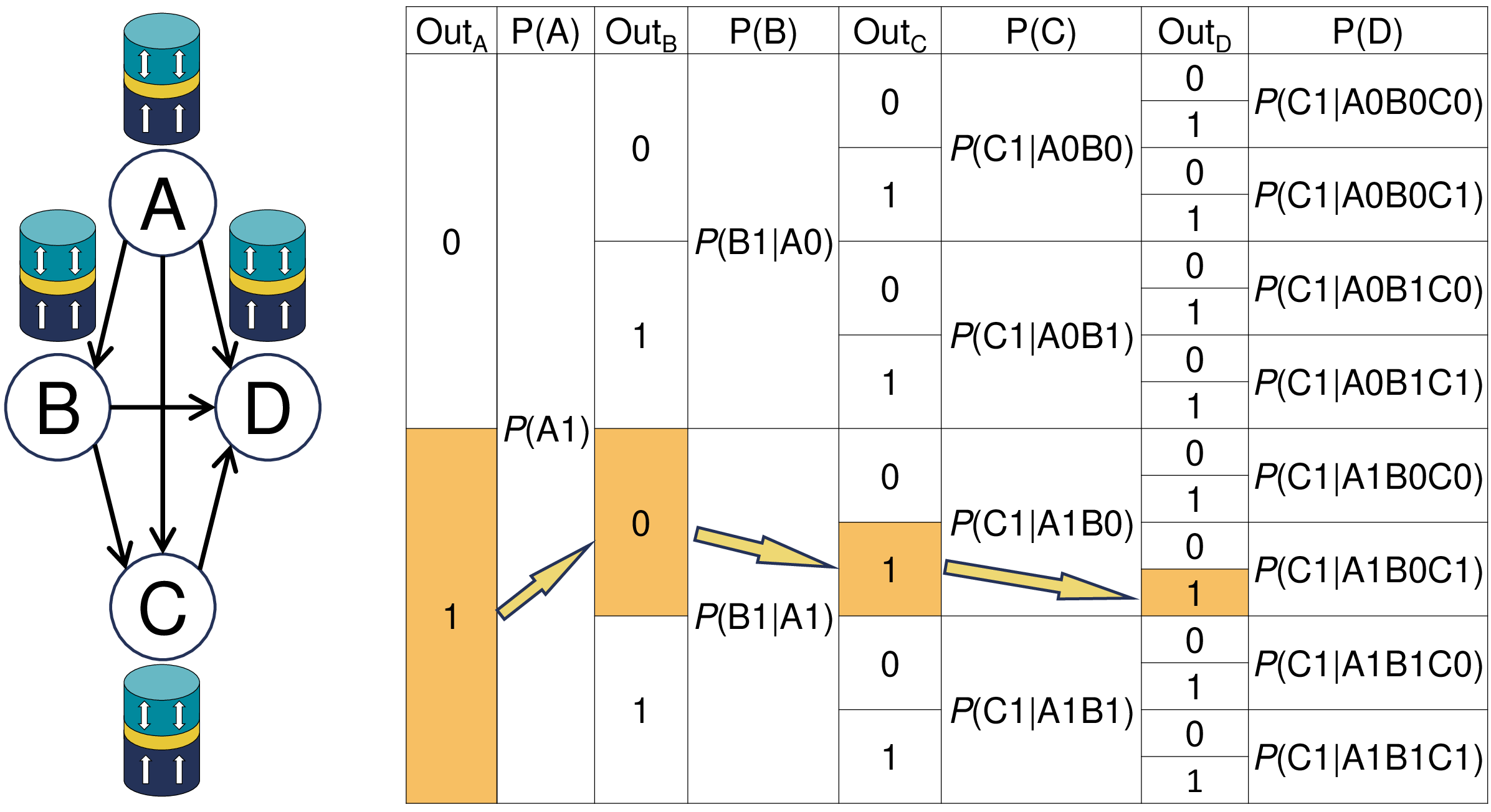
Figure 3: Example of a four-level MTJ-based Bayesian inference network, demonstrating conditional probability encoding of multi-bit random outputs.
This configuration allows the MCPT-Solver to synthesize arbitrary discrete probability distributions—uniform, Gaussian, or domain-matched cross-section tables—by programmable voltage control (via a VDD decoder).
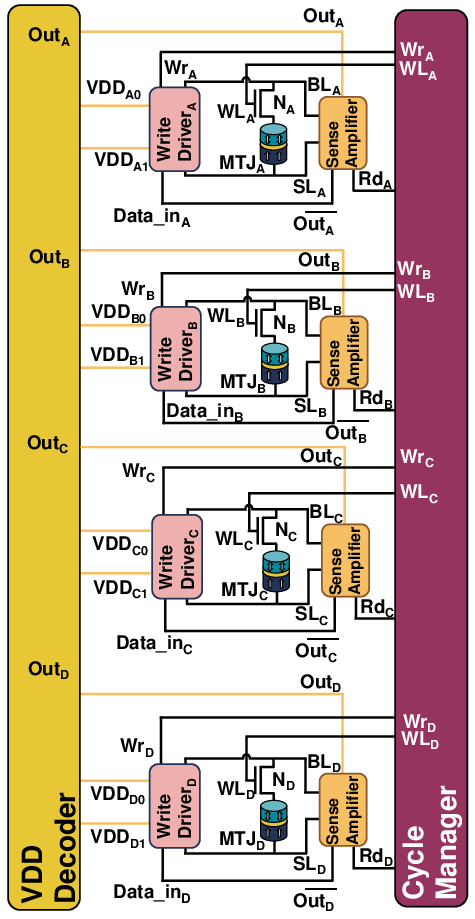
Figure 4: Circuit-level block diagram of MCPT-Solver illustrating integration of BRNGs, write drivers, and conditional voltage decoders.
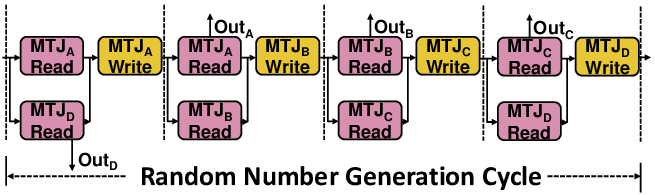
Figure 5: Control logic overview for sequential and conditional MTJ switching, implementing probabilistic state evolution and output registration.
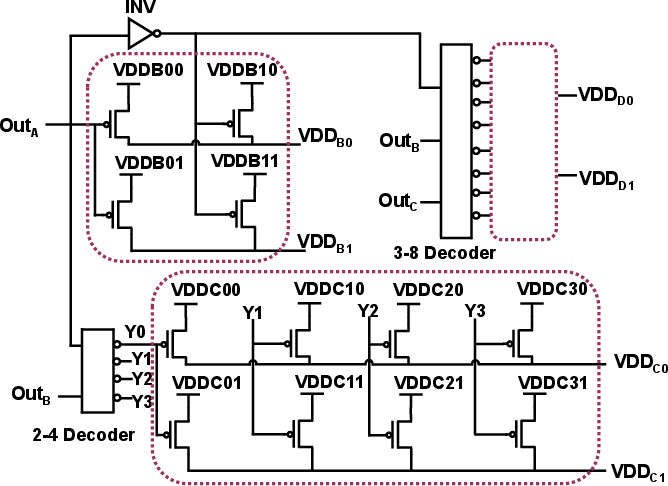
Figure 6: VDD decoder, a critical block for hierarchical conditional voltage selection based on BRNG output history.
Sequential Control and PVT Tolerance
The design enables pipelined, sequential updating of MTJ outputs, synchronized to sampling windows, and uses write voltage compensation to maintain distribution fidelity under process-voltage-temperature variation.
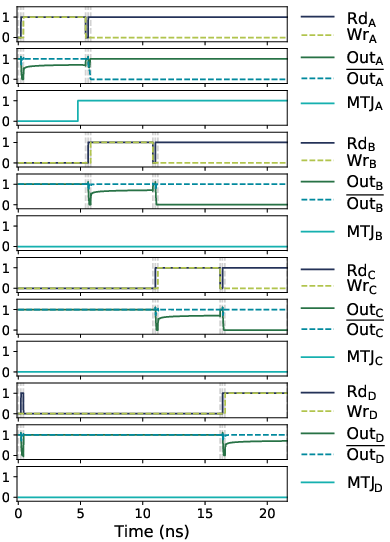
Figure 7: Sequential timing and switching control—each MTJ output is calculated conditioned on prior outputs for precise probabilistic state generation.
Randomness Quality and Variation Resilience
Random outputs from MCPT-Solver pass all standard NIST randomness tests with p-values far above rejection thresholds, demonstrating high entropy and low bias. Under significant temperature shifts (±60 K), MCPT-Solver maintains Gaussian distribution shape and achieves one to two orders of magnitude lower mean square error (MSE) compared to prior configurable TRNGs.
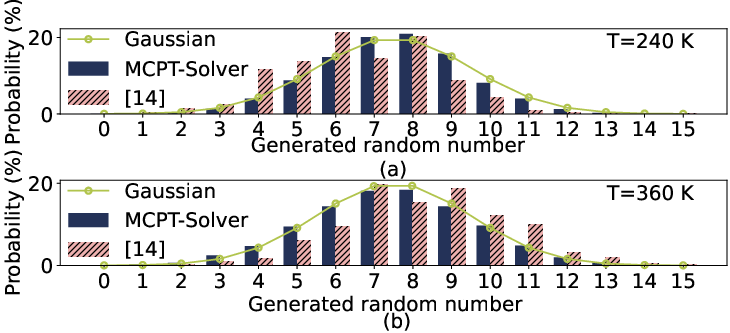
Figure 8: Random number distribution versus ideal and a prior SOT-based TRNG method, under varying temperatures—MCPT-Solver shows strong robustness.
Hardware Evaluation
MCPT-Solver is benchmarked under comprehensive PVT variation. For MC simulation workflows, voltage perturbations up to ±15% introduce minimal degradation in distribution accuracy, with MSE and sum-squared-errors (SSE) significantly lower than competing designs.
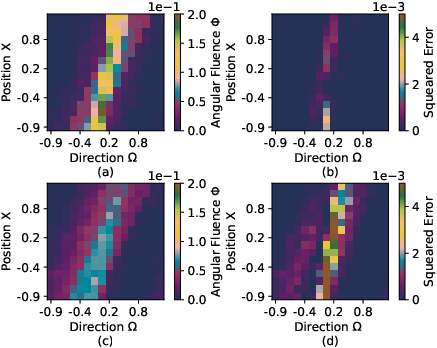
Figure 9: Solution accuracy (and squared error) under −15% voltage deviation, demonstrating MCPT-Solver's resilience.
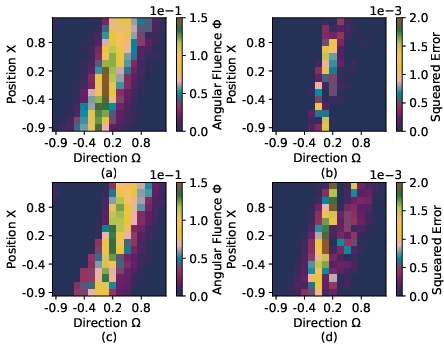
Figure 10: Solution accuracy (and squared error) under +15% voltage deviation, further confirming PVT tolerance.
System-Level Monte Carlo Simulation
Particle Transport Model
A Markov-based spatial particle transport model is solved, with MCPT-Solver providing native random samples for discrete position-angle state evolutions. The simulation implements non-uniform (Gaussian) scattering kernels, mapping directly onto the hardware's programmable Bayesian network.
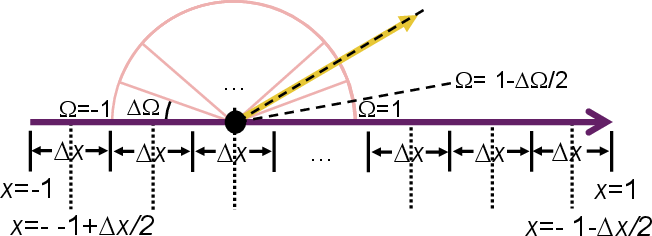
Figure 11: Discrete model of spatial particle transport with P(t)-governed scattering; state transitions are sampled from hardware-generated distributions.
MCPT-Solver yields an overall MSE of 7.6×10⁻⁶ for angular flux density compared to high-precision software MC with 104 trajectories, indicating that loss in physical accuracy is negligible.
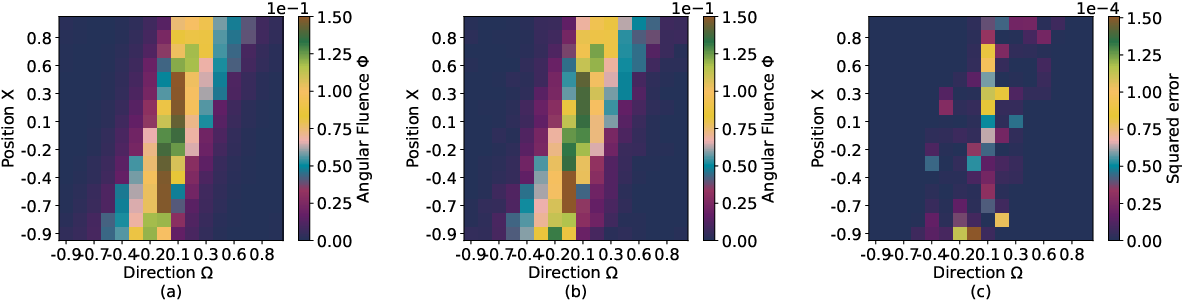
Figure 12: MCPT-Solver hardware-based solution versus CPU baseline and associated pointwise squared error.
Monte Carlo workflows on CPUs are bottlenecked by random control flow and cache misses, with per-particle processing time spanning 21.9 μs to 30.4 μs. MCPT-Solver generates 4-bit random numbers per $21.6$ ns, corresponding to drastic per-sample speedup, since both sampling and cross-section lookup are merged in local probabilistic hardware.
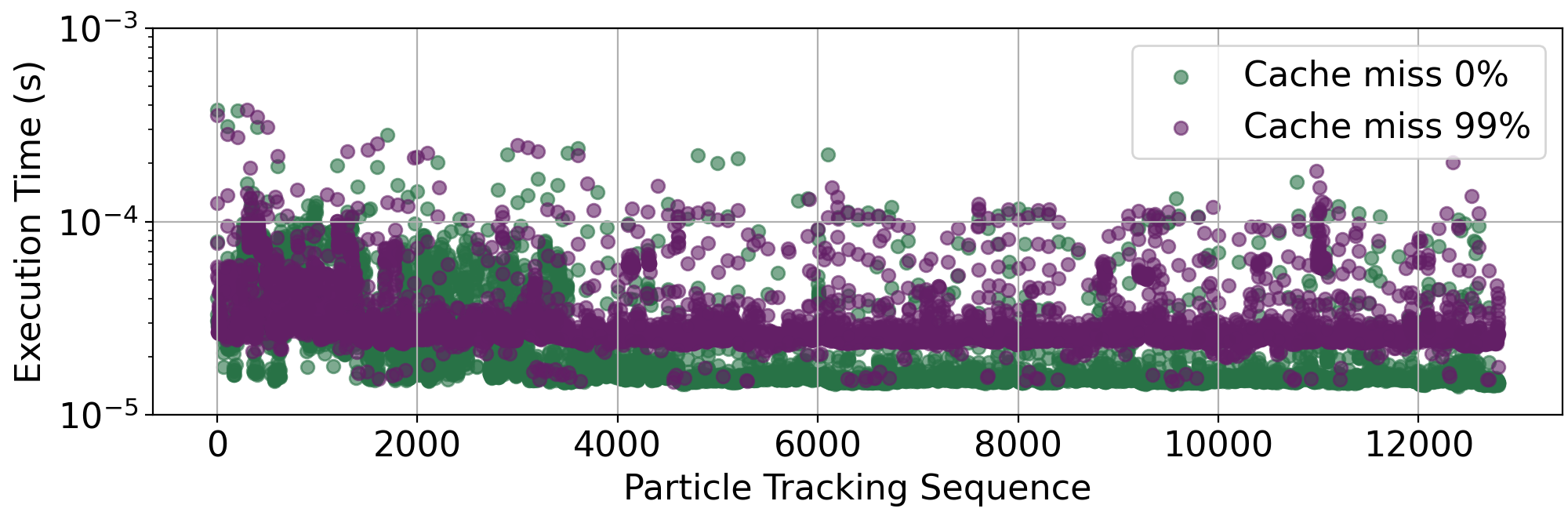
Figure 13: CPU time per particle (low/high cache miss). Software MC is disadvantaged by memory/system architecture, in contrast to MCPT-Solver.
Hardware Metrics and Comparative Analysis
The post-layout MCPT-Solver implementation (GPDK045) demonstrates a compact footprint (±15%0/bit), bit throughput of ±15%1 Mb/s, and energy cost of ±15%2 pJ/bit—exceeding or equaling prior STT-MTJ TRNGs except for ultra-optimized cases with narrower function coverage.
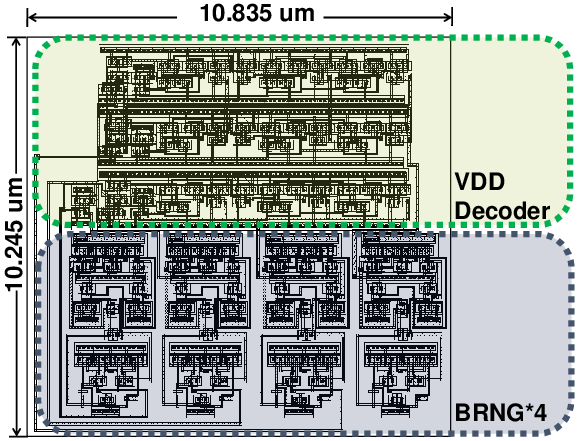
Figure 14: Final circuit layout of MCPT-Solver showing high-density integration.
In terms of function and robustness, MCPT-Solver is the only existing design to provide both true randomness, probability distribution configurability, and strong PVT tolerance in a single integrated solution. Competing probabilistic hardware approaches either require large digital area (LFSR-based TreeGRNG), lack true randomness/entropy, or are highly susceptible to process drifts.
Implications and Future Directions
MCPT-Solver demonstrates the efficacy of mapping physical stochastic phenomena (here, spintronic device-level noise) directly to computational kernels in scientific computing. Its architecture is generalizable to other stochastic workloads in AI, Bayesian inference, and probabilistic neural computation. The realization of direct mapping from physical random process to application-level probability distribution marks a significant advance in hardware-algorithm co-design for scientific and engineering MC simulations.
Scaling the architecture via MTJ array parallelism and optimizing the processor-to-TRNG data path are plausible next steps toward realizing real-world system co-processors for particle physics, medical MC modeling, and probabilistic ML.
Conclusion
MCPT-Solver provides a robust, compact, and efficient hardware solution for MC particle transport, outperforming prior spintronic and digital TRNGs in randomness quality, statistical fidelity, and environmental robustness. Its integration of a Bayesian inference network enables programmable distribution sampling, crucial for non-uniform stochastic simulations. This work positions MTJ-based probabilistic hardware as a foundational building block for next-generation scientific computation accelerators, narrowing the gap between physical process simulation and computing substrate.
Cited as:
"MCPT-Solver: An Monte Carlo Algorithm Solver Using MTJ Devices for Particle Transport Problems" (2603.28042)

