- The paper demonstrates that engineered correlated disorder in DUT-8 MOF can serve as a solid-state chemical reservoir, enabling high-fidelity classification tasks.
- The methodology employs Monte Carlo sampling and X-ray diffraction to convert disordered states into a 27-channel computational fingerprint.
- The study shows that temporal dynamics driven by synthetic chemical fields introduce history-dependent responses, confirming significant memory effects.
Solid-State Reservoir Computing via Responsive Disorder in DUT-8 MOF
Introduction and Motivation
Reservoir computing leverages dynamic, nonlinear physical substrates with memory effects to perform machine learning tasks in an energy-efficient manner. While most physical reservoirs explored to date operate at macro- or meso-scales, the study "Responsive Disorder in a Metal-Organic Framework Enables Solid-State Reservoir Computing" (2602.18335) demonstrates the potential of atomic-scale reservoir computing based on correlated disorder within a crystalline solid. The authors specifically use the MOF DUT-8, a dabco-linked Ni2-carboxylate system that exhibits a complex, guest-responsive landscape of disordered configurations, to show that engineered disorder can be exploited for neuromorphic computation. This work establishes DUT-8 as a solid-state, chemically-controlled reservoir, offering a pathway toward energy-efficient, high-density unconventional computing devices.
DUT-8's structure exhibits correlated disorder, primarily due to its 2,6-naphthalene-dicarboxylate (ndc) linkers inducing up/down shifts in the linked columns. These shifts are not random but constrained by network topology, creating a manifold of allowed configurations mapped onto the six-vertex model—a classic complexity-theoretic construct. There exist exactly six configurations per channel, which form the basis for a large ensemble of disordered, degenerate states, as illustrated by the jigsaw-tile mapping of the configuration space.
Exposure to guest molecules such as DCM or DMF actuates reversible disorder–disorder transitions, biasing the system toward different regions of its configurational landscape. This guest-induced structural plasticity is reflected in the diffuse scattering features of X-ray diffraction, which encode the system's current state and serve as a readout for computation.
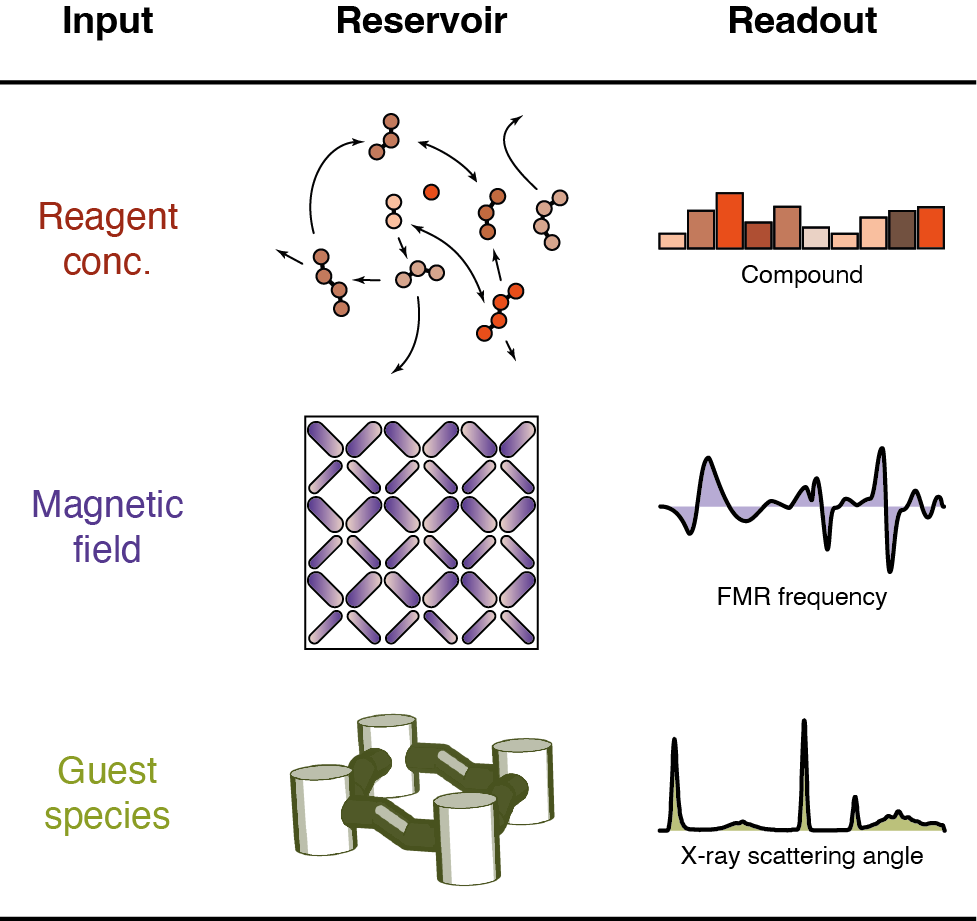
Figure 1: Examples of chemical and physical reservoir systems, with the DUT-8 reservoir relying on columnar rearrangement and X-ray diffraction for input and readout, respectively.
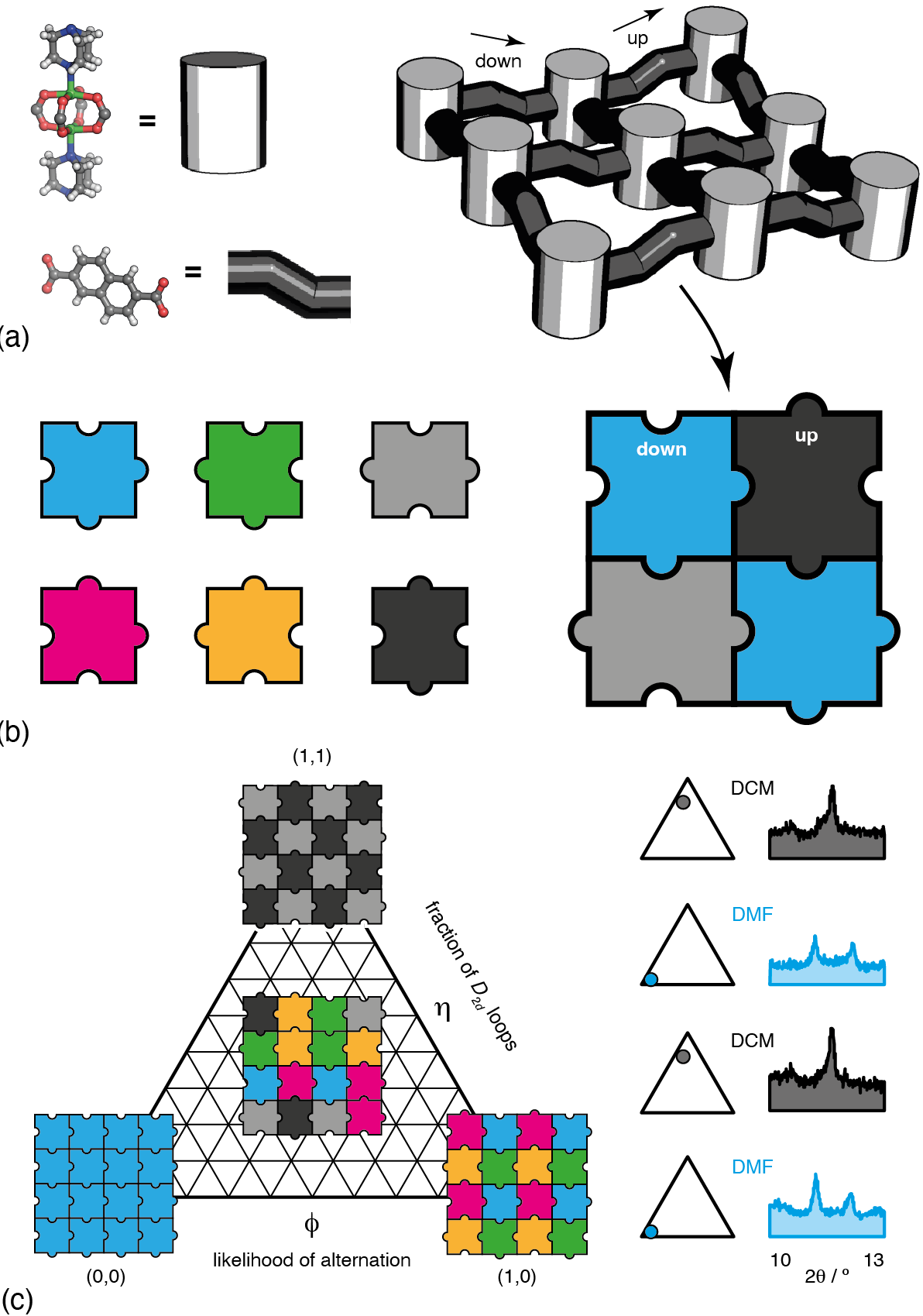
Figure 2: Schematic and configurational landscape of DUT-8, with up/down shifts, jigsaw-tile representations, and the triangular projection of accessible disordered states under chemical bias.
To probe the suitability of DUT-8 as a reservoir, the authors generate an extensive set of disordered configurations using MC sampling under periodic boundary conditions. These configurations are projected onto (ϕ,η) coordinates that quantify up/down alternation and the relative fraction of a high-symmetry channel type. For each configuration, the team computes the resulting X-ray diffuse scattering pattern within a defined angular window, discretizing these into a 27-channel fingerprint that serves as the reservoir's observable output.
Classification tasks are executed by mapping these outputs to nonlinear target functions (e.g., logical gates) using a linear support vector classifier. The system demonstrates strong nonlinear separation, achieving high accuracies comparable to leading chemical (formose) and mesoscopic (spin-vortex ice) reservoirs. Critically, classification error is predominantly observed at function boundaries.
A direct comparison against classification on raw (ϕ,η) input highlights the nonlinear enhancement provided by the reservoir: the reservoir-based model achieves superior performance, especially for highly nonlinear target functions, underscoring the sufficiency of DUT-8's responsive disorder for computational utility.
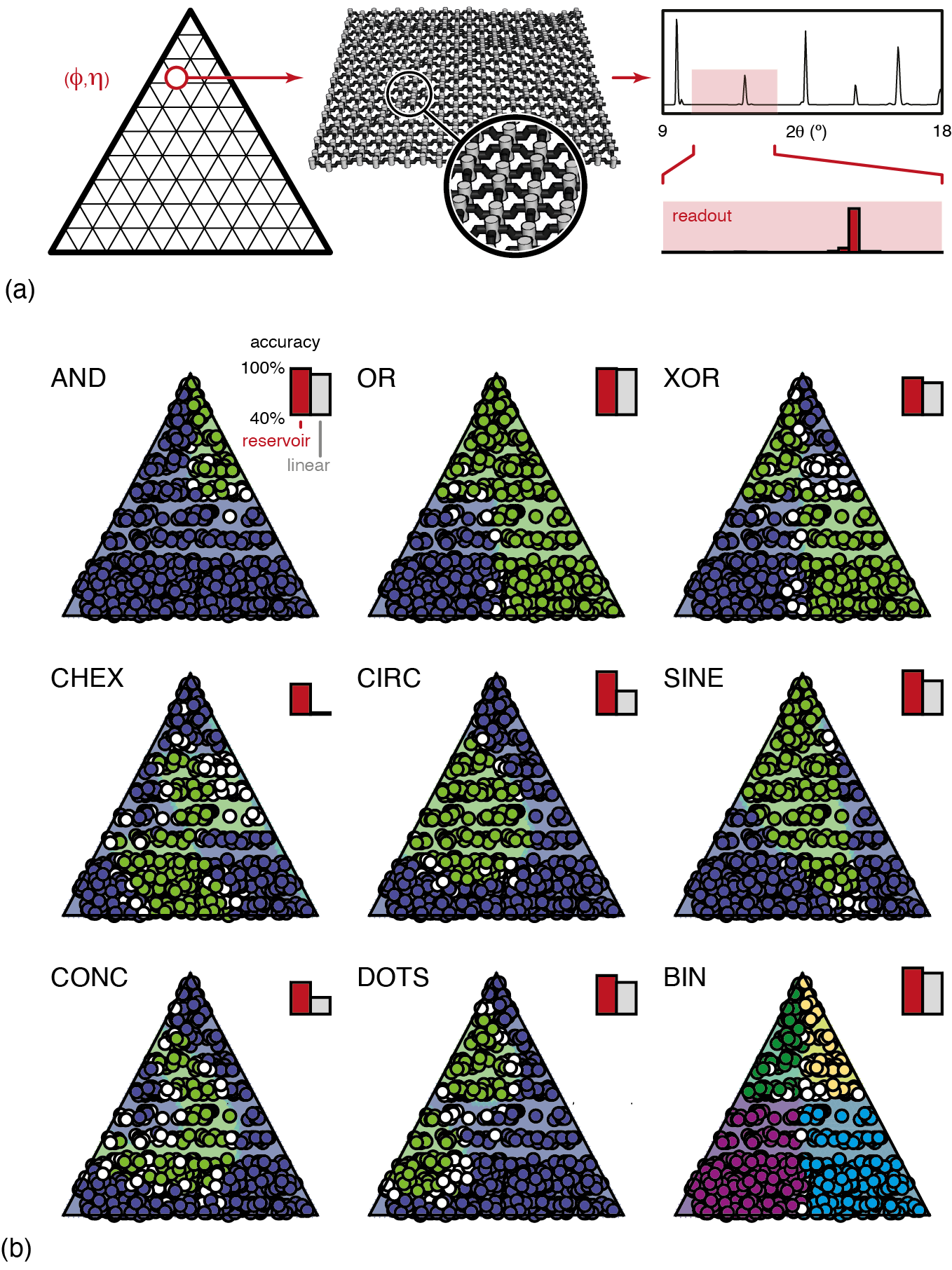
Figure 3: Workflow for emulating reservoir computation with DUT-8, showing encoding of configuration, computation of the diffraction readout, and resulting accuracy for nontrivial classification tasks.
Temporal Dynamics and Memory Capacities
Memory effects are critical for time series transformations in reservoir computing. The authors implement synthetic time series by applying a sinusoidal "chemical field" term to the Monte Carlo Hamiltonian, simulating guest cycling. This effectively modulates the system across its configuration landscape in a history-dependent, non-repetitive manner, closely paralleling field-driven protocols used in spin-ice reservoirs. At each timestep, the diffuse X-ray pattern serves as the observable for supervised regression onto time-dependent target functions.
The system accurately transforms both symmetric and strongly asymmetric temporal inputs, including the canonical sawtooth function, with performance metrics on par with established physical reservoirs. Explicit demonstration of memory is observed: system state for a given field value depends not only on the instantaneous external condition but also on the sequence of prior states, as confirmed both computationally and in experimental literature.
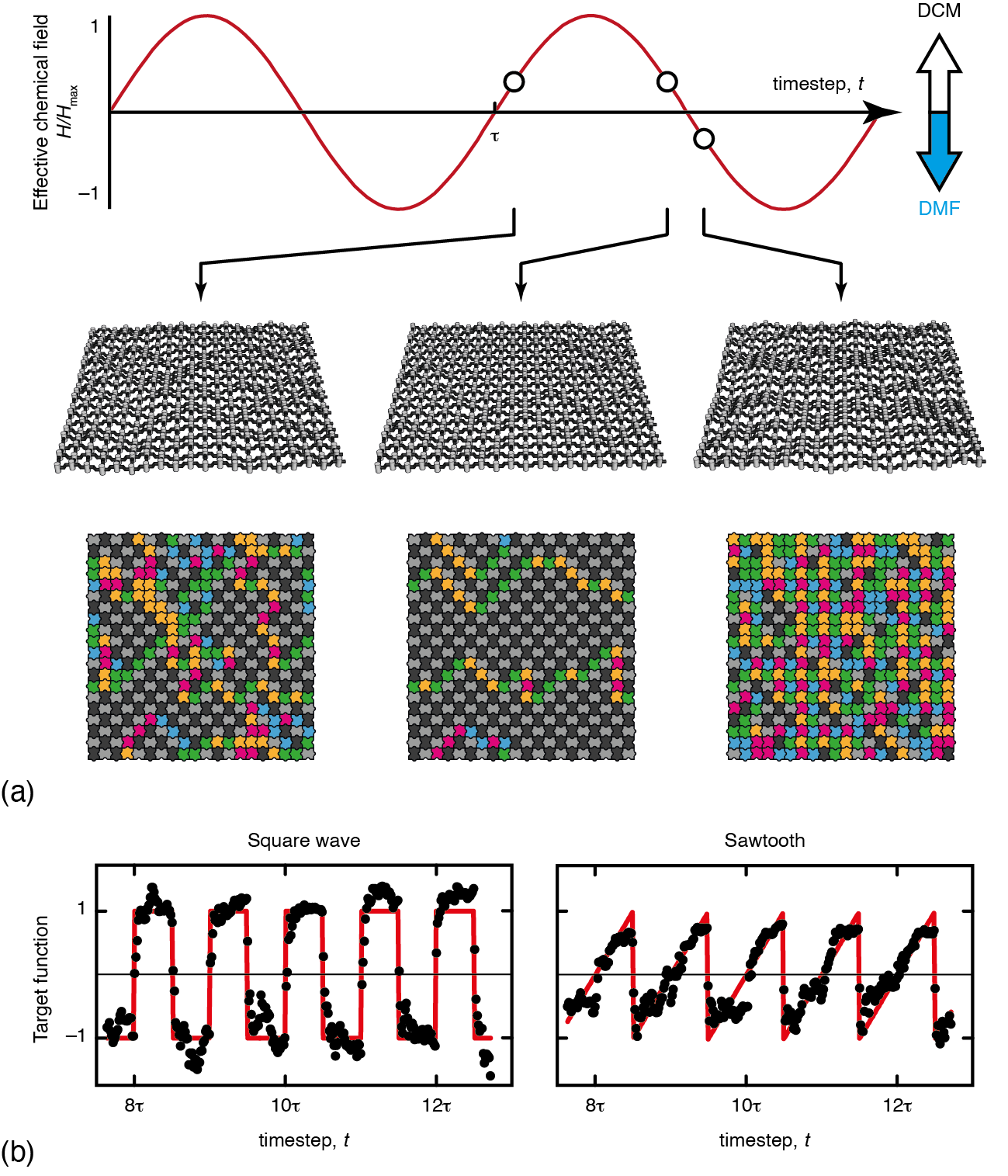
Figure 4: DUT-8 time-series simulation: dynamic evolution under field cycling, visualized configurations, and regression performance for representative target transformations.
Implications and Future Directions
The decoupling of nonlinearity and memory from purely electronic degrees of freedom enables the conceptual leap demonstrated here: the use of responsive disorder as a reservoir. DUT-8 exemplifies how the combination of correlated disorder and tunability can yield physically robust, chemically extensible platforms for neuromorphic computation. The approach generalizes to any system in which disorder can be engineered and controlled, including hydrogen-bonded networks, liquid crystal assemblies, and other MOFs exhibiting guest- or field-responsive disorder.
The practical implications are significant: in situ X-ray readouts, exploration of input/output modalities (e.g., strain or IR spectroscopy), and compositional tuning via isoreticular chemistry open new, experimentally-tractable routes for deploying high-density solid-state reservoir computers. These systems promise device-level energy efficiency, high information capacity (due to atomic scale), and extensibility to reconfigurable or adaptive computing paradigms.
Conclusion
This study establishes disordered DUT-8 as a functional solid-state reservoir computer capable of high-fidelity classification and time series tasks underpinned by nonlinear, history-dependent response. The findings both validate the use of crystalline, responsive disorder for physical reservoir computing and chart a course toward programmable atomic-scale information processing architectures beyond the limits set by conventional neural network hardware.

