- The paper extends standard models by incorporating a multipole-Padé approximant framework that accounts for both momentum and frequency dependent plasmonic behavior.
- It employs first-principles RPA within DFT and Kohn-Sham states to accurately capture intra- and inter-band contributions, highlighting dominant intra-band effects in metals like sodium.
- Validation with EELS data demonstrates strong alignment between computed loss functions and experimental observations, underscoring potential advances in photonic applications.
Introduction
The study of bulk plasmons in elemental metals presents a comprehensive assessment of plasmons as collective oscillations of free electron density in metallic systems. Utilizing first-principles calculations within the random-phase approximation (RPA), this research examines the spectral properties, momentum dispersion, and broadening of plasmons across 25 elemental metals. This analysis is crucial in understanding the fundamental electronic excitations that contribute to the distinct optical and electronic properties of elemental metals. The research extends established models, notably the multipole-Padé approximant (MPA) model, to simultaneously account for both momentum and frequency dependencies in dielectric responses.
Theoretical Framework
The dielectric function ε(q,ω), intrinsic to the electromagnetic interaction within a material, is critical for evaluating the collective excitation modes. In metals, free electrons are typically modeled using the Drude form, extended by Lindhard theory within the RPA to account for momentum dependence. The study leverages density functional theory (DFT) and Kohn-Sham states to compute the RPA dielectric function with expressions for microscopic polarizability, as encapsulated in Eqs. (1) through (3) of the research.
Intra-band vs. Inter-band Contributions
Bulk plasmon energies are characterized by evaluating intra-band and inter-band contributions to the dielectric function. Metals with fewer inter-band contributions, such as alkali metals, display prominent plasmonic features dominated by intra-band transitions. For instance, in sodium (Na), intra-band contributions account for 94% of the total plasmon energy, whereas metals like tungsten (W) exhibit significant inter-band excitation contributions, dispersing spectral weight across numerous poles.
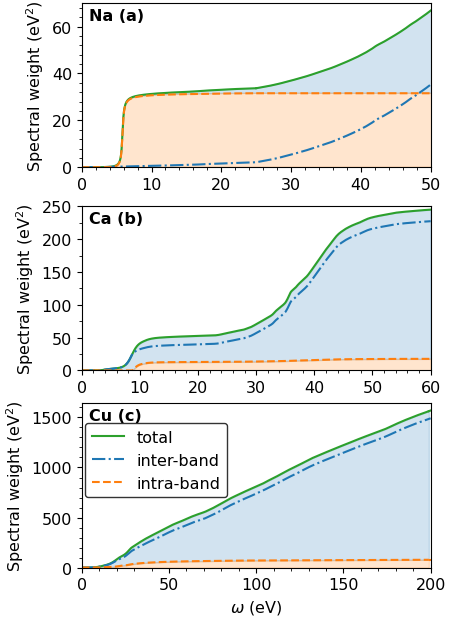
Figure 1: Spectral contributions of the intra-band, inter-band, and plasma frequencies as a function of energy.
Spectra in the Optical Limit
In comparing computational results with experimental data through electron energy loss spectroscopy (EELS), the research shows strong agreement, particularly in the optical limit. For metals like vanadium (V), copper (Cu), and zinc (Zn), calculated loss functions closely align with empirical observations, validating the methodologies used.
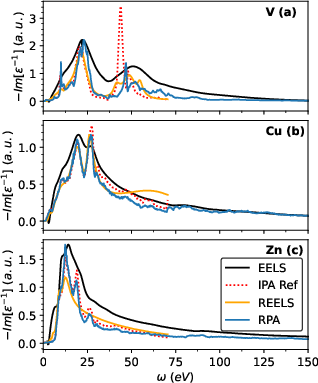
Figure 2: Comparison of the computed RPA loss function in the optical limit with experimental EELS data.
Deviation from Free-Electron Gas and PPA
The research challenges the adequacy of the free-electron gas model and the single plasmon-pole approximation (PPA) in complex metals. The work identifies significant deviations attributed to the presence of multiple poles and overlapping spectral features that a simple PPA fails to capture. The effective number of electrons, Zeff, calculated from the MPA models, suggests that this discrepancy is due to the complex nature of metal's electronic structures.
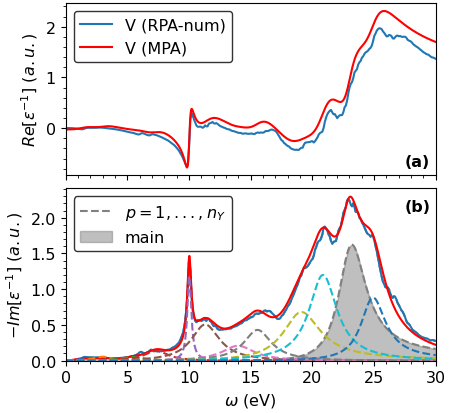
Figure 3: Real and imaginary parts of the inverse dielectric function of V, showing the MPA model contributions.
Spectral Band Structures
Detailed spectral band structures for elemental metals reveal rich excitation landscapes influenced by anisotropies in electronic band structures. These structures exhibit non-parabolic dispersions, indicating complex interactions beyond simple models. Discontinuities and band crossings are signatures of the layered complexity in these systems.
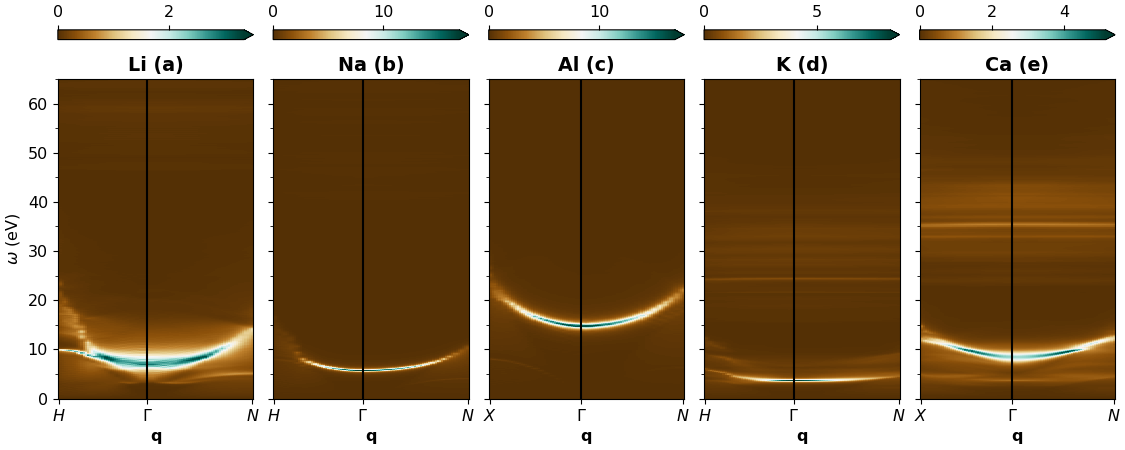
Figure 4: Spectral band structures of cubic elemental metals in high-symmetry lines.
Spectral Properties Within MPA(q)
MPA(q) allows for precision in modeling complex plasmonic band structures by accommodating detailed momentum and frequency dependencies. This framework is invaluable in predicting plasmonic behavior within technological applications, potentially reducing computational costs for more complex GW/BSE calculations without significant loss of detail.
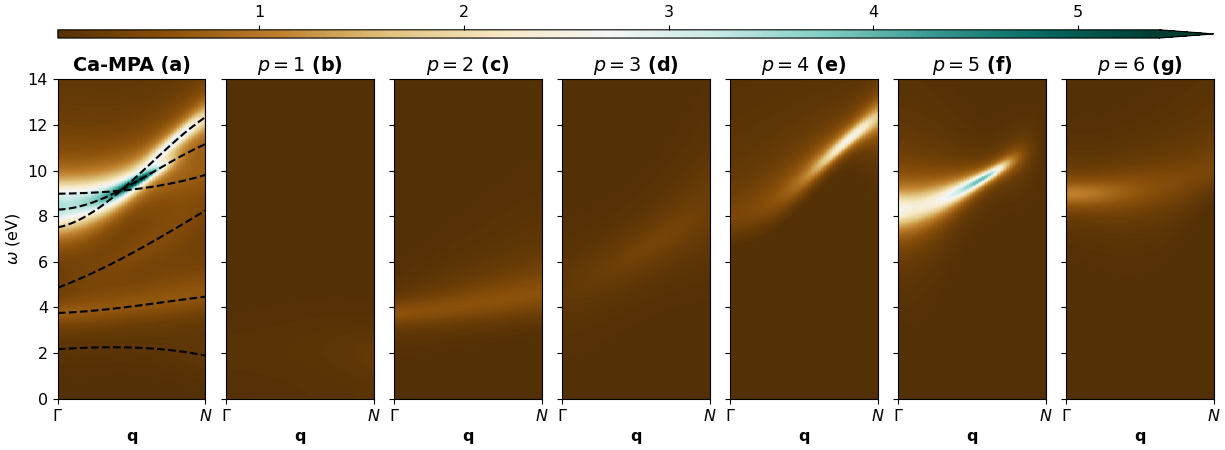
Figure 5: Spectral band structure of Ca reconstructed with MPA(q) showing distinct plasmonic peaks.
Conclusions
The comprehensive study of bulk plasmons across elemental metals underscores the nuanced interplay of electronic structural components within plasmonic behavior. By extending standard models to embrace broader parameter space, the research significantly enhances the predictive power available in plasmonics—enabling deeper insights into metallic behavior that are invaluable in the pursuit of efficient photonic applications. The novel MPA(q) framework stands as a robust tool for future explorations in computational material sciences, especially in scenarios demanding simultaneous momentum and frequency dependent analysis.